
Web Scraping with AI for Dynamic Websites in 2026
TL;DR: Dynamic websites update content through JavaScript, API requests, and user interactions, so the initial HTML may contain no usable records. Start with permitted JSON or HTML, use browser automation only when necessary, and reserve AI-assisted extraction for irregular text or layouts. Validate every record against a defined schema and monitor template drift.
This guide presents a reference architecture for collecting permitted data from JavaScript-rendered pages, infinite-scroll catalogs, and changing templates. It covers source inspection, deterministic extraction, selective model use, validation, proxy sessions, cost controls, and legal review.
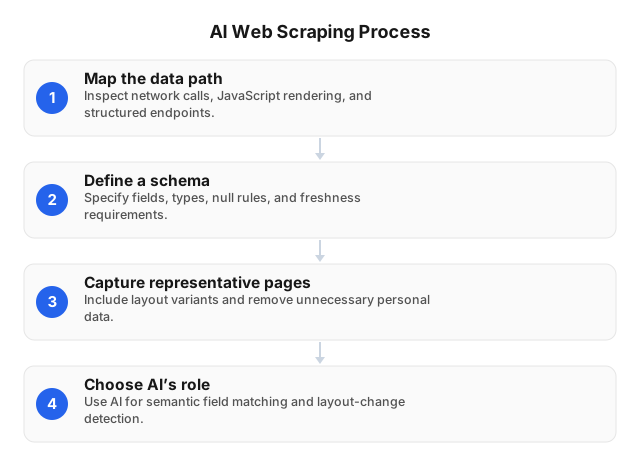
What Is AI Web Scraping?
In this guide, AI web scraping means using a machine-learning model within a conventional collection pipeline to classify pages, map irregular content to fields, or flag uncertain records. The model does not replace the HTTP client, browser, scheduler, access controls, or database.
A fixed parser might read a price from .product-card .price. A schema-constrained model could map “Now €49” and “Sale price: 49 EUR” to the same structure:
price: 49.00
currency: EUR
availability: in_stock
Each component has a specific job:
- HTTP clients or permitted APIs: retrieve HTML and structured responses.
- Browser automation: execute JavaScript and reproduce necessary interactions.
- CSS, XPath, or JSONPath: extract stable fields deterministically.
- Models: interpret inconsistent labels, prose, or visual placement.
- Schema validators: reject missing, mistyped, or implausible values.
Model output requires independent validation. NIST’s Generative AI Profile identifies confabulation and data-integrity risks that make unverified model output unsuitable as a source of record.
Track accepted records, validation failures, model-review volume, latency, and cost per accepted record. A run that downloads 100,000 pages but produces 40% invalid records is not 100% successful. Applying this division of labor starts with identifying how the target website delivers its data.
How Dynamic Websites Deliver Data
A dynamic website generates or changes content in response to JavaScript execution, API data, user input, session state, or time. MDN’s dynamic website glossary distinguishes this behavior from static delivery.
Scrapers commonly encounter three data layers:
- Initial HTML: the server’s first response.
- Rendered DOM: elements created or changed after scripts execute.
- Network responses: JSON, GraphQL, or HTML fragments requested by the page.
The browser’s fetch() interface can load records after the initial document arrives, as described in the MDN Fetch API documentation. A catalog’s first response might therefore contain navigation and skeleton cards while /api/products?page=2 contains the actual IDs, prices, and inventory fields.
Inspect the browser’s network panel before writing DOM selectors. If a permitted JSON response contains every required field, collect it directly. Render the page in a browser only when the result depends on JavaScript, interaction, or browser-held state.
Challenges of Scraping Dynamic Websites
After identifying the relevant data layer, the collector must account for timing, state, and data-integrity problems that static HTML collectors do not need to solve.
Typical failures include:
- selectors matching skeleton loaders before products appear;
- infinite scroll repeating the final batch;
- pagination cursors expiring midway through a run;
- cookies or consent state changing the returned template;
- localized prices using commas rather than periods;
- HTTP 200 responses containing login or rate-limit pages;
- a redesign moving discount values into the regular-price field;
- client-side requests requiring short-lived headers or tokens.
Wait for a defined network response or page state instead of sleeping for an arbitrary number of seconds. Playwright documents request and response inspection in its official network guide.
No single success-rate or latency benchmark applies to every dynamic site. Test at least 100 representative URLs across relevant templates, locales, missing-field cases, and pagination boundaries; then report the browser version, region, concurrency, acceptance rules, and test date. Once these failure modes are understood, AI-assisted parsing can be limited to the cases where deterministic methods are insufficient.
Where AI-Assisted Parsing Fits
Models are best treated as exception handlers rather than default parsers.
Semantic field mapping
A constrained model can normalize “Ships tomorrow,” “Available for dispatch,” and “Only two left” into an approved availability enum. Reject any value outside that enum rather than accepting free-form model output.
Page-state classification
Classify responses as content, loading, consent, login, rate-limit, or unknown before extracting fields. This prevents text from a non-content page from entering a product or article dataset.
Drift detection
Compare each run with expected types, null rates, template fingerprints, and field distributions. If missing prices rise from 2% to 70%, quarantine the batch even when every request returns HTTP 200.
Exception routing
Keep stable HTML and JSON on deterministic paths. Send only unmatched labels or unknown templates to a model, recording the model version, input evidence, output, and review status.
Do not use a model to defeat CAPTCHAs, authentication, or access controls. Stop the workflow or obtain an authorized access method. This selective approach can be implemented with several interchangeable tools.
Recommended Technical Stack
The following tools are examples, not mandatory dependencies. Their suitability depends on the target’s render path, scale, and data contract.
| Layer | Example | Specific use | Trade-off |
|---|---|---|---|
| HTTP collection | Scrapy, Requests, HTTPX | HTML, JSON, pagination, retries | Does not execute page JavaScript |
| Browser automation | Playwright, Selenium | Rendering, clicks, scrolling, response capture | Higher CPU, memory, and bandwidth |
| Parsing | CSS, XPath, JSONPath | Stable DOM or payload fields | Selectors require template maintenance |
| AI-assisted extraction | Schema-constrained language or vision model | Irregular labels and layouts | Cost, latency, and unsupported output |
| Validation | Pydantic, JSON Schema | Types, enums, null rules, nested objects | Requires an explicit contract |
| Storage | Parquet, object storage, relational database | Replay, analytics, lineage | Requires retention and schema planning |
JSON Schema’s official guide shows how to define required properties, types, and nested structures. Engineers new to collection frameworks can also consult Web Scraping Tools for Beginners: 2026 Guide.
Six-Step Reference Workflow
Regardless of the specific tools selected, the following six-step plan provides an implementation sequence rather than a universal standard.
- Map the source. Record initial HTML, relevant network responses, pagination behavior, cookies, and required interactions.
- Define the contract. Specify field names, types, enums, allowed nulls, identifiers, timestamps, and source URLs.
- Build a test set. Include every known template, locale, promotional layout, empty state, and pagination boundary.
- Implement deterministic extraction. Prefer permitted JSON responses, followed by stable DOM selectors.
- Route exceptions selectively. Invoke a constrained model only for fields that deterministic rules cannot resolve.
- Instrument production runs. Log response class, template ID, render time, retries, validation errors, bytes transferred, and model version.
Store raw responses or approved snapshots when retention policy permits. Replayable evidence allows engineers to repair a parser without requesting the same page again. An infinite-scroll catalog shows how these steps work together in practice.
Infinite-Scroll Catalog Reference Design
Consider a catalog whose product cards appear after scrolling and whose skeleton loaders share the .product-card class. Waiting for that selector would signal completion too early.
A more reliable design uses four controls:
- Monitor the catalog’s JSON response rather than a generic DOM class.
- Stop when a response produces no unseen product IDs, not after a fixed scroll count.
- Extract IDs, URLs, prices, and currencies from JSON with deterministic code.
- Route only unmapped free-text availability labels to the model.
Validate each record for numeric price, approved currency, unique product ID, collection timestamp, and source URL. Quarantine login, consent, empty-state, and unknown-template pages before field extraction.
At production scale, the same design must also preserve necessary session state while controlling network cost.
Proxy, Session, and Cost Design
Proxies can preserve an authorized session, route requests through a required region, or distribute permitted collection traffic. They do not grant permission to access restricted content.
Use a sticky session when a multi-step flow depends on cookies, pagination state, or location. Rotate between independent jobs rather than midway through the same search or pagination sequence. Set per-domain concurrency limits and exponential backoff for 429 and 503 responses.
EProxies provides 72M+ residential IPs across 195+ countries, with HTTP(S) and SOCKS5 support. Service options include:
- pay-as-you-go residential traffic from $0.25/GB;
- tiered residential pricing down to approximately $0.73/GB at 300GB;
- ISP SOCKS5 proxies from $0.95/IP;
- unlimited plans from $79 per month;
- 98.2% uptime, backed by a 99.9% uptime SLA.
Estimate plan size from measured transfer volume rather than page count. A browser may download scripts, fonts, images, and analytics resources that a direct JSON request avoids. Block unneeded assets only after confirming that doing so does not change the required page state.
See Dynamic Proxies for Fast Web Requests for request-routing mechanics. Network reliability, however, does not guarantee data quality; accepted records still require explicit validation and ongoing monitoring.
Validation and Monitoring
Reject records that violate explicit rules; never overwrite source evidence with a model-generated correction.
Apply checks such as:
priceis numeric and non-negative;currencybelongs to an approved ISO 4217 set;product_idis unique within the source;collected_atfalls inside the run window;- required fields are non-null;
- every record includes its source URL;
- the response is classified as content rather than login, consent, or rate-limit.
Type checks alone cannot detect a selector that extracts a shipping fee instead of a product price. Compare null rates, ranges, medians, category counts, and template fingerprints between runs, with alert thresholds defined before deployment.
These technical controls should operate within documented legal, privacy, and governance boundaries.
Compliance Controls
Limit collection to data required for a documented purpose. Personal, sensitive, authenticated, or access-controlled data requires additional authorization and legal review.
The Robots Exclusion Protocol is standardized in RFC 9309, but robots directives do not resolve contract, privacy, copyright, database-right, or access-control questions. The UK Information Commissioner’s Office has also published a joint statement on data scraping and privacy, illustrating why publicly accessible personal data still needs privacy controls.
Define retention, deletion, domain-level request limits, audit logging, and escalation ownership before production. Compare regional requirements in Web Scraping Legality by Country: 2026 Map.
Related Reading
- How Web Scraping Reshapes News Distribution in 2026
- Web Scraping Legality by Country: 2026 Map
- How Web Scraping Powers AI and ML in 2026
FAQ
What is AI web scraping?
AI web scraping uses a machine-learning model to classify, normalize, or validate data inside a conventional scraping pipeline. HTTP clients or browsers still collect the source material, while deterministic rules and schemas control what enters the dataset.
How does AI improve web scraping?
AI can map semantically equivalent labels, classify page states, and process layouts that lack stable selectors. Use it only for exceptions, then validate its output against types, enums, ranges, and source evidence.
What are dynamic websites?
Dynamic websites generate or update content through JavaScript, API requests, user interactions, session state, or time-based logic. Their initial HTML may contain placeholders rather than records, requiring collection from a permitted network response or a rendered browser session.
What challenges do dynamic websites present for scraping?
Dynamic websites create asynchronous-loading, pagination, session, localization, and template-drift problems. Scrapers must wait for defined states, preserve cookies when required, deduplicate stable IDs, classify non-content responses, and retain enough metadata to reproduce failures.
What tools are best for AI web scraping?
Use an HTTP framework for HTML or JSON, browser automation for JavaScript-dependent interactions, deterministic selectors for stable fields, and JSON Schema or another validator for the data contract. Add a schema-constrained model only for irregular text or layouts.
Should an AI scraper use browser automation or website APIs?
Prefer an authorized API or permitted JSON response when it contains the required fields. Use browser automation when collection depends on JavaScript execution, interaction, or browser-held state, because rendering increases CPU, memory, latency, and bandwidth consumption.
Is AI web scraping legal?
Legality depends on jurisdiction, data type, access method, website terms, and intended use. Public visibility does not eliminate privacy, copyright, contract, database-right, or access-control obligations, so higher-risk projects require qualified legal review.
This article was written by the EProxies team and reviewed against our editorial quality standards before publishing.