
Web Scraping Legality by Country: 2026 Map
TL;DR: Web scraping legality in different countries depends on the data collected, access method, website terms, intellectual property rights, privacy law, and intended use; public availability alone does not create blanket permission to scrape.
This 2026 guide is built for data analysts designing collection workflows and compliance officers reviewing international exposure. The interactive map covers more than 100 countries and connects each jurisdiction to relevant statutes, legal cases, data-risk categories, and concrete controls for defensible public-web research.
Introduction to Web Scraping Legality
Web scraping legality is the legal status of collecting website data through automated requests, determined by the collector’s jurisdiction, the target site’s location, the data collected, and the method of access. A lawful project in one country may create privacy, copyright, database, or contractual liability in another.
Public accessibility alone does not settle the question. Compliance officers must assess where affected individuals reside, whether personal data is processed, which website terms govern access, and whether the collection interferes with technical restrictions. EU analysis, for example, can involve data-protection, copyright, and contract law simultaneously.
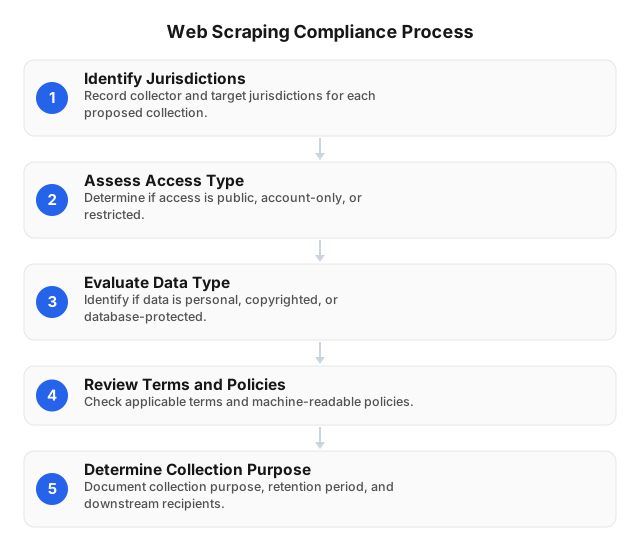
Use the interactive map as a screening tool, not a legal opinion. For each proposed collection, record:
- collector and target jurisdictions;
- public, account-only, or restricted access;
- personal, copyrighted, or database-protected content;
- applicable terms and machine-readable policies;
- collection purpose, retention period, and downstream recipients.
Country labels such as “permitted” or “restricted” cannot capture every conflict-of-laws issue. Route projects with personal data, authenticated access, or cross-border reuse to counsel after reviewing the relevant geo-specific scraping regulations.
Core Principles of Web Scraping Legality
In 2026, web scraping legality turns on the data collected, access method, website rules, and collector’s purpose—not merely whether a page is public. Public, non-personal data generally presents the strongest position, but public accessibility does not erase privacy, copyright, contract, or computer-access risk.
Privacy laws may apply whenever records identify or can be linked to individuals. Compliance teams should document the lawful basis, collection purpose, retention period, security controls, and response process for deletion or access requests.
Copyright usually protects original expression rather than underlying facts. Extracting product prices may therefore create less copyright exposure than reproducing descriptions, photographs, or a database’s protected selection and arrangement.
Terms of service can create contractual risk, particularly when users accepted them through an account or affirmative click. Robots.txt communicates crawler preferences but is neither universal legal permission nor, by itself, a statute.
In the United States, the Computer Fraud and Abuse Act affects whether automated access is characterized as unauthorized. Public availability can strengthen a scraper’s position, while accessing authenticated areas, circumventing technical controls, or continuing after credentials are revoked materially increases risk. Separate privacy, copyright, and contract claims can still survive even when CFAA exposure is limited.
Interactive Map: Web Scraping Laws by Country
Web scraping laws by country cannot be reduced to a legal-or-illegal switch: the map classifies each jurisdiction by privacy, copyright, contract, and access-control exposure. Public availability lowers risk, but personal data, accepted terms, paywalls, and technical restrictions can change the result—even for the same dataset.
| Map region | Example jurisdictions | Primary review | Operational decision |
|---|---|---|---|
| European Union | France, Germany, Spain, Italy | GDPR, copyright, database rights, site terms | Establish a lawful basis before collecting personal data; apply minimization and retention limits. |
| United Kingdom | UK | Data protection, copyright, contract | Review personal-data fields and whether terms became binding. |
| North America | US, Canada, Mexico | Computer-access, privacy, copyright, contract | Separate public pages from authenticated, paywalled, or restricted areas. |
| Asia-Pacific | Japan, India, Singapore, Australia, South Korea | Local privacy, cybercrime, copyright, contract | Obtain country-specific counsel before processing identifiable records. |
| Latin America | Brazil, Argentina, Chile, Colombia | Privacy and consent requirements | Document purpose, storage location, deletion, and data-subject procedures. |
| Middle East and Africa | UAE, Saudi Arabia, South Africa, Kenya | Privacy, cybercrime, localization | Check transfer and localization rules before collection begins. |
For EU targets, GDPR compliance is crucial, including when the operator is located elsewhere. Treat every map color as a triage label requiring current local review—not legal clearance.
Key Legal Cases Impacting Web Scraping
Key legal cases affecting web scraping distinguish access to public pages from access behind authentication or technical barriers. In hiQ Labs v. LinkedIn, the US Ninth Circuit found that collecting publicly accessible data likely did not constitute unauthorized access under the Computer Fraud and Abuse Act (CFAA). Public visibility, however, is not blanket permission to scrape.
The ruling followed a narrower interpretation of “without authorization” in the CFAA, but it did not eliminate exposure under contract, copyright, privacy, trespass, or state unfair-competition law. A cease-and-desist letter may therefore create risks even where it does not convert public-page access into CFAA hacking.
Compliance teams should record four facts when applying hiQ:
- whether every requested URL is publicly accessible;
- whether collection requires login credentials;
- whether the scraper circumvents CAPTCHAs, paywalls, or access controls;
- whether terms prohibit automated collection and can bind the operator.
For multinational projects, treat hiQ as a US access-control precedent—not a global safe harbor. EU projects still require separate GDPR, database-right, copyright, and contractual analysis under the relevant member state’s law.
Compliance Tips for Web Scraping
Web-scraping compliance starts with four documented checks—access, data type, contractual terms, and jurisdiction—before collection begins. Public availability alone does not resolve privacy, copyright, database-right, or contractual exposure; compliance officers should approve the purpose, collection method, retention period, and downstream use separately.
- Map every relevant jurisdiction. Record the target website, scraper location, data-subject location, and processing destination. Use an interactive regulatory map to visualize differences, then confirm current local law with counsel.
- Classify the data. Separate non-personal facts from personal data, sensitive data, copyrighted content, and protected databases. Apply stricter review to profiles, contact details, biometrics, health information, and children’s data.
- Document lawful purpose and authority. For personal data, identify the applicable privacy-law basis and provide required notices. Do not assume publication equals consent.
- Review access rules. Archive terms of service, robots.txt, API conditions, and visible prohibitions. Robots.txt is a technical signal—not universal legal permission—but ignoring it increases dispute risk.
- Avoid restricted access. Do not defeat authentication, paywalls, CAPTCHAs, or technical controls. Prefer licensed APIs where available.
- Minimize and govern collection. Rate-limit requests, collect only necessary fields, set deletion schedules, restrict internal access, and retain approval logs, timestamps, and source URLs.
Risks and Challenges in Web Scraping
Web scraping creates overlapping exposure under privacy, copyright, database, contract, computer-misuse, and consumer-protection rules. Publicly reachable content is not automatically free to collect or reuse. The decisive facts are data type, access method, stated purpose, target terms, and every country connected to collection, storage, analysis, and publication.
The highest-risk projects combine personal data, restricted access, ignored objections, and commercial republication. GDPR obligations may attach to names, profiles, identifiers, or inferred traits even when the source page is public. Copyright and EU database rights can separately restrict copying or repeated extraction.
Terms of service and robots.txt create another challenge. Robots.txt is not legislation, but disregarding it can weaken evidence of good faith; violating accepted terms may support contractual claims. Continuing after authentication barriers, blocks, or cease-and-desist notices can increase computer-misuse risk.
Country, city, or ASN targeting helps validate localized public content, but proxies do not change legal authorization. Compliance teams should log URLs, timestamps, consent or lawful-basis decisions, robots.txt changes, retention periods, deletion requests, and escalation outcomes. Rate limits should also prevent service disruption and document proportionate collection.
Future Trends in Web Scraping Legislation
Web scraping legislation in 2026 is moving toward tighter oversight of personal-data collection, AI training datasets, contractual restrictions, and cross-border transfers. Compliance teams should expect lawful access to remain only one part of the analysis; provenance, purpose, retention, and downstream use will increasingly determine whether a project is defensible.
Regulators are likely to examine scraping as a complete data lifecycle rather than an isolated HTTP request. EU analysis already treats data protection, copyright, and contract law as separate but overlapping legal layers. Teams should therefore record the source URL, collection date, data category, legal basis, applicable terms, retention period, and recipient country.
AI governance will add pressure for dataset traceability. Organizations using scraped material for model development should preserve source inventories, rights assessments, opt-out handling, and deletion workflows instead of relying on a general “publicly available” label.
Terms of service and robots.txt may also become stronger evidence of notice, even where they do not independently decide legality. Build machine-readable policy checks into crawler deployment, but route conflicts to legal review.
Country maps should be versioned, not treated as static references. Assign counsel to monitor privacy, copyright, database-right, cybercrime, and consumer-protection changes in every collection and destination jurisdiction.
FAQ
Web scraping is not inherently legal or illegal; legality depends on the target’s accessibility, the data collected, the collector’s conduct, and the governing jurisdiction. Compliance teams should separately assess computer-access laws, privacy rules, copyright and database rights, contractual terms, robots.txt instructions, and any technical restrictions before collection begins.
Is web scraping legal in the US?
Scraping publicly accessible, non-personal information is generally permissible in the US, but public access is not a blanket authorization. Teams must assess the CFAA, state computer-access laws, copyright, privacy obligations, website terms, and whether collection continues after receiving a cease-and-desist notice or encountering an access control.
What are the risks of web scraping?
The main risks are unauthorized-access claims, privacy violations, copyright or database-right infringement, breach-of-contract allegations, and operational measures such as IP blocking. Risk rises sharply when a scraper collects personal data, accesses authenticated pages, ignores technical restrictions, republishes protected content, or uses information for a purpose people would not reasonably expect.
How does GDPR affect web scraping?
GDPR applies when scraped information relates to an identifiable person, even if that information appears on a public webpage. The controller must establish a lawful basis, minimize the fields collected, define retention limits, secure the dataset, honor applicable data-subject rights, and evaluate transparency requirements and international transfers before processing EU personal data.
What is the CFAA and its impact on scraping?
The Computer Fraud and Abuse Act is a US federal law addressing unauthorized access to protected computers, making the boundary between public access and restricted access central to scraping risk. The hiQ Labs v. LinkedIn litigation indicated that collecting publicly available pages was not, by itself, access “without authorization,” but that reasoning does not authorize entry into logged-in areas or circumvention of technical access controls.
Are there any landmark web scraping cases?
hiQ Labs v. LinkedIn is the leading US scraping case because it addressed CFAA claims involving information available without authentication. Its practical limit matters: the decision did not eliminate possible claims based on contract, copyright, privacy, or other laws, so compliance officers should treat public accessibility as one factor rather than a complete defense.
Does robots.txt make web scraping legally binding?
A robots.txt file communicates a website operator’s automated-access preferences, but its legal effect depends on the jurisdiction, surrounding terms, and the scraper’s conduct. Treat a disallow rule as a compliance warning: document the business justification, review applicable terms, avoid restricted paths, and obtain legal approval before proceeding against the stated preference.
Can website terms of service prohibit scraping public data?
Website terms can create contractual risk when the operator can show that the scraper accepted or was legally bound by them. Compliance teams should record whether terms were presented through clickwrap, browsewrap, or an authenticated account, then assess governing law, prohibited uses, termination language, and whether continued access after notice could support additional claims.
This article was written by the EProxies team and reviewed against our editorial quality standards before publishing.