
GEO-Specific Regulations for Web Scraping
TL;DR: GEO-specific web scraping compliance depends on where the target site, data subjects, scraper, storage, and end use are located. Proxies can help teams test and collect region-specific public data responsibly, but they do not override privacy law, copyright, contracts, access controls, website terms, or cross-border transfer rules.
Web Scraping and GEO-Specific Legal Risk
Web scraping is not automatically illegal, and it is not automatically permitted. The legal analysis depends on what data is collected, how access is obtained, where the relevant parties are located, and how the data is used.
A lower-risk project typically collects public, factual, non-personal information—such as prices, availability, store locations, public rankings, or product stock status—at reasonable rates. Risk increases when scraping involves:
- Personal data: names, emails, user profiles, IDs, location signals, behavioral data, or anything that can identify a person.
- Copyrighted or protected content: articles, images, product descriptions, reviews, structured databases, or creative works copied at scale.
- Restricted access: login-only pages, paywalled content, private APIs, technical access controls, or data collected after a site objects.
- Harmful use: spam, fraud, impersonation, unfair competition, or request volumes that degrade a website’s service.
GEO-specific regulations matter because privacy, copyright, database rights, contract rules, cybersecurity laws, and consumer protection requirements vary by jurisdiction. A workflow that is acceptable for public price monitoring in one market may require additional notice, minimization, lawful basis, or transfer controls in another.
For implementation guidance, see ethical proxy use for web scraping.
How Web Scraping Laws Differ by Region
Regional law turns the general risk factors above into different operational requirements. The same dataset, access method, or end use can be treated differently depending on the target market, the people represented in the data, and where collection or processing takes place.
United States
In the U.S., scraping disputes often focus on access authorization, contracts, copyright, unfair competition, and state privacy laws. Scraping public web pages is generally lower risk than accessing login-gated or technically restricted systems, but site terms, cease-and-desist notices, copyrighted content, and personal data still matter.
Cases such as hiQ Labs v. LinkedIn and Van Buren v. United States shaped how courts analyze public access and “authorized access” under the Computer Fraud and Abuse Act. They did not create a blanket right to scrape. Businesses still need to evaluate terms of service, authentication barriers, rate limits, data type, and downstream use.
EU/EEA and UK
The EU/EEA and UK are privacy-first environments. Under GDPR and UK GDPR, scraping personal data can require a lawful basis, transparency, data minimization, purpose limitation, retention limits, and processes for data subject rights such as access, objection, or deletion.
“Publicly visible” does not mean “free to collect and reuse.” Public profile information, emails, employment data, or location-based data may still be personal data. Large-scale extraction may also raise copyright or database-right concerns.
Canada, Brazil, China, and APAC Markets
Other regions combine privacy, cybersecurity, consumer protection, and platform-abuse rules. Canada’s privacy framework, Brazil’s LGPD, China’s PIPL, and emerging APAC regulations can affect consent, notice, localization, cross-border transfers, and sensitive data handling.
The practical rule is to avoid treating “global scraping” as one legal category. Map each project by target country, data subject location, business location, storage location, and intended use.
A Practical GEO-Specific Compliance Workflow
Once the relevant regions are mapped, translate them into a project workflow before launching a scraper:
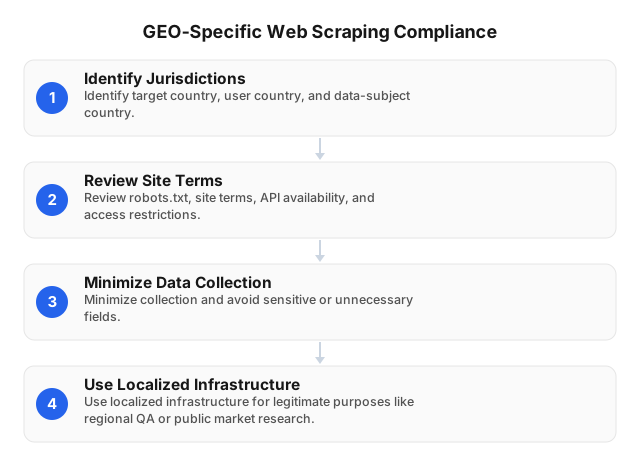
- Identify jurisdictions. Record the target site’s country, the data subject location, the scraping entity’s location, and where data will be stored or processed.
- Classify data. Separate public factual data from personal data, copyrighted content, sensitive data, children’s data, health data, financial data, and login-gated information.
- Review access rules. Check terms of service, robots.txt, API availability, authentication requirements, rate-limit expectations, and prior objections.
- Minimize collection. Collect only fields needed for the stated purpose. Avoid unnecessary names, emails, profile links, or unique identifiers.
- Set technical guardrails. Use rate limits, retry caps, user-agent policies where appropriate, error handling, and blocklist or suppression processes.
- Document decisions. Keep logs showing what was collected, when, from where, why, under which policy, and when it will be deleted.
- Escalate high-risk cases. Require legal review for personal data, restricted content, regulated sectors, large-scale extraction, or cross-border transfers.
If your project uses scraping APIs, align them with the same governance model. EProxies’ guide to creating effective web scraping strategies using APIs can help teams structure request handling without ignoring legal constraints.
The Role of Proxies in Navigating GEO-Specific Regulations
After the legal and governance requirements are defined, proxies can support the technical side of GEO-specific workflows. Proxies are infrastructure tools: they route requests through different IP addresses and locations, which can help teams access the same public web experience a user would see in a specific country, city, or network environment. That makes them useful for localization testing, ad verification, public market research, price monitoring, content availability checks, and quality assurance.
Their compliance role is practical, not magical:
- Localization validation: Confirm whether a site displays the correct cookie banner, privacy notice, currency, shipping option, or age gate for users in a specific country.
- Jurisdiction-aware testing: Verify whether EU-facing pages behave differently from U.S., UK, Canadian, or APAC-facing pages.
- Responsible request distribution: Avoid concentrating all traffic on one IP or region, while still respecting rate limits and site rules.
- Workflow separation: Keep country-specific projects, credentials, logs, and data stores distinct for audit and governance.
- Evidence and auditability: Pair proxy sessions with authentication, logging, and approval records so teams can show how and why a region was accessed.
Proxies should not be used to bypass logins, defeat technical access controls, ignore terms, evade a block after objection, or collect prohibited data. They also do not solve cross-border transfer rules by themselves: if EU personal data is routed through an EU proxy but stored or analyzed elsewhere, GDPR transfer and processing obligations may still apply.
According to EProxies’ published product information, EProxies offers 72M+ residential IPs across 195+ countries, HTTP(S) and SOCKS5 support, rotating and sticky/static sessions, and city- or ASN-level targeting. Current service positioning also lists 98.2% uptime backed by a 99.9% uptime SLA. Pricing options include pay-as-you-go residential traffic from $0.25/GB, tiered residential plans down to about $0.73/GB at 300GB, ISP SOCKS5 from $0.95/IP, and unlimited plans from $79/month. Teams should confirm current plan terms, targeting availability, and permitted-use requirements before deployment.
For teams comparing infrastructure choices, see Residential or Datacenter Proxies? 2026 Guide and the Comprehensive Overview of Proxy Server Types.
Best Practices for Ethical Proxy-Based Scraping
The most reliable proxy-based scraping programs combine the jurisdictional workflow above with operational controls:
- Route requests only for legitimate purposes such as public data collection, QA, localization testing, or ad verification.
- Respect authentication boundaries, paywalls, opt-outs, robots.txt guidance where applicable, and site terms.
- Cap request rates and avoid patterns that impair service availability.
- Avoid scraping sensitive personal data unless legal approval is explicit.
- Keep audit logs tied to project purpose, jurisdiction, data category, and retention period.
- Use suppression lists when a site or individual objects.
- Review free or unknown proxy sources carefully; unreliable proxy networks can create security, consent, and data-integrity risks. See Comparing Free vs Paid Proxy Servers: Pros and Cons.
Future Trends in GEO-Specific Scraping Regulation
Regulators and courts are increasingly focused on the gap between “publicly visible” and “lawfully reusable.” Expect more scrutiny around personal data scraped from profiles, datasets used for AI training, sensitive categories, children’s data, and large-scale aggregation.
Copyright and database-right disputes are also likely to grow, especially when scraped content is republished, used to train models, or extracted from structured databases. Businesses should prepare for more operational compliance requirements: documented purpose, region-specific policies, retention limits, deletion workflows, and stronger vendor governance.
Proxies will remain important for localization and public web data workflows, but their value will increasingly depend on governance: precise GEO targeting, controlled sessions, rate management, authentication, logging, and documented legal review.
FAQ
What are the key legal considerations for web scraping?
The main factors are data type, access method, jurisdiction, website terms, and intended use. Public, factual, non-personal data is generally lower risk, while personal data, copyrighted material, trade secrets, login-only pages, or restricted systems require stricter review. Businesses should also consider rate limits, robots.txt guidance, API availability, and whether collection could harm the target site or users.
How do web scraping laws differ across regions?
In the U.S., risk often turns on authorization, contracts, copyright, unfair competition, and state privacy laws. In the EU/EEA and UK, GDPR-style rules make personal data collection especially sensitive because lawful basis, transparency, minimization, and data subject rights apply. Other regions, including Brazil, China, Canada, and APAC markets, may impose consent, localization, cybersecurity, or cross-border transfer requirements.
What are some notable legal cases related to web scraping?
hiQ Labs v. LinkedIn addressed scraping publicly available profile data and helped shape U.S. debate around public access under the CFAA. Van Buren v. United States narrowed the interpretation of “exceeds authorized access,” which matters when analyzing whether a scraper accessed data it was permitted to reach. These cases do not make scraping universally lawful; contracts, copyright, privacy, technical restrictions, and site objections can still create risk.
How can businesses ensure compliance with web scraping laws?
Start with a written policy that defines purpose, data categories, target jurisdictions, retention limits, and prohibited sources. Review privacy law, copyright/database rights, site terms, access restrictions, and cross-border transfer rules before launch. Then enforce technical controls such as rate limits, data minimization, audit logs, deletion workflows, and legal approval for high-risk targets.
What role do proxies play in adhering to GEO-specific regulations?
Proxies help teams access and test region-specific public content from relevant geographies, which supports localization testing, market research, ad verification, and jurisdiction-aware compliance checks. They can help confirm whether a site shows the correct consent banner, pricing, availability, or legal notice in a specific country or city. However, businesses must still respect privacy laws, copyright, website terms, access controls, rate limits, and cross-border data rules.
Is scraping personal data from public websites allowed?
Public availability does not remove privacy obligations. In GDPR/UK GDPR regions, scraping personal data usually requires a lawful basis, transparency, minimization, purpose limitation, retention controls, and rights-handling processes. Sensitive data, children’s data, profiling, or large-scale collection should receive legal review before scraping begins.
Can proxies be used to avoid website rules or access controls?
No. A compliant proxy strategy focuses on localization, responsible request distribution, public data access, auditability, and alignment with applicable laws and site rules—not bypassing logins, defeating technical controls, evading blocks, ignoring terms, or collecting data from restricted areas.
This article was written by the EProxies team and reviewed against our editorial quality standards before publishing.