
2026: The Year of 5G Proxies and Data Efficiency
TL;DR: For 2026 planning, treat 5G proxies as a specialized tool for mobile-specific, latency-sensitive, or media-heavy workflows—not a universal replacement for residential, ISP, or datacenter proxies. The efficiency gain comes from using the right proxy type for each job: 5G for mobile-network validation, residential for broad geo coverage, ISP/static SOCKS5 for stable sessions, and datacenter only where targets allow it.
Direct Answer: What Should Teams Do in 2026?
Use 5G proxies when the result depends on mobile-network context: mobile ad verification, app QA, mobile SERP checks, rich-media validation, carrier-aware testing, or time-sensitive localized monitoring. If the workflow does not require a mobile network, residential or ISP/static proxies are often more predictable and cost-efficient.
A practical proxy stack usually separates workloads:
- 5G/mobile routing: mobile-first pages, app flows, ad delivery, video checks
- Residential proxies: broad public web data collection and country/city localization
- ISP/static SOCKS5: longer sessions, QA, account-permitted workflows, stable connections
- Datacenter proxies: high-volume tasks on tolerant targets where policy and detection risk allow
For 5G-specific projects, validate carrier, city, latency, and session behavior against your own targets before scaling. The rest of this guide explains where 5G fits, how to benchmark it, and how to combine it with residential, ISP/static, and datacenter proxies without adding unnecessary cost.
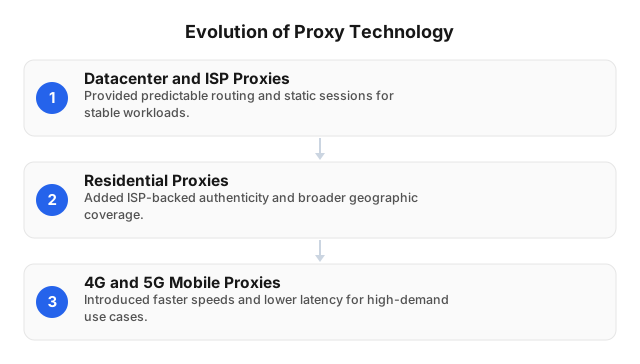
Why 5G Proxies Matter for Data Efficiency
5G proxies matter when mobile-network characteristics change the quality of the result. The technical reason is straightforward: 5G standards were designed for higher throughput and lower latency than previous mobile generations. The ITU IMT-2020 requirements define ideal 5G targets such as peak data rates up to 20 Gbit/s downlink and 10 Gbit/s uplink, with very low user-plane latency under controlled conditions.
Real proxy performance will be lower than lab targets because it depends on carrier congestion, device/modem quality, routing distance, server load, and target-site behavior. Still, compared with older mobile routing, 5G can be useful when a workflow is slowed by media loading, mobile-page rendering, or time-sensitive checks.
The important metric is not “fastest proxy.” It is cost per usable result.
Track:
- Success rate by target: a proxy that works on one domain may fail on another
- Median and p95 response time: p95 exposes slow-tail behavior
- Retry rate: retries quietly increase GB usage and cost
- Bandwidth per valid record: especially important for images, video, and JavaScript-heavy pages
- Session stability: critical for carts, QA flows, and multi-step checks
- Geo accuracy: country, city, carrier, and ASN can all matter
- Block and challenge rate: captchas, 403s, 429s, soft blocks, and incomplete pages
With those metrics in mind, the next step is choosing the right proxy category for each workload. For teams still comparing the basics, start with Residential or Datacenter Proxies? 2026 Guide or this Comprehensive Overview of Proxy Server Types.
5G vs. Residential vs. ISP vs. Datacenter Proxies
| Proxy type | Network identity | Best use | Efficiency risk | Practical recommendation |
|---|---|---|---|---|
| 5G mobile proxies | Mobile carrier network | Mobile SERPs, ad verification, app QA, video/rich-media checks | Higher cost, uneven city/carrier availability, variable radio conditions | Use only where mobile routing changes the result |
| Residential proxies | Consumer residential IPs | Public web data collection, localization, market research | Waste from poor rotation, retries, or over-targeting | Use for broad country/city coverage and scalable collection |
| ISP/static SOCKS5 proxies | ISP-assigned static IPs | Long sessions, stable QA, account-permitted workflows | Less rotation diversity than residential pools | Use when continuity matters more than IP variety |
| Datacenter proxies | Cloud or hosting network | High-speed tasks on tolerant targets | Easier to detect on stricter sites | Use where target policies and detection risk allow |
Session behavior—rotating, sticky, or static—should be chosen based on the task and the selected plan, not applied uniformly across all targets.
The takeaway: do not choose 5G because it is newer. Choose it when the workflow requires mobile routing, mobile-localized validation, or faster handling of mobile media. Then use the process below to keep the full stack efficient.
A Practical 6-Step Process for Efficient Proxy Workflows
1. Define the data outcome
Before choosing a proxy type, write down the exact output:
- Product price by city
- Mobile ad placement by carrier
- Search ranking by location and device type
- Video availability by country
- Public listing status every 30 minutes
- App onboarding behavior in a target market
If the output does not require a mobile network, 5G routing may add cost without improving accuracy.
2. Segment targets by difficulty
Group targets before scaling:
- Low friction: static pages, public directories, tolerant endpoints
- Medium friction: dynamic retail, travel, local search, review pages
- High friction: heavy JavaScript, strict rate limits, frequent anti-bot checks, multi-step flows
Use cheaper and more stable routing for low-friction targets. Reserve 5G/mobile routing for cases where it improves result quality.
3. Set rotation and session rules before scaling
Over-rotation is a common source of waste. Changing IPs too often can break sessions, duplicate work, trigger quality controls, and increase retry volume.
Use:
- Rotating sessions for broad public page collection
- Sticky sessions for multi-step flows, carts, mobile localization, and QA
- Static/ISP sessions for long-running tasks where continuity matters
For more on session behavior, see Exploring the Security Benefits of Rotating Proxies.
4. Measure cost per usable result
Do not evaluate proxy infrastructure only by price per GB.
Use:
cost per usable result = total proxy cost / valid records collected
Also calculate:
- retry percentage
- GB per 1,000 valid records
- duplicate rate
- incomplete-page rate
- blocked-request rate
- p95 latency by target group
If 20% of requests are retries, your effective cost is materially higher than the headline proxy price.
5. Add polite limits and backoff
Efficient collection is not aggressive collection. Build workflows with:
- concurrency caps by domain
- exponential backoff after 403, 429, timeout, or captcha events
- caching for unchanged pages
- deduplication before storage
- robots.txt and terms review where applicable
- API-first collection when an official API exists
- data minimization so you collect only what is needed
For implementation patterns, see Creating Effective Web Scraping Strategies Using APIs and Ethical Use of Proxies for Web Scraping.
6. Benchmark with real targets
Run a pilot before buying at scale. Test at least:
- 1,000–5,000 requests per target group
- success rate by target
- median and p95 response time
- retry rate
- bandwidth used
- duplicate rate
- data completeness
- geo accuracy
- session stability
- cost per usable result
Generic speed tests are not enough. A proxy setup can look excellent on easy endpoints and still fail on your real target mix.
Field Note: What We See in Real Migrations
In one anonymized EProxies onboarding review, a retail intelligence team was collecting public product pages across multiple countries. The core issue was not lack of IPs. It was waste: every request rotated, retries fired too quickly after soft errors, and the same routing policy was used for static pages, dynamic pages, and localized search.
The revised setup separated traffic by purpose:
- residential proxies for broad public product collection
- sticky sessions for localized search and cart-flow QA
- lower concurrency on stricter domains
- cached unchanged product pages
- separate retry rules for timeout, 403, and 429 responses
- city-level targeting only where the business question required it
The workflow became easier to debug because each target group had its own proxy and session policy. The broader lesson: proxy efficiency usually improves more from routing discipline than from simply buying a faster connection.
That same discipline is what determines whether 5G adds value. The strongest use cases are the ones where mobile context changes what you can see or how reliably you can validate it.
Where 5G Proxies Add the Most Value
Mobile ad verification
Advertisers need to confirm whether ads, landing pages, redirects, and app-install prompts appear correctly for mobile users in specific regions. 5G proxies can help approximate mobile-network delivery conditions better than fixed broadband or datacenter routing.
Mobile SERP and local SEO checks
Search results can vary by device, location, and sometimes network context. For mobile-first search monitoring, 5G routing may reveal differences that desktop, datacenter, or fixed residential routes miss.
Video and rich-media validation
If the workflow involves thumbnails, playback checks, streaming availability, or mobile page rendering, higher mobile throughput can reduce delays. This matters when each failed media load triggers another request and increases bandwidth waste.
App and mobile web QA
QA teams can test onboarding pages, app landing pages, regional content, and mobile payment flows from more realistic mobile environments. Sticky sessions are often important here because app flows usually span multiple requests.
Time-sensitive public monitoring
For inventory, pricing, ticketing, delivery availability, and listing-status checks, lower latency can reduce the delay between a page changing and your system detecting it. Rate limits, site terms, and data minimization still apply.
Challenges Users May Face With 5G Proxies
5G proxies are powerful, but they are not frictionless. The same mobile-network characteristics that make them useful can also make them harder to operate at scale.
Common challenges include:
- Higher cost per GB or per port
5G/mobile infrastructure is usually more expensive than datacenter or many residential options, so poor retry logic can become costly quickly. - Uneven coverage by city or carrier
A country may have good 5G availability overall, but the exact city, carrier, or ASN you need may be limited. - Variable performance
Mobile performance changes with carrier load, signal quality, routing distance, and device/modem capacity. - Session instability
Mobile IPs may rotate unexpectedly depending on carrier NAT, modem resets, or provider configuration. - Harder debugging
When a request fails, the cause may be target policy, carrier routing, session changes, JavaScript behavior, or application logic. - Compliance requirements still apply
Mobile routing does not bypass privacy laws, site terms, robots guidance where applicable, or responsible rate limiting.
These risks are manageable, but only if teams avoid the operational mistakes that usually create waste.
Common Mistakes to Avoid
- Using 5G for everything
Many workflows do not need mobile routing. Residential or ISP proxies may be cheaper and more stable. - Ignoring retry waste
A high retry rate can double effective cost even when the headline proxy price looks low. - Rotating too aggressively
Some workflows need continuity. Use sticky or static sessions when a task spans multiple steps. - Benchmarking only on easy endpoints
Test against real targets, not just stable pages. - Skipping compliance review
Faster infrastructure does not remove the need to respect site terms, privacy rules, robots guidance where applicable, and data minimization principles. - Over-targeting geography
City, ASN, and carrier targeting can improve accuracy, but unnecessary precision may reduce pool size and increase failures.
Once those guardrails are in place, teams can decide how EProxies’ residential and ISP/static options fit alongside any 5G/mobile routing they use.
How EProxies Fits a Hybrid Proxy Stack
EProxies is best used as part of a workload-based proxy plan:
- Residential proxies: 72M+ residential IPs across 195+ countries
- Protocols: HTTP(S) and SOCKS5
- Reliability: 98.2% uptime backed by a 99.9% uptime SLA
- Residential pricing: pay-as-you-go from $0.25/GB, with tiered pricing down to about $0.73/GB at 300GB
- ISP SOCKS5 pricing: from $0.95/IP
- Unlimited plans: from $79/month
A sensible setup is to use residential proxies for broad geo-distributed public data workflows, ISP/static SOCKS5 for stable sessions, and 5G/mobile routing only when mobile-network context is required. For teams replacing free or unstable infrastructure, this guide may also help: Comparing Free vs Paid Proxy Servers: Pros and Cons.
FAQ
What are 5G proxies?
5G proxies route traffic through mobile carrier networks using 5G connectivity. They are useful when a workflow needs mobile-network identity, mobile-localized validation, lower mobile latency, or higher throughput for media-heavy tasks.
What are the key differences between 5G proxies and traditional proxies?
5G proxies use mobile carrier networks, while traditional proxies usually refer to residential, ISP/static, or datacenter routes. The main differences are network identity, latency profile, session behavior, cost, and availability by location or carrier. 5G proxies are best for mobile-specific workflows; residential and ISP proxies are often better for broad coverage or stable long-running sessions.
What challenges might users face when using 5G proxies?
Users may face higher costs, uneven carrier or city availability, variable performance, and session instability. Debugging can also be harder because failures may come from the carrier route, the proxy session, the target website, or the application workflow. Compliance obligations still apply, including rate limits, privacy rules, and site terms.
How do 5G proxies improve data efficiency?
5G proxies can improve data efficiency by reducing delays and failed media loads in mobile-specific workflows, which can mean fewer retries and less wasted bandwidth. The biggest gains come when 5G is paired with smart session control, caching, rate limits, and target-specific retry rules. If the task does not require mobile routing, residential or ISP proxies may deliver a lower cost per usable result.
Are 5G proxies always better than residential proxies?
No. Residential proxies are often better for broad public web data collection, localization, and market research. 5G proxies are better when the task specifically depends on mobile routing, carrier context, or rich mobile experiences.
When should I use residential proxies instead?
Use residential proxies when you need broad country or city coverage and scalable public data collection.
What should I test before scaling proxy usage?
Test success rate, response time, p95 latency, retry rate, bandwidth use, geo accuracy, session stability, duplicate rate, and cost per usable result against your real targets. Run separate tests for low-, medium-, and high-friction target groups.
How should teams use proxies ethically?
Collect only data you are permitted to access, respect applicable terms and privacy laws, avoid overloading websites, use rate limits, and minimize unnecessary data collection. Start with Ethical Use of Proxies for Web Scraping.
This article was written by the EProxies team and reviewed against our editorial quality standards before publishing.