
How to Scrape Social Media Data Legally in 2026
TL;DR: Scrape social media only when the data is public, necessary, and allowed for your purpose. Define fields before collection, prefer official APIs, respect rate limits, avoid sensitive or gated data, use proxies for localization—not evasion—and keep logs that prove what was collected, when, why, and under which controls.
What Social Media Scraping Should Mean in 2026
Social media scraping is the structured collection of data from social platforms, usually into CSV, JSON, a database, or an analytics pipeline. A compliant project focuses on fields visible without bypassing access controls: public posts, comments, hashtags, timestamps, public engagement counts, and public page URLs.
Treat the dataset as a field-level design problem, not a “scrape the platform” task:
- Post data: post text, public URL, timestamp, hashtags, public engagement count.
- Comment data: public replies, thread position, timestamp, language.
- Profile data: public bio fields or account category, only when needed.
- Discovery data: public search results, public topic pages, public group or page listings.
A brand sentiment report may need post text, date, hashtag, language, and aggregate engagement. It usually does not need usernames, profile photos, follower lists, inferred age, or inferred location. If the question can be answered with aggregates, do not retain identity fields.
Legal and Ethical Boundaries
Public visibility does not automatically make reuse lawful, ethical, or contract-compliant. Check four controls before running a crawler:
- Platform rules: terms of service, API policies, robots directives where applicable, login-wall restrictions, and published rate limits.
- Privacy law: lawful basis, minimization, retention, access rights, deletion rules, and cross-border transfer controls.
- Copyright and database rights: text, images, videos, and compiled datasets may carry separate restrictions.
- User expectations: private messages, gated groups, minors’ data, health data, political opinions, and other sensitive categories require higher review.
EU-linked projects need extra care because GDPR regulates personal data, including online identifiers and content tied to identifiable people. Handles, profile URLs, comments attached to accounts, and stable user IDs should be treated as personal data unless counsel approves another classification. For a deeper EU checklist, see /blog/legal-guidelines-for-web-scraping-in-the-eu.
Use this rule in planning: if aggregate counts, sampled text, or hashed IDs answer the research question, do not retain raw identity fields.
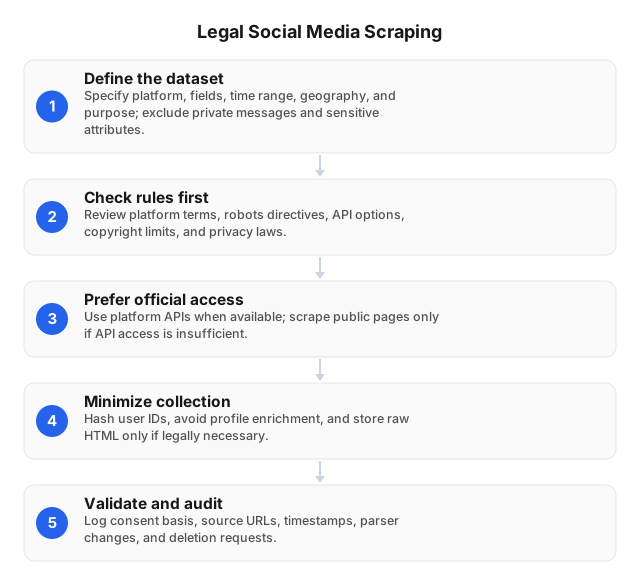
Build a Compliance-First Workflow
A defensible workflow starts before collection. It should leave an audit trail that a legal, security, or data governance reviewer can inspect later.
1. Define the business question
Write one sentence that limits the project. Example: “Measure weekly sentiment around Product X in public English-language posts from January to March 2026.” That sentence defines platform scope, fields, geography, date range, retention, and access method.
2. Map every field to the purpose
Create a field table before extraction:
| Field | Needed? | Reason | Retention |
|---|---|---|---|
| Post text | Yes | Sentiment analysis | 90 days or aggregate |
| Timestamp | Yes | Weekly trend chart | 12 months |
| Public URL | Yes | Audit and deduplication | 90 days |
| Username | Usually no | Not needed for aggregate sentiment | Hash or exclude |
| Profile photo | No | No analytical purpose | Do not collect |
This table blocks “just in case” scraping, which creates privacy, storage, and breach-notification risk without improving the analysis.
3. Check the approved access path
Use official APIs first when they provide the needed fields and permissions. APIs usually provide scoped tokens, documented rate limits, structured responses, and deletion workflows.
Scraping public pages can be appropriate when the API is unavailable, incomplete, or unsuitable for the approved use case. The same limits apply: no private areas, no login-wall bypassing, no collection beyond purpose, and no attempts to defeat access controls.
For crawler design patterns, see How to Automate Web Scraping Without Getting Blocked.
4. Set request limits before launch
Define request rates, retry caps, exponential backoff, concurrency limits, and stop conditions before production. Treat repeated 403s, 429s, CAPTCHA walls, login prompts, and account restrictions as review signals, not engineering obstacles.
Proxy rotation can support localization and load distribution, but it must not be used to evade platform rules. For technical setup patterns, see proxy rotation technicalities.
5. Log the audit trail
Keep records that answer five questions:
- What source URL or endpoint was accessed?
- What fields were collected?
- What rule, permission, or approved purpose allowed collection?
- When was the data collected?
- When will raw data be deleted, hashed, or aggregated?
Store parser versions, schema changes, consent or permission records where relevant, and deletion requests with the dataset. Six months later, the audit file should explain why each field exists.
Tooling for Ethical Social Media Scraping
The best stack enforces limits instead of only increasing throughput.
| Layer | Compliance function | What to require |
|---|---|---|
| Official API | Approved access path | Scoped tokens, documented quotas, deletion handling |
| Browser automation | Public-page rendering | No login-wall bypassing, visible waits, retry caps |
| Parser or AI extraction | Field structuring | Schema validation, confidence scores, human review |
| Proxy infrastructure | Localization and reliability | Residential routing, rotating and sticky sessions, clear authentication |
| Governance layer | Proof of compliance | Logs, retention rules, PII redaction, role-based access |
For ethical scraping, combine purpose controls with technical controls. A practical stack may include an official API where available, a headless browser only for public pages that require rendering, a parser that validates each field against a schema, and a governance layer that redacts or hashes identifiers before analysts receive the data.
AI extraction can classify topics, detect duplicates, and structure messy comments. It also adds risk when labels involve politics, health, religion, union status, ethnicity, or other sensitive categories. Require explainable labeling rules and manual review for high-impact outputs. For AI data pipelines, see How Web Scraping Powers AI and ML in 2026.
EProxies supports compliant public-data workflows with HTTP(S) and SOCKS5, rotating and sticky sessions, city- and ASN-level targeting, username-password authentication, and IP whitelist authentication. The residential network includes 72M+ IPs across 195+ countries. EProxies publishes 98.2% uptime and backs service availability with a 99.9% uptime SLA.
Pricing options include pay-as-you-go residential plans from $0.25/GB, tiered residential packages down to about $0.73/GB at 300GB, ISP SOCKS5 from $0.95/IP, and unlimited plans from $79/month. Match the plan to traffic volume, target rules, session design, geography, and logging requirements.
Common Mistakes to Avoid
Collecting more data than the analysis needs
A sentiment dashboard rarely needs names, bios, profile images, follower lists, or precise location hints. Keep raw text only as long as needed for quality checks, then aggregate, hash, or delete.
Treating rate limits as blocks to defeat
Rate limits are policy signals. If a platform slows responses or returns 429s, reduce volume and review the access method. Adding more IPs to force throughput increases legal, contractual, and reputational risk.
Using proxies for the wrong reason
Residential proxies should support legitimate public-data access, localization checks, stable sessions, and responsible request distribution. They should not be used to access restricted content, bypass login walls, or hide abusive scraping behavior. For implementation details, review proxy rotation technicalities.
Keeping no deletion plan
Retention should be defined before extraction. Example: store raw post text for 90 days, keep weekly aggregates for 12 months, and delete source identifiers after deduplication unless a legal hold applies.
Ignoring downstream reuse
A dataset collected for aggregate market research should not later become a user-level profiling system without fresh review. New purpose means new legal, ethical, and security checks.
Practical Examples
Brand sentiment monitoring
A team tracks public posts mentioning one product launch for eight weeks. Approved fields are post text, timestamp, language, public URL, hashtag, and aggregate engagement count. Usernames are hashed for deduplication and deleted after quality review. Reports show weekly sentiment trends, not individual user profiles.
Public-interest misinformation research
A research group compares public narratives across regions. It collects public posts by country and city where content is openly visible. Residential proxies test localized public availability and reduce request concentration. They are not used to access gated communities or login-only content.
Social media campaign reporting
A marketing analyst collects public comments on owned brand pages and campaign hashtags. The dataset excludes private messages, customer service tickets, minors’ data, and inferred sensitive traits. The report uses aggregate engagement, recurring themes, and representative excerpts with direct identifiers removed.
For broader social media proxy operations, see Best Practices for Using Proxies in Social Media 2026.
Reliability Planning Without Unsupported Benchmarks
Do not build a scraping plan around generic success-rate claims. Results depend on platform rules, page structure, login requirements, geography, request rate, session design, parser quality, and front-end changes.
Run a pilot instead:
- Select 100 to 500 representative public URLs or queries.
- Test at the intended request rate, not an artificial burst rate.
- Record HTTP status, render success, parse success, duplicate rate, and missing-field rate.
- Review failures by cause: blocked, unavailable, changed layout, deleted content, or parser error.
- Set production thresholds, such as “pause if parse success drops below 95% for two consecutive batches.”
This gives the team a measured baseline for the actual target, workload, and compliance limits.
FAQ
What is social media data scraping?
Social media data scraping is the automated collection of social platform data into a structured format. Typical fields include public post text, comments, hashtags, timestamps, public engagement counts, and public URLs. Compliance depends on source permissions, platform rules, data type, purpose, and retention.
Is it legal to scrape social media data?
It can be legal, but there is no universal answer. The analysis depends on platform terms, access method, jurisdiction, privacy law, copyright, and whether personal data is collected. Safer projects use authorized access, collect only necessary public data, document purpose, and apply minimization and deletion rules.
How can I scrape social media data without breaking rules?
Start with a written purpose and field list. Check platform terms and API options. Avoid private content, gated groups, login-only areas, minors’ data, and sensitive attributes. Respect rate limits and keep logs for source URLs, timestamps, collected fields, access basis, and retention.
What tools are best for ethical data scraping?
The best tools are the ones that enforce scope: official APIs, schema-validated parsers, rate-limited crawlers, headless browsers for public rendering only, PII redaction tools, and audit logging. Use proxies for localization and stable sessions, not for bypassing access controls. A strong stack also includes retention controls, access permissions, and deletion workflows.
What are the risks of scraping social media data?
The main risks are violating platform terms, collecting personal or sensitive data without a lawful basis, retaining identifiers longer than needed, and creating user-level profiles from data collected for aggregate analysis. Operational risks include rate-limit blocks, parser errors, duplicate data, and front-end changes that corrupt fields. Reputational risk rises quickly if the project touches minors, private groups, health topics, political views, or harassment-prone communities.
Should I use a social media API instead of scraping?
Use an official API first when it provides the required fields and permissions. APIs usually offer clearer limits, structured responses, and better auditability. Scraping public pages should be a secondary method when API access is unavailable, incomplete, or unsuitable for the approved use case.
What role do proxies play in compliant scraping?
Proxies help with localization, stable sessions, and responsible request distribution. They should not be used to bypass access controls, ignore rate limits, or collect restricted content. EProxies supports HTTP(S) and SOCKS5, rotating and sticky sessions, city- and ASN-level targeting, 72M+ residential IPs across 195+ countries, and published 98.2% uptime backed by a 99.9% uptime SLA.
What data should I avoid collecting?
Avoid private messages, gated-group content, non-public profile data, children’s data, sensitive attributes, unnecessary identifiers, and fields that do not map to the approved purpose. If aggregate analysis works, aggregate early and delete raw identifiers.
How should I test scraper reliability?
Run a small pilot on representative public pages. Measure request success, render success, parse success, duplicate rate, and missing fields. Track failures by cause and use those numbers to set retry rules, pause thresholds, and parser QA checks before scaling.
This article was written by the EProxies team and reviewed against our editorial quality standards before publishing.