
Web Scraping for Non-Profit Organizations in 2026
TL;DR: Non-profits should scrape public web data only when it answers a defined program, policy, research, or advocacy question. Start with APIs or downloads, use HTML parsers before browsers, validate 5–10% of pilot records, document legal and ethical checks, and add residential proxies only for compliant location coverage, stability, or rate distribution.
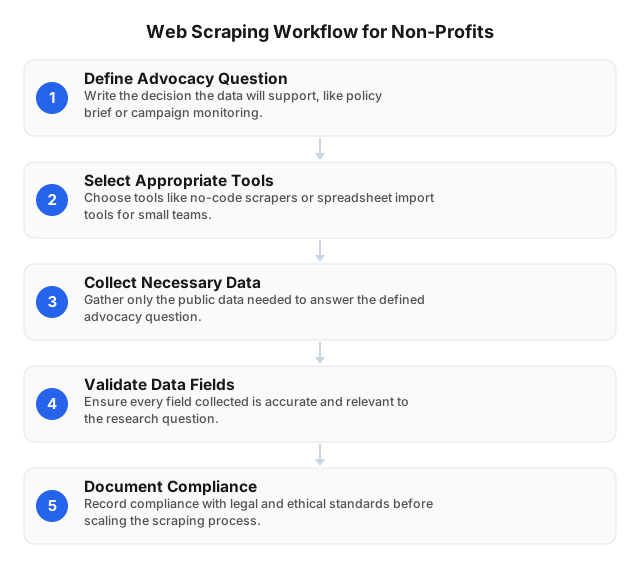
What Web Scraping Means for Non-Profits
Direct answer: Web scraping is structured collection of public web data when a site does not provide a usable API, CSV, or bulk download. For a non-profit, the output should support one concrete decision: a service map, policy report, grant shortlist, watchdog finding, litigation-support file, or outreach update.
A housing group might track advertised rent changes within 1 mile of transit stops. An environmental group might monitor permit notices by county, facility, date, and status. A health-equity team might compare clinic directory listings against weekend hours and bus routes.
Most projects need only 5–8 fields: source URL, scrape date, record title or ID, location, category, status, date posted, and last-seen date. Add a field only when it changes the analysis or publication.
For AI-assisted classification, keep collection and inference separate. The audit log should show which values came from the source page and which labels were produced later by software. For related workflows, see How Web Scraping Powers AI and ML in 2026.
Where Scraping Saves Non-Profit Time
Direct answer: Scraping saves time when staff repeatedly check public pages for changes. A scheduled job can monitor 200 agency pages every week and produce a change log, replacing hours of manual copy-paste work.
High-value non-profit use cases include:
- Policy monitoring: bills, public consultation portals, procurement notices, inspection records, and agency alerts.
- Service mapping: food pantry hours, shelter eligibility rules, clinic directories, school meal sites, and transit disruptions.
- Grant research: foundation announcements, public award databases, application deadlines, and corporate giving pages.
- Watchdog work: public spending records, permit updates, court calendars, lobbying disclosures, and compliance reports.
- Community research: public listings, public comments, price signals, access rules, and local availability data.
The best outputs are dated tables, maps, and source-backed claims. “12 of 38 county pages removed Spanish-language application instructions between March and May” is stronger than “web data shows access barriers.”
Ethical Rules Before Code Runs
Direct answer: Ethical scraping means collecting the least data needed, reducing harm, respecting access rules, and publishing results at the safest useful level of detail. Write a short preflight note before any crawler runs.
| Decision | What to document |
|---|---|
| Purpose | The report, campaign, map, or internal decision the data supports |
| Fields | Each field collected and why it is necessary |
| Harm review | Groups that could be exposed, profiled, or misrepresented |
| Retention | How long raw HTML, screenshots, and cleaned records will be stored |
Do not collect personal data “just in case.” Names, emails, phone numbers, photos, comments, and profile URLs can create safety risks in projects involving homelessness, immigration, health, labor organizing, domestic violence, children, or small communities.
Respect robots.txt, terms of service, and published rate limits. Use aggregation where possible. If a shelter directory is the source, publish counts by neighborhood and service type rather than raw records that could expose staff or clients. For proxy-specific safeguards, see ethical proxy use for scraping.
Legal Checks for Non-Profit Scraping
Direct answer: Non-profit status does not create a scraping exemption. Legal risk depends on jurisdiction, access method, terms, privacy impact, copyright or database rights, and whether technical access controls are bypassed.
Use this checklist before collection:
- Public access: Do not scrape login-gated, paywalled, or access-controlled content without review.
- Terms and robots.txt: Record the date checked and the relevant restrictions.
- Privacy: Avoid sensitive personal data unless counsel has approved the basis, safeguards, and retention period.
- Copyright and database rights: Store factual fields where possible; avoid republishing protected text at scale.
- Source burden: Set conservative request rates and crawl windows.
- Audit trail: Keep target URLs, timestamps, scraper version, fields collected, and validation notes.
EU-facing projects need extra care because GDPR and database rights can apply even when a page is publicly reachable. Review EU scraping legal guidelines before collecting EU personal data, public comments, directories, or large database extracts.
Best Tools for Non-Profit Web Scraping
Direct answer: The best tools are APIs or downloads first, HTML parsers second, headless browsers only for JavaScript-heavy pages, AI extraction for messy layouts after validation, and residential proxies only when compliant public-data collection needs location coverage or stable request distribution.
| Tool | Best fit | Practical guardrail |
|---|---|---|
| API connector | Open-data portals, public registries, research databases | Record license terms, pagination rules, and rate limits |
| CSV/XLS download | Government data portals, grant tables, inspection exports | Store file hash, download date, and source page |
| HTML parser | Static pages, press releases, grant listings, public notices | Monitor selector failures and layout changes |
| Headless browser | JavaScript dashboards, maps, filters, infinite scroll | Use only after static requests fail; higher compute cost |
| Browser automation | Permitted forms, pagination, multi-step filters | Log actions and avoid restricted workflows |
| AI extraction | Inconsistent public pages with messy formatting | Human-check samples before publication |
| Residential proxies | Localized pages or rate-limited public collection | Document geography, rotation, session length, and request budget |
Do not start with the heaviest stack. A benefits-office monitoring project may need only scheduled HTTP requests and an HTML parser. A national service-map project may need browser rendering for JavaScript directories and regional proxy routing to confirm localized results.
For API-first planning, see Creating Effective Web Scraping Strategies Using APIs. For rotation design, session logic, and error handling, see technical proxy rotation guidance.
A Practical Workflow for Non-Profit Analysts
Direct answer: Treat scraping as evidence collection. A pilot should prove usefulness, accuracy, legality, and operational stability before the project scales beyond one source or region.
1. Scope one decision
Write the decision in one sentence: “We need weekly changes in county benefit office hours to update outreach scripts.” If no decision changes after the scrape, pause the project.
2. Choose sources
Rank sources by reliability. Government pages, official notices, open-data portals, and public registries usually beat reposted summaries. Prefer APIs, CSVs, or bulk downloads when available.
3. Define the schema
Create a data dictionary before extraction. Include field name, example value, source selector, allowed format, and validation rule. Store dates in ISO format and keep both raw and normalized location fields.
4. Build a minimal collector
Start with one source and 20–50 pages. Add request delays, retries, descriptive logs, and user-agent identification where appropriate. Do not add proxies, browsers, or AI extraction until the simpler method fails.
5. Validate samples
Check at least 5–10% of pilot records against live pages or saved HTML. Flag missing values, changed page layouts, duplicate records, and parsing errors. Store source URL and scrape timestamp on every row.
6. Scale in controlled steps
Move from one city to five, then one state, then national coverage. Each step needs a request budget, failure threshold, review owner, and rollback plan.
Using Proxies Without Turning Them Into a Shortcut
Direct answer: A proxy is infrastructure for compliant access to public web data, not a way to bypass rules. Use proxies only when geography, uptime, session stability, or request distribution is required for a legitimate project.
Common non-profit proxy needs include checking whether public pages differ by state, monitoring local search results for service availability, or spreading conservative requests across sessions so one source is not overloaded. Document target domains, countries or regions, rotation settings, retry limits, and maximum requests per minute.
EProxies supports residential and ISP proxy setups for teams that need controlled public-web collection: 72M+ residential IPs across 195+ countries, HTTP(S) and SOCKS5, 98.2% uptime backed by a 99.9% uptime SLA, pay-as-you-go residential from $0.25/GB, tiered residential pricing down to about $0.73/GB at 300GB, ISP SOCKS5 from $0.95/IP, and unlimited plans from $79/month.
Before production, confirm session duration, rotation behavior, geographic granularity, authentication method, and traffic estimates. For automation patterns that reduce blocks without aggressive behavior, see How to Automate Web Scraping Without Getting Blocked.
Three Non-Profit Scraping Examples
Public-benefits access monitoring
A policy team tracks 58 county benefits pages every Monday. Fields include county, program name, application URL, office hours, phone number, language availability, and last-seen date. The output is a change log showing which counties removed, changed, or added application instructions.
Housing and eviction research
A housing non-profit collects public court calendar entries, municipal notices, and rental listings. It stores address, date, case type, listed rent, source URL, and confidence score. Address matches below a set threshold go to human review before entering the advocacy dataset.
Environmental justice tracking
An analyst monitors public permit notices, inspection records, and agency updates by facility and ZIP code. Published findings use counts, timelines, and maps. Raw records that could identify individual complainants or small households stay out of public reports.
Data Quality Standards Before Publication
Direct answer: Do not publish scraped findings until the dataset passes completeness, accuracy, deduplication, provenance, change-tracking, and privacy checks. Advocacy claims should be reproducible from source URLs, timestamps, and validation notes.
Minimum checks:
- Completeness: Required fields meet the agreed threshold, such as 95% of records.
- Accuracy: A sample matches the source pages or saved HTML.
- Deduplication: Records with the same ID, URL, date, and title are merged or flagged.
- Provenance: Every row includes source URL, scrape date, and extraction method.
- Change tracking: Updated records retain first-seen and last-seen dates.
- Privacy review: Sensitive fields are removed, aggregated, or justified.
For high-stakes reports, add a manual review column with reviewer initials, review date, and correction notes. This small step makes later fact-checking faster than reconstructing the scrape from logs.
FAQ
What is web scraping used for in non-profits?
Non-profits use scraping to collect public web data for policy monitoring, service mapping, grant research, watchdog reporting, and community analysis. Examples include tracking housing waitlist updates, clinic hours, food pantry schedules, grant deadlines, inspection notices, and public procurement records.
Is web scraping legal for non-profit organizations?
It can be legal, but legality depends on the source, jurisdiction, terms of service, access method, and data type. Avoid login-gated content, paywalls, technical access controls, and sensitive personal data unless counsel has reviewed the project. Keep URLs, timestamps, fields, rate limits, and legal-review notes.
How can non-profits scrape ethically?
Collect the minimum fields needed, respect access rules, limit request rates, and reduce harm before publication. For a shelter-services project, hours and eligibility rules may be necessary; staff emails, client stories, and informal comments usually are not. Publish aggregated findings when raw records could expose vulnerable people.
What tools are best for non-profit web scraping?
APIs, CSV downloads, and official bulk exports are best when available because they are stable, documented, and less intrusive than crawling pages. For pages without usable downloads, use HTML parsers for static content, headless browsers for JavaScript-heavy pages, and AI extraction only after human validation of samples. Residential proxies are useful only when compliant public-data collection requires location testing, session stability, or conservative request distribution.
How should a non-profit estimate scraping costs?
Budget for staff time, legal review, data cleaning, hosting, monitoring, browser compute, and proxy traffic if needed. Record quoted prices and dates because vendor pricing changes. EProxies lists residential pay-as-you-go access from $0.25/GB, tiered residential pricing down to about $0.73/GB at 300GB, ISP SOCKS5 from $0.95/IP, and unlimited plans from $79/month.
How can non-profits validate scraped data before advocacy use?
Check source-page samples, required-field completeness, duplicate records, date formats, location normalization, and provenance columns. A defensible row should show what was collected, when it was collected, where it came from, and whether a human reviewed it. For public reports, keep saved HTML or screenshots for the records behind headline claims.
This article was written by the EProxies team and reviewed against our editorial quality standards before publishing.