
How Web Scraping Powers AI and ML in 2026
TL;DR: Web scraping powers AI and ML by converting public, fast-changing web pages into structured datasets for training, evaluation, monitoring, and retrieval. The reliable version is not “scrape more”; it is: define the model objective, collect only relevant public data, preserve source metadata, validate every field, and run the pipeline within site terms and applicable law.
Introduction to Web Scraping for AI and ML
Web scraping for AI and ML is the automated collection and structuring of web data so teams can train, evaluate, or refresh models with current examples. A useful scraper does three jobs: fetch public pages, extract fields such as text, price, rating, timestamp, image URL, or metadata, and turn those fields into records that pass schema and quality checks.
The value for model teams is dataset coverage. Public web pages contain product changes, forum language, review phrasing, job postings, regional availability, documentation updates, and search-result variations that may not exist in internal databases or licensed benchmark sets. IBM describes AI scraping as using machine learning to automate large-scale extraction and broaden what can be collected from web pages, especially where content is less structured or layouts change over time (IBM Think: AI scraping).
For production ML, scraping is not a single crawler. It is a governed data pipeline:
- Acquisition: collect public pages, rendered JavaScript views, feeds, or permitted endpoints.
- Extraction: convert DOM elements, tables, embedded JSON, images, and text blocks into normalized fields.
- ML readiness: deduplicate, remove boilerplate, detect language, preserve timestamps, attach source URLs, and version datasets before training.
The Role of Web Scraping in AI and ML
Scraping is most useful when the model depends on breadth, recency, or domain-specific signals that static datasets do not provide. A classifier trained on one marketplace may miss seller phrasing used elsewhere. A pricing model trained on last month’s export may miss discount cycles. A retrieval model built from old documentation may answer with deprecated API parameters.
A 2025 Springer paper on combining web scraping with AI-based models describes the pairing as a way to analyze unstructured and semi-structured web information at scale, especially when downstream models need richer feature extraction rather than raw HTML (Springer).
For data scientists, scraping usually supports four ML tasks:
- Training: collect examples for classifiers, recommenders, entity extractors, rankers, and domain language models.
- Fine-tuning: adapt general models to product catalogs, legal text, support pages, technical documentation, or industry-specific vocabulary.
- Evaluation: build current test sets from public pages to catch drift, hallucination risk, and retrieval gaps.
- Monitoring: track changes in vocabulary, prices, page templates, sentiment, availability, and search-result composition.
Key Benefits of Web Scraping for AI/ML
The strongest benefit is not raw volume. It is controlled freshness: a scheduled crawl can update datasets daily, weekly, or monthly based on how fast the target domain changes.
Broader training coverage
Multi-source collection reduces dependence on one publisher, one taxonomy, or one writing style. For example, a product-matching model can compare titles, attributes, seller descriptions, categories, and review snippets across several public catalogs instead of learning from one internal SKU table.
Better feature extraction
Modern scraping pipelines can parse JavaScript-rendered pages, embedded JSON, tables, page metadata, and image references. The output should be a typed record, not a text dump:
source_url, crawl_time, country, title, price, currency, rating, review_count, availability
That structure lets downstream code validate null rates, range errors, duplicate rows, and schema drift before records enter a feature store or training set.
Stronger model evaluation
Scraped evaluation sets can reflect current pages rather than frozen benchmarks. A retrieval-augmented generation system, for example, can be tested against newly published documentation pages to identify stale embeddings or missing chunks.
Step-by-Step Guide to Implementing Web Scraping for AI/ML
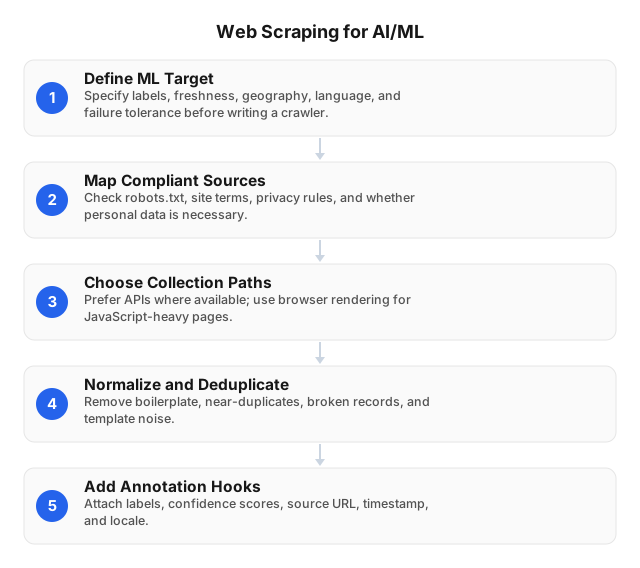
Model performance depends more on dataset design than crawler volume. Start with a dataset contract, then build the scraper around it.
- Define the ML target. Specify the prediction task, labels, required fields, freshness window, geography, languages, and acceptable error rate. A sentiment model and a price-monitoring model need different crawl schedules, metadata, and validation rules.
- Map compliant sources. Review robots.txt, site terms, authentication boundaries, copyright risk, privacy rules, and whether personal data is necessary. For sensitive projects, document lawful basis, minimization rules, retention limits, and deletion workflows. See ethical proxy use and Legal Guidelines for Web Scraping in the EU 2026.
- Prefer APIs where they fit. If a source offers a stable API with the fields you need, use it. Scraping is better reserved for public pages where no adequate API exists, where rendered content matters, or where the dataset depends on what users actually see. For hybrid designs, see Creating Effective Web Scraping Strategies Using APIs.
- Choose the right rendering path. Static HTML parsers are faster and cheaper. Browser rendering is necessary when data appears only after JavaScript execution. Network inspection can sometimes identify public JSON responses that are cleaner than DOM extraction.
- Normalize and deduplicate. Remove navigation text, ads, cookie banners, repeated footers, broken records, and near-duplicates. Keep canonical URLs and crawl timestamps for auditability.
- Add annotation hooks. Attach labels, weak labels, confidence scores, source URL, crawl time, locale, and reviewer notes. Annotate after cleaning so human reviewers do not label duplicate or malformed records.
- Use distributed collection responsibly. Residential proxies can support localized public-data collection when pages vary by country, city, network, language, or availability rules. EProxies provides access to a 72M+ residential IP pool across 195+ countries, supports HTTP(S) and SOCKS5, reports 98.2% uptime, and backs service with a 99.9% uptime SLA. For session design, read Understanding Proxy Rotation: Tech & Best Vendors.
- Monitor extraction drift. Track field null rates, parser errors, HTTP status codes, duplicate ratios, language mix, value ranges, and sudden layout changes. Silent drift is worse than a failed crawl because it can poison training data without triggering an obvious outage.
Challenges and Solutions in Web Scraping for AI/ML
Dynamic pages and changing layouts
JavaScript-heavy sites may require browser automation, wait conditions, and DOM-aware parsing. AI-assisted extractors can help identify repeated patterns such as “price,” “review count,” or “job title,” but validation rules still need to catch swapped fields, missing values, and template changes.
Noisy training data
Raw pages contain menus, ads, duplicate blocks, hidden text, cookie banners, and unrelated recommendations. Clean NLP datasets with boilerplate removal, canonical URL mapping, language detection, near-duplicate detection, and source-level sampling. For supervised learning, inspect label quality by source because one noisy domain can dominate model loss.
Coverage bias
A dataset collected from one country, one device type, or one category can produce brittle models. If geography affects what users see—such as price, stock status, shipping text, language, or search results—record the collection location and treat it as a feature or stratification variable. Do not assume a page fetched from one network represents every user.
Reliability and compliance
Avoid aggressive request rates, authenticated areas without permission, and collection of unnecessary personal data. Use crawl budgets, backoff rules, source allowlists, and deletion workflows. For deeper operational controls, see ethical proxy use for web scraping.
Real-World Applications of Web-Scraped Data in AI/ML
Model training and fine-tuning
Scraped product pages, reviews, public forums, job posts, and documentation can train classifiers, recommenders, entity extractors, and domain-specific language models. A pricing model may need title, seller, shipping text, discount labels, currency, and regional availability rather than a single catalog price.
Retrieval and knowledge systems
RAG pipelines often need current public documentation, product pages, release notes, and support articles. Scraping feeds those documents into chunking, embedding, and indexing workflows, while source URLs and timestamps help users verify answers.
Benchmarking and evaluation
Current public pages help test whether models generalize across layouts, regions, and writing styles. A search-quality model can be evaluated on localized result pages; a product-matching model can be tested against newly listed items; a summarizer can be checked against recent support threads.
Drift monitoring
Recurring crawls detect changes in terminology, pricing, page structure, review sentiment, and catalog composition. Feed drift signals into retraining only after deduplication, validation, and annotation QA; otherwise the retraining job may amplify extraction errors.
Legal and Ethical Considerations in Web Scraping
Legal and ethical scraping means collecting only data you are allowed to access, minimizing personal data, and documenting source, purpose, retention, and deletion rules before the dataset enters an AI workflow.
Public availability does not automatically mean unrestricted use. Review site terms, robots.txt signals, authentication boundaries, copyright, database rights, privacy law, and whether the data contains personal or sensitive attributes. AI teams should also consider downstream risk: combining fields from several public pages can create identifiable profiles even when each page looked low-risk alone.
Ethical scraping improves data quality as well as compliance. Respectful request rates reduce disruption. Source logs support lineage. Opt-out handling prevents disputed data from reappearing in future training runs. Proxy-based collection should follow the same rules; infrastructure is not a substitute for permission, minimization, or rate control.
EProxies pricing is designed for teams that need flexible collection capacity: pay-as-you-go residential traffic starts from $0.25/GB, residential tiers scale down to about $0.73/GB at 300GB, ISP SOCKS5 starts from $0.95/IP, and unlimited plans start from $79/month.
FAQ
What is web scraping in AI?
Web scraping in AI is the process of collecting public web data and converting it into structured records for model training, evaluation, retrieval, or monitoring. A pipeline might extract product titles, prices, reviews, images, timestamps, and source URLs, then store them as JSON, CSV, or feature-store records.
How does web scraping benefit machine learning?
It gives models fresher and more domain-specific examples than many static datasets provide. A recommendation model can use current product metadata, a pricing model can track market changes, and an NLP model can learn from public reviews, documentation, forums, or support pages.
What are the main challenges of scraping for AI?
The main challenges are JavaScript-rendered content, changing layouts, duplicate records, noisy text, biased source coverage, rate limits, and privacy constraints. The most dangerous failure is silent drift: the scraper still returns rows, but a changed layout maps the wrong value into a feature column.
How should data scientists implement scraping for AI models?
Start with a dataset contract: fields, labels, sources, freshness, geography, language, and validation rules. Then fetch pages, render JavaScript where needed, parse fields, clean records, deduplicate, attach metadata, annotate, validate schema quality, and version the dataset before training.
Is web scraping legal for AI data collection?
It depends on the data, source, method, jurisdiction, and site terms. Safer programs focus on publicly accessible data, avoid unnecessary personal or sensitive information, respect contractual and technical signals where applicable, and document collection purpose, retention, and deletion rules.
How do proxies fit into AI web scraping pipelines?
Proxies help distribute requests and collect localized public pages when content varies by country, city, network, language, or availability. They do not replace legal review, robots.txt checks, source-specific rate limits, or data minimization. EProxies offers 72M+ residential IPs across 195+ countries with HTTP(S) and SOCKS5 support.
How can teams reduce noise in scraped AI datasets?
Validate every field before training. Use duplicate detection, canonical URL mapping, language detection, outlier filtering, boilerplate removal, schema drift alerts, source sampling, and human review for high-impact labels. Clean first, annotate second.
This article was written by the EProxies team and reviewed against our editorial quality standards before publishing.