
API-Driven Web Scraping for Industry Reports in 2026
TL;DR: API-driven web scraping turns permitted web pages into repeatable, auditable datasets. Define the schema before collection, store raw evidence, validate content separately from HTTP status, and choose routing and session settings per source. EProxies provides 72M+ residential IPs across 195+ countries, HTTP(S) and SOCKS5 support, rotating and sticky sessions, plus country-, city-, and ASN-level targeting.12
A production reporting pipeline should separate retrieval, extraction, validation, and publication. That design allows analysts to rerun failed jobs, quarantine suspect records, and trace each published figure to its URL, retrieval time, parser version, and raw response.
What Is API-Driven Web Scraping?
API-driven web scraping sends structured collection instructions to a service and receives HTML, JSON, or normalized records through a documented response format. It is useful for recurring industry reports because the same fields, validation rules, and evidence requirements can run on every collection cycle.
A practical request-and-response contract includes:
- Request: target URL, requested country or city, rendering mode, session policy, timeout, and required fields.
- Collection: routing, retrieval, optional JavaScript execution, bounded retries, and parsing.
- Response: extracted fields, source URL, timestamp, HTTP status, detected locale, and error codes.
- Evidence: raw HTML or JSON, request ID, parser version, and validation result.
Keep report logic independent from collection infrastructure. A team should be able to update a selector without changing the warehouse schema, or change its routing policy without rewriting the report template.
A scraping API is not the same as a publisher’s first-party API. A first-party API exposes fields and usage conditions selected by the publisher. A scraping workflow retrieves permitted web content and converts it into structured data; it does not remove contractual, privacy, copyright, access-control, or database-rights considerations.
How Do APIs Improve Industry Reporting?
They replace manual copying with scheduled observations that use consistent fields and timestamps. Suitable sources can include regional prices, stock status, regulatory notices, public company announcements, publication times, search results, and product catalogs.
The concrete benefits are:
- Stable field names support period-to-period comparisons.
- Retrieval timestamps establish the reporting cutoff.
- Raw-response references provide evidence for disputed figures.
- Geographic routing captures market-specific currencies, catalogs, and availability.
- Validation rules prevent incomplete records from entering charts.
- Parser versions reveal whether a changed result came from the source or the extraction code.
API delivery does not eliminate source-specific work. A pipeline must still identify login pages, consent screens, redirects, changed templates, and valid pages that omit required fields. Maximizing Web Scraping Efficiency With APIs covers additional orchestration and integration patterns.
The Main Failure Modes—and Their Controls
Dynamic pages can return empty initial HTML
A JavaScript-rendered table may depend on background requests, cookies, pagination tokens, or client-side state. The initial request can return HTTP 200 without containing the values required for the report.
Inspect permitted network responses before using a browser. If the fields are present in server-rendered HTML or an authorized endpoint, collect them with an HTTP client. Browser rendering usually transfers more data and introduces additional timeout, dependency, and state failures.
For pages that require rendering:
- Wait for a named element or network response, not a fixed sleep period.
- Set a maximum navigation and render time.
- Block images, fonts, or analytics only after testing that the content remains unchanged.
- Save the failed HTML or a screenshot for diagnosis.
- Classify consent, login, and challenge pages as extraction failures rather than valid records.
For frequently changing layouts, see Web Scraping with AI for Dynamic Websites in 2026.
HTTP success is not data success
A 200 response can contain the wrong country, an empty template, a soft error page, or a redirect rendered as normal HTML. Monitor transport and record quality as separate layers.
A publishable pricing record might require all of the following:
- Product ID is present.
- Currency matches the requested market.
- Price parses as a decimal.
- Stock state uses an accepted value.
- Detected locale matches the routing request.
- The record is not a duplicate.
- A large price change is flagged for review rather than silently accepted.
This distinction makes the success metric explicit:
publishable rate = validated unique records ÷ attempted source records
Do not calculate it from HTTP 2xx responses.
Unbounded retries create duplicates and cost spikes
Retry connection failures, timeouts, and selected server errors with exponential backoff and a fixed attempt ceiling. Do not retry deterministic parser failures, prohibited sources, or repeated consent pages.
Give each logical observation an idempotency key, such as a hash of the source ID, target date, locale, and reporting run. If an initial request succeeds after the client has timed out, the retry can update the same observation rather than create a duplicate.
Track retry bytes separately from successful-record bytes. A job with a 95% final completion rate can still be inefficient if repeated rendering multiplies traffic per accepted record.
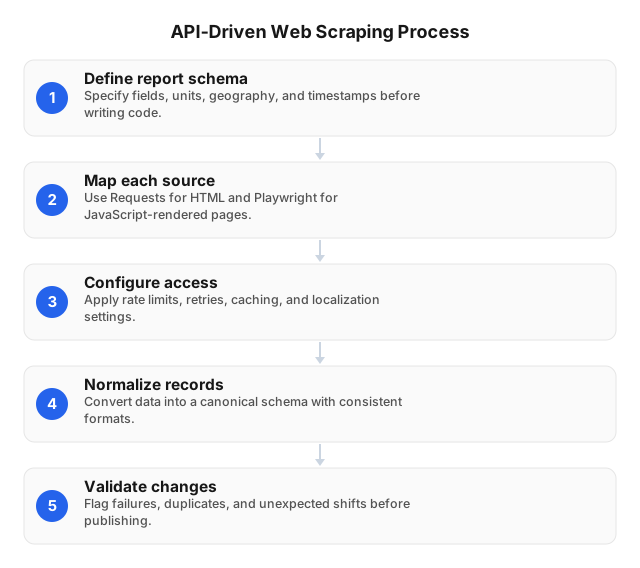
A Six-Step Implementation Workflow
1. Define the evidence schema
Specify the report’s fields before writing the collector. Each observation should store:
- Source URL and retrieval timestamp
- Requested and detected locale
- Source identifier, such as product or notice ID
- Original value and unit
- Normalized value and unit
- Publication or effective date
- Parser version
- Raw-response reference
- Validation status and reason code
Never replace the original field during currency, timezone, or unit normalization. Store displayed_price, displayed_currency, normalized_price, and normalization_rate_id as separate fields.
2. Maintain an approved-source registry
For every domain, record the collection purpose, permitted fields, frequency, owner, terms-review date, relevant robots instructions, and retention period. Pause collection automatically when an approval or legal review expires.
Requirements differ by jurisdiction, source, data type, and intended use. Consult the web scraping legality guidelines before adding a new country or category of data.
3. Use the lightest viable collector
Use an official API when its fields, limits, reliability, and permitted uses meet the report requirements. Choose a standard HTTP client for server-rendered pages. Reserve browser automation for permitted pages that genuinely require JavaScript or multi-step navigation.
Test the choice with a representative sample rather than a single URL. Include normal pages, pagination, missing records, redirects, and at least one known error state.
4. Configure routing and sessions deliberately
Use rotating sessions for independent requests, such as unrelated product URLs. Use sticky sessions when an approved multi-step workflow must retain the same IP context, cookies, cart state, or geographic setting. Do not assume a fixed sticky-session duration; configure and test the session behavior supported by the selected product.
EProxies documents:
- 72M+ residential IPs across 195+ countries1
- HTTP(S) and SOCKS5 connectivity2
- Rotating and sticky session modes2
- Country-, city-, and ASN-level targeting2
Geographic targeting improves routing precision but does not prove that a returned page uses the intended locale. Verify the currency, language, store identifier, tax treatment, or another page-level locale signal before accepting the record.
5. Validate and quarantine records
Run validation before loading report-ready tables. Checks should cover required fields, accepted types, plausible ranges, duplicate keys, units, currencies, and locale consistency.
Send failures to a quarantine table with machine-readable reasons:
missing_product_idcurrency_mismatchduplicate_observationunexpected_redirecttemplate_changedconsent_pageprice_change_review
A quarantine queue is more useful than a generic failure log because analysts can group records by cause, correct the parser, and replay only the affected observations.
6. Publish only from approved tables
Charts, aggregates, and narrative claims should read from validated tables rather than raw extraction output. Store raw responses separately with access controls, retention limits, and deletion procedures.
For every figure in a report, retain a reproducible path from the published metric to the normalized records, source observations, and raw evidence.
Monitoring the Full Pipeline
| Layer | Metric or control |
|---|---|
| Retrieval | Status codes, timeouts, latency, bytes transferred |
| Rendering | Navigation time, render time, blocked resources |
| Routing | Requested locale, detected locale, session identifier |
| Extraction | Required-field coverage, selector failures |
| Validation | Type errors, range alerts, duplicate rate |
| Storage | Raw-response growth, retention expiry |
| Publication | Record count, reporting cutoff, evidence coverage |
| Governance | Source approval, terms review, deletion status |
EProxies publishes a 98.2% uptime figure backed by a 99.9% uptime SLA.3 These are provider-level service figures, not guarantees that a target page will return usable report data. Target downtime, template changes, localization errors, rendering failures, and parser defects require separate monitoring.
A fast consent page is still a failed observation. Alerting should therefore combine transport thresholds with content thresholds—for example, “HTTP success above 95% but required-field coverage below 80%.”
Two Concrete Reporting Patterns
Localized retail pricing
Store the requested market, detected market, displayed currency, price, tax note, stock status, timestamp, and stable product identifier.
Use rotating sessions for independent product pages. Use a sticky session for approved category pagination when location or cookie state must remain constant. Reject or quarantine records when:
- The requested market is France but the page displays another market’s currency.
- The price field contains a promotional label without a numeric amount.
- An out-of-stock message appears but the stock field reports
available. - Several URLs resolve to the same canonical product without deduplication.
For a batch of 10,000 products, report both coverage and validity. “9,700 pages returned HTTP 200” is insufficient; “9,240 unique records passed field, locale, and duplicate checks” describes usable output.
Public media monitoring
Collect permitted headlines, publication times, section labels, canonical URLs, and correction notices. Deduplicate by canonical URL, then use a normalized text fingerprint when a canonical URL is absent.
Store corrected articles as new versions instead of overwriting prior observations. The version history preserves the evidence behind changes in headline counts, publication times, or topic classifications. How Web Scraping Reshapes News Distribution in 2026 examines related newsroom workflows.
Cost Planning
Estimate cost from transferred data and accepted records, not URL count alone. Rendering may load scripts, images, fonts, and analytics requests; retries increase traffic without increasing report coverage.
Measure a representative sample for:
- Median bytes per successful record
- Browser-rendered versus HTTP-only traffic
- Retry bytes by failure category
- Validated records per gigabyte
- Quarantine-review time
- Monthly raw-response storage growth
For example, if a tested workflow transfers 500 KB per attempt, 100,000 attempts consume roughly 50 GB before accounting for retries or storage copies. Treat this as a planning calculation, then replace the estimate with measured production bytes.
EProxies lists these entry points and billing models:
- Pay-as-you-go residential traffic from $0.25/GB
- Residential package pricing of approximately $0.73/GB at 300GB
- ISP SOCKS5 proxies from $0.95/IP
- Unlimited plans from $79/month4
These products use different billing units and conditions, so the lowest displayed unit price is not automatically the lowest project cost. Confirm current limits, included traffic, targeting requirements, concurrency, and renewal terms before budgeting.
Pre-Publication Checklist
- Trace every reported figure to one or more validated observations.
- Verify locale, currency, unit, timezone, and reporting date.
- Review schema changes and quarantined records.
- Compare high-impact figures with an authoritative source where feasible.
- Check retrieval timestamps against the reporting cutoff.
- Retain parser versions and transformation code.
- Record corrections without deleting the previous evidence state.
- Enforce the approved retention and deletion schedule.
- Restrict access to raw responses that may contain unnecessary personal data.
Public visibility does not by itself determine whether collection or reuse is permitted. If personal data is necessary, document the purpose, applicable lawful basis, minimization measures, access policy, and deletion process. Obtain jurisdiction-specific legal review before expanding collection.
FAQ
What are the main challenges in API-driven web scraping?
Dynamic rendering, schema changes, incorrect localization, rate limits, duplicate retries, and HTTP 200 responses containing unusable pages are the main technical challenges. Source permissions, personal data, retention, and access restrictions require separate governance controls.
How can teams ensure scraped-data quality?
Define required fields, types, units, locale rules, and acceptable ranges before collection. Preserve raw values, deduplicate by stable source keys, quarantine failed records with reason codes, and validate high-impact figures against an authoritative source before publication.
Which tools are best for API-driven web scraping?
Use first-party APIs where they satisfy the report’s field and usage requirements. Use HTTP clients and parsers for server-rendered pages, and browser automation only for permitted JavaScript-dependent workflows. Production systems also need scheduling, queues, routing, raw-response storage, schema validation, monitoring, and quarantine handling. Web Scraping Tools for Beginners: 2026 Guide compares the main collection approaches.
How should scraping success be measured?
Measure transport and data quality separately. Transport metrics include status codes, latency, timeouts, retries, and transferred bytes. Report-quality metrics include required-field coverage, locale accuracy, unique-record rate, schema validity, quarantine rate, and evidence coverage.
Should a pipeline use rotating or sticky sessions?
Use rotating sessions for independent requests. Use sticky sessions for approved workflows that must preserve one location, cookie set, or session state across several requests. EProxies documents both session modes, but the required duration should be configured and tested rather than assumed.2
Does proxy uptime guarantee complete report data?
No. EProxies publishes 98.2% uptime backed by a 99.9% uptime SLA, but target availability, page structure, rendering, and extraction quality remain separate dependencies.3 Monitor required-field coverage and locale accuracy even when proxy requests succeed.
Footnotes
- EProxies official network coverage information: 72M+ residential IPs across 195+ countries. ↩ ↩2
- EProxies official protocol, session, and targeting documentation: HTTP(S), SOCKS5, rotating and sticky sessions, and country-, city-, and ASN-level targeting. ↩ ↩2 ↩3 ↩4 ↩5
- EProxies published service information: 98.2% uptime backed by a 99.9% uptime SLA. ↩ ↩2
- EProxies official pricing information; prices, package conditions, and billing terms may change. ↩
This article was written by the EProxies team and reviewed against our editorial quality standards before publishing.