
How Web Scraping Reshapes News Distribution in 2026
TL;DR: Web scraping expands news distribution by feeding search, monitoring, aggregation, research, and AI systems, but full-text reuse can replace publisher visits rather than generate them. Its economic effect depends on referral traffic, licensing revenue, infrastructure load, and lost advertising or subscriptions. Reliable projects preserve version history, measure field completeness, minimize requests, and avoid circumventing access controls.
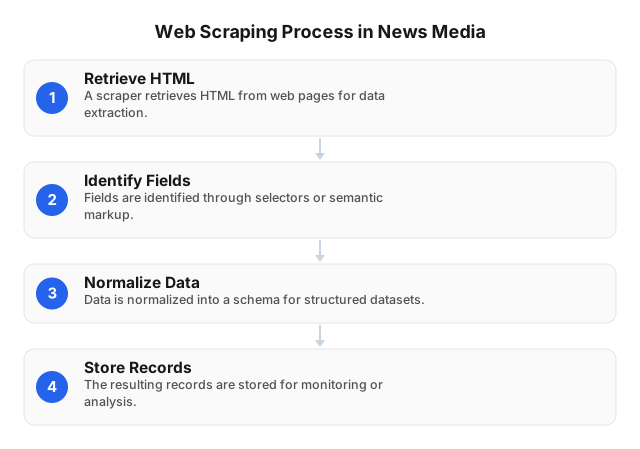
How Scraping Changes News Distribution
A scraped article can move from a publisher’s site into search indexes, media-monitoring dashboards, investor alerts, academic datasets, and AI-generated answers within minutes. That reach can help a local investigation find a national audience. It can also detach a headline from its correction, omit regional context, or present enough copied material that readers never visit the newsroom that funded the report.
From publication to redistribution
Collectors change distribution through four distinct mechanisms:
- Discovery: RSS feeds, sitemaps, section pages, and social posts expose new URLs.
- Extraction: Parsers collect headlines, dates, bylines, article text, tags, and media.
- Transformation: Aggregators cluster stories, translate headlines, summarize articles, or rank coverage.
- Redistribution: Extracted material appears in alerts, dashboards, search results, newsletters, datasets, and generated answers.
The result may be additive or substitutive. A card containing the headline, publisher, short excerpt, and prominent canonical link can send readers to the source. A full-text copy or comprehensive generated answer may satisfy the reader without producing a page view, advertising impression, registration, or subscription opportunity.
Correction handling also affects distribution quality. If a publisher updates a headline at 10:12 and adds a correction at 10:40, a collector that captured the page at 10:05 may continue distributing the original claim. Every downstream record therefore needs an update path, not merely a one-time publication pipeline.
Distribution measurements that reveal the effect
Publishers and aggregators should track:
- Referral click-through rate by placement
- Extract length and percentage of article text displayed
- Canonical link visibility
- Time from publication to first collection
- Time from publisher correction to downstream update
- Geographic edition and accepted language
- Subscription, registration, or licensing conversions
- Withdrawn stories still available downstream
Consider an illustrative aggregator showing one million article cards. At a 4% click-through rate, it sends 40,000 visits to publishers; at 1%, it sends 10,000. The 30,000-visit difference may result from placement, source prominence, or how completely the cards answer the reader’s need—not from the number of pages collected.
The Economic Impact on News Media
These distribution patterns have direct economic consequences. Scraping can produce revenue through referrals, syndication, monitoring products, archive licensing, and data partnerships. It can also reduce publisher income when copied articles or generated summaries replace source visits, weakening advertising inventory, subscription funnels, and bargaining power over licensing.
Publisher gains and losses
The principal positive effects are:
- Audience acquisition: Search and aggregation services can expose specialist or local reporting to readers who would not visit the homepage.
- Licensing revenue: Publishers can sell structured feeds, archive access, or rights for monitoring and AI applications.
- Lower internal research costs: Newsrooms can monitor thousands of public notices, court listings, procurement awards, or company announcements automatically.
- Faster competitive intelligence: Editors can identify emerging stories, headline changes, and gaps in regional coverage.
The principal costs are:
- Traffic substitution: Long extracts, copied text, or generated answers can remove the reason to open the source.
- Lost conversion opportunities: Fewer source visits mean fewer newsletter sign-ups, registrations, donations, and subscriptions.
- Infrastructure load: Aggressive collectors consume bandwidth, compute, logging, and security resources.
- Enforcement expense: Publishers may need bot management, legal review, rights-management systems, and complaint handling.
- Reduced licensing leverage: A business that acquires equivalent content without an agreement has less incentive to pay for a feed.
A useful channel-level calculation is:
Net publisher value = referral and licensing revenue − displaced advertising and subscriptions − delivery and enforcement costs
Each term should be measured separately. A monitoring service paying for an API and returning prominent links has different economics from a site that republishes complete reporting without payment or meaningful referrals.
Collector economics
Collectors avoid reporting and editing costs, but extraction is not free:
Cost per valid record = (traffic + rendering + storage + retries + parsing + validation + compliance) ÷ validated records
The denominator matters. If 100,000 requests return 200 OK but 8,000 contain consent pages and 2,000 assign the wrong date, the system produced 90,000 usable records—not 100,000.
Browser rendering costs more than direct HTML or feed parsing because it may execute JavaScript and download advertisements, fonts, analytics, images, and video. Teams can reduce costs and publisher load by using RSS or APIs first, honoring ETag and Last-Modified, blocking nonessential assets, caching unchanged pages, and setting retry ceilings.
Building an Auditable News Dataset
Measuring those costs and effects requires reliable records. A monitoring record must show what the collector observed, where it observed it, and when. At minimum, retain:
- Publisher, byline, headline, section, and canonical URL
- Original publication and publisher-update timestamps
- Retrieval and subsequent verification timestamps
- Language, geographic edition, and exit country
- Correction, withdrawal, consent, and paywall status
- Extracted fields and source quotations
- Content hash, parser version, and collection method
Preserve four separate times
News pages change after publication. Headlines are rewritten, live blogs expand, quotations are clarified, and correction notices appear. Store these values independently:
- Original publication time: the publisher’s stated first-publication time
- Publisher update time: the latest revision time displayed by the source
- Retrieval time: when the collector captured a particular version
- Verification time: when a person or later process confirmed the record
A 2025 study of scraped news data found that retrieval delays can systematically affect access to hard-news pages, distorting which articles enter a dataset. A six- or 12-hour collection interval can therefore create topic bias if fast-changing reports are corrected, restricted, or removed before collection.
When a content hash changes, save a new version rather than overwriting the old one. A field-level diff can then show that the headline changed while the article body remained stable, or that a correction removed a disputed quotation.
Treat missingness as data
A missing article does not prove nonpublication. Collection can fail because of:
- Regional editions or geolocation
- Consent screens and soft paywalls
- Authentication requirements
- JavaScript rendering failures
- Rate limits and temporary blocks
- Deleted pages or redirects
- Template changes that break selectors
Coverage reports should state the collection interval, collection window, exit region, parser version, failure status, and required-field completeness. “Not observed from a French residential session between 08:00 and 20:00 UTC” is defensible; “the publisher never covered the event” may not be.
A Production Workflow for News Monitoring
Once the record structure is defined, the collection workflow should minimize unnecessary requests while validating the evidence that each response contains.
1. Discover URLs without repeatedly rendering pages
Use publisher APIs, RSS, sitemaps, newsletters, and licensed archives before crawling section pages. Poll high-volatility sources more frequently: a live election blog may justify two- to five-minute checks, while a weekly opinion archive may need one daily pass.
2. Validate fields rather than HTTP status
A 200 OK response may contain a bot challenge, consent page, empty JavaScript shell, or subscription prompt. Track completeness for the headline, byline, publication time, body, canonical URL, and correction notice.
A deployment gate might require 99% headline extraction, 97% publication-time extraction, and explicit classification of every missing body. Those are example thresholds, not universal standards; a quotation-verification system may need stricter body completeness than a headline-monitoring dashboard.
3. Test difficult page classes
A representative fixture set should include:
- Static and JavaScript-rendered articles
- Live blogs and rolling updates
- Regional and translated editions
- Corrections and withdrawals
- Consent screens and soft paywalls
- Deleted pages, redirects, and intermittent errors
Run these fixtures after every parser change. Store the parser version with each record so a later audit can distinguish publisher edits from extraction defects.
4. Verify geographic differences
Record the exit country, session identifier, accepted language, cookies, URL, and retrieval time. Recheck a suspected regional difference using a fresh session; caching, personalization, or an old consent cookie can otherwise look like an editorial decision.
For a 100-URL pilot, calculate body completeness, median latency, block rate, bytes transferred, and cost per valid record for each target country. Scale only after the pilot confirms that the response contains the requested article rather than a challenge page.
5. Maintain a correction pipeline
When a source hash changes:
- Fetch the new version.
- Compare headline, body, timestamps, and correction labels.
- Mark the prior record as superseded without deleting it.
- Update downstream indexes, charts, and summaries.
- Escalate material factual changes for human review.
Quotations, allegations, and figures used in published reporting should be verified against the source page or underlying document. AI output is not source evidence.
Legal and Ethical Boundaries
Even a technically sound workflow must account for legal and ethical limits. Public visibility is not blanket permission to collect or reuse content. Legal exposure depends on the jurisdiction, access method, source terms, data type, volume, and resulting product.
Copyright and database rights
Facts generally receive different treatment from article prose, photographs, graphics, and editorial selection. Extracting titles and URLs for internal monitoring presents a different risk profile from republishing complete stories.
In the EU, systematic extraction may also implicate database rights even when individual facts are not protected by copyright. Cross-border projects should review country-specific scraping rules and the more specific EU scraping guidelines.
Access controls, contracts, and computer-access rules
Risk increases when a collector bypasses authentication, paywalls, CAPTCHAs, IP blocks, or other technical restrictions. Terms of service may support contractual claims, while computer-access laws can apply when collection exceeds or circumvents authorization.
robots.txt communicates crawler preferences. It does not provide a copyright license, cancel contractual restrictions, authorize paywall bypass, or resolve privacy obligations.
Personal data
News pages can contain names, photographs, allegations, locations, employers, and social handles. Combining those fields into a searchable profile can create privacy and safety risks beyond those posed by the original article.
Document the purpose and legal basis, collect only necessary fields, restrict access, set retention periods, and support correction and deletion requests. User-level social content needs the additional controls described in How to Scrape Social Media Data Legally in 2026.
Before launch, record:
- Purpose and required fields
- Source terms, licenses, and restrictions
- Request-rate and concurrency limits
- Personal-data basis and retention period
- Attribution and canonical link rules
- Correction and withdrawal procedures
- Complaint, opt-out, and deletion contacts
- Applicable scraping regulations
How Technology Is Changing Media Scraping
Within those boundaries, event-driven feeds and content hashes are replacing indiscriminate recrawling. Instead of rendering 50,000 unchanged articles every hour, a system can consume feed updates, issue conditional requests, and process only records with new timestamps or hashes.
AI-assisted parsers can map different publisher templates into a common schema, classify corrections, cluster duplicate coverage, and flag anomalous dates. They also create a new failure mode: a model may infer a missing byline, normalize an ambiguous date incorrectly, or generate text absent from the page. Production systems should preserve raw evidence, attach field-level confidence scores, and reject unsupported values rather than filling gaps.
Browser automation will remain necessary for some JavaScript applications, but it should be the fallback rather than the default. APIs and structured feeds provide clearer provenance, lower bandwidth use, more stable schemas, and better correction handling.
Geographic Collection With EProxies
For projects that need to verify legitimately accessible regional differences, EProxies provides 72M+ residential IPs across 195+ countries, with HTTP(S) and SOCKS5 support. Available pricing structures include:
- Pay-as-you-go residential traffic from $0.25/GB
- Tiered residential pricing of approximately $0.73/GB at 300GB
- ISP SOCKS5 proxies from $0.95/IP
- Unlimited plans from $79/month
The network reports 98.2% uptime, backed by a 99.9% uptime SLA. The reported metric and contractual SLA may use different measurement windows, exclusions, and remedies, so teams should confirm current terms before forecasting collection capacity.
A proxy supplies geographic routing; it does not authorize restricted access. Use it to test regional editions, language variants, and localization—not to circumvent subscriptions or authentication.
FAQ
How does web scraping affect news content distribution?
Web scraping moves news into search indexes, aggregators, alerts, research datasets, and AI systems, often extending a story beyond the publisher’s direct audience. Short attributed previews can generate discovery and referral traffic, while full-text copies or comprehensive summaries can substitute for source visits. Delayed or incomplete recrawling can also keep outdated headlines and corrected claims in circulation.
What are the economic impacts of web scraping on news media?
Scraping can create referral traffic, licensing revenue, lower research costs, and new monitoring products. It can also reduce advertising impressions, subscriptions, and licensing leverage when reused content satisfies readers without sending them to the publisher. Newsrooms additionally bear bandwidth, bot-management, legal, and enforcement costs.
How is technology shaping the future of web scraping in media?
Feeds, conditional requests, content hashes, and event-driven collectors are making collection faster and less wasteful. AI-assisted parsers can normalize inconsistent layouts and detect corrections, but they may invent missing fields or misattribute content. Auditable systems will preserve source snapshots, attach confidence scores, and require human verification for consequential claims.
What legal challenges does web scraping present?
Web scraping can trigger copyright, database-right, privacy, contract, and computer-access disputes. Risk rises when collectors copy substantial expressive content, aggregate personal data, violate binding restrictions, or bypass authentication and paywalls. Public accessibility alone does not settle whether a particular collection or reuse is lawful.
Is scraping a public news page always legal?
No. Jurisdiction, site terms, access method, collected fields, scale, and reuse all affect the analysis. Internal metadata monitoring and commercial full-text republication have materially different legal profiles.
Does robots.txt determine legality?
No. It states crawler preferences but does not grant a content license, authorize restricted access, or override privacy and contractual duties. Teams should treat it as one operational signal within a broader compliance review.
How can analysts reduce sampling bias?
Record publication, update, retrieval, and verification times separately. Report field-level failures, collection intervals, geographic routes, paywall states, and parser changes so readers can distinguish unobserved pages from confirmed nonpublication.
What should teams use before page scraping?
Start with publisher APIs, RSS feeds, sitemaps, licensed archives, newsletters, syndication services, and direct data-sharing agreements. These sources generally reduce server load, parsing failures, and ambiguity around timestamps or permissions.
This article was written by the EProxies team and reviewed against our editorial quality standards before publishing.