
Web Scraping Laws: Region and Data-Type Guide
TL;DR: Web scraping compliance depends on what you access, what you collect, where people or servers are located, what the site terms say, and how you use the data. Lower-risk projects usually collect non-personal facts from public pages at modest rates; higher-risk projects involve logins, paywalls, personal data, copyrighted content, AI training, resale, profiling, or continued scraping after access is blocked. Build a documented compliance workflow before scaling—and use proxies for lawful access management, localization, and reliability, not for evasion.
Web Scraping Legality: The Practical Test
There is no single global “web scraping law.” Most projects are assessed through overlapping areas: unauthorized-access law, privacy law, contract law, copyright, database rights, consumer protection, and sector-specific rules.
A useful first-pass review is:
| Question | Lower-risk answer | Higher-risk answer |
|---|---|---|
| Is the page public? | Viewable without login, payment, account, or token | Behind login, paywall, private API, CAPTCHA, or blocked access |
| Is the data personal? | Product prices, stock counts, opening hours | Names, emails, phone numbers, profile URLs, location, employment history |
| Is the content factual or expressive? | Price, SKU, address, availability | Articles, images, reviews, videos, code, proprietary datasets |
| What is the purpose? | Price monitoring, ad verification, localization QA | Profiling, lead enrichment, resale, automated decisions, AI training |
| How is collection handled? | Rate limits, caching, opt-outs, source exclusions | Barrier bypass, excessive requests, ignored refusals, weak documentation |
The biggest compliance failures are rarely caused by “scraping” alone. They usually come from combining personal data + unclear purpose + aggressive collection + poor records.
This article is practical guidance, not legal advice. Ask counsel to review projects involving personal data, regulated sectors, cross-border collection, resale, or high-volume automation.
Regional Legal Differences That Matter
The practical test changes by jurisdiction. A workflow that is reasonable for public, non-personal market data in one region may need additional privacy, transfer, contract, or sector review in another.
Quick Regional Comparison
| Region | Main pressure points | Practical takeaway |
|---|---|---|
| United States | CFAA, state privacy laws, contracts, copyright, unfair competition | Public pages are lower risk, but access boundaries and terms matter. |
| EU / UK | GDPR / UK GDPR, ePrivacy, database rights, copyright | Public visibility does not remove GDPR duties for personal data. |
| California / U.S. states | CCPA/CPRA and similar state privacy laws | Scraped personal information can trigger notice, deletion, access, and opt-out rights. |
| Canada | PIPEDA and provincial laws | Purpose, consent or lawful authority, safeguards, and cross-border disclosures matter. |
| Brazil / LATAM | LGPD and local consumer/privacy rules | GDPR-like principles apply to identifiable personal data. |
| China / APAC | PIPL, cybersecurity, data security, PDPA-style laws | Extra care is needed for personal information, transfers, localization, and platform rules. |
| MENA / Africa | Emerging privacy, cybercrime, telecom, and sector laws | Review country-specific restrictions before scaling. |
United States: Access Boundaries Are Central
In the U.S., scraping risk often turns on whether the scraper accessed a system “without authorization” or exceeded allowed access. Public pages are generally treated differently from pages behind logins, paywalls, API keys, session controls, or explicit revocation.
A U.S. compliance review should check:
- whether the page is public or authenticated;
- whether terms of service restrict automated collection;
- whether the workflow ignores blocks, rate limits, or cease-and-desist notices;
- whether state privacy laws apply to collected personal information;
- whether copied content is factual data or protected expression.
For example, internal price intelligence from public pages is usually easier to justify than creating accounts to scrape user profiles, copying full reviews, or continuing after access is revoked.
EU and UK: GDPR Can Apply to Public Data
In the EU and UK, “it was public” is not enough if the data identifies a person. Names, work history, profile links, email addresses, photos, device identifiers, and location signals can all be personal data.
If GDPR or UK GDPR applies, teams may need:
- a lawful basis under Article 6, often legitimate interests or consent;
- a documented legitimate-interest assessment when relying on legitimate interests;
- data minimization, purpose limitation, and retention limits;
- security controls and processor agreements;
- a process for access, deletion, objection, and opt-out requests;
- safeguards for cross-border transfers;
- strict avoidance or special handling for sensitive data such as health, biometric, political, religious, union-membership, sexual-orientation, or children’s data.
EU and UK database rights can also apply when a project extracts or reuses a substantial part of a protected database, even if individual facts are not copyrighted.
California and Other U.S. State Privacy Laws
The CCPA/CPRA may apply to for-profit businesses doing business in California if they meet thresholds such as annual gross revenue, processing volume, or revenue from selling or sharing personal information. Other U.S. states now have similar but non-identical privacy laws.
If scraped data can be linked to a consumer or household, plan for:
- privacy notice coverage;
- access, deletion, and correction workflows;
- opt-outs for sale, sharing, or targeted advertising;
- sensitive personal information limits;
- vendor/service-provider contract terms;
- retention schedules and documented purposes.
Do not treat “business contact data” as automatically safe. In many privacy regimes, a work email or professional profile can still be personal information.
Data Risk: What You Scrape Matters
Across regions, the content of the dataset is one of the clearest risk indicators. Start by separating non-personal factual data from personal, sensitive, access-controlled, or expressive content.
Usually Lower Risk
These are not risk-free, but they are commonly easier to assess:
- public product prices;
- stock availability;
- public search results;
- business addresses and opening hours;
- shipping fees;
- non-personal market statistics;
- public ad placements for verification;
- factual metadata such as SKU, model, or category.
Even then, check terms of service, robots.txt, rate limits, copyright, and downstream use.
Higher Risk
Escalate before collecting:
- names, emails, phone numbers, profile URLs, or photos;
- employment history or social media activity tied to individuals;
- precise location, financial, health, biometric, or children’s data;
- content behind login, subscription, API credential, or private endpoint;
- articles, images, videos, source code, reviews, or full datasets;
- data used for AI training, scoring, eligibility, profiling, or resale;
- data collected after blocking, account suspension, or explicit refusal.
A simple rule: if the data identifies a person, is access-controlled, or will be repurposed commercially, slow down and review it.
A Compliance Workflow for Scraping Teams
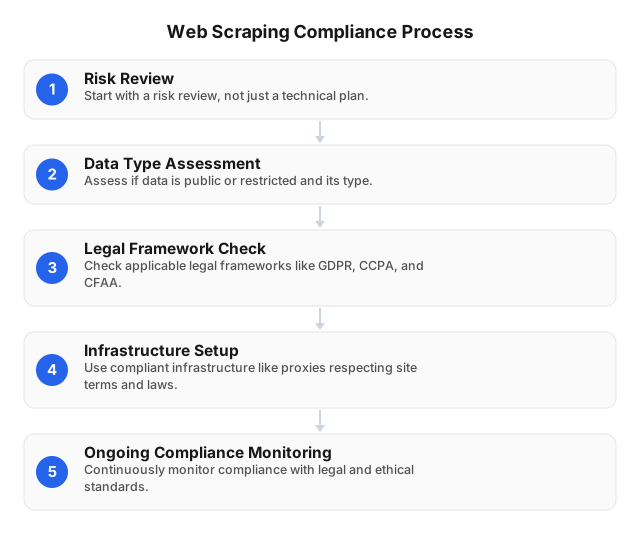
Once you understand the access path, region, and data risk, turn that assessment into an operating process that engineering, legal, security, and business owners can follow consistently.
1. Create a Source Register Before Building
For each target, document:
- domain and URL patterns;
- whether login, payment, API credentials, or session tokens are required;
- data fields collected;
- business purpose;
- jurisdictions involved;
- terms-of-service and robots.txt review;
- rate limits, retry rules, and backoff logic;
- retention period;
- exclusion and opt-out process;
- owner, reviewer, and approval date.
This prevents “shadow scraping” and gives legal, security, and engineering teams the same record.
2. Prefer APIs Where They Fit
Official APIs often reduce ambiguity because they define authentication, rate limits, permitted uses, and data formats. They may be incomplete or expensive, but they should be checked before building a scraper. For implementation planning, see Creating Effective Web Scraping Strategies Using APIs.
3. Minimize the Dataset
Collect only what the business purpose requires. If you need product prices, do not also collect seller names, reviewer profiles, comments, or account identifiers unless they are necessary and approved. Use aggregation, hashing, redaction, field exclusions, and short retention periods where possible.
4. Respect Operational Boundaries
Responsible scraping should avoid unnecessary load and access-control bypass. Use caching, incremental updates, request caps, randomized but conservative scheduling, exponential backoff, and source-level exclusions. Review ethical web scraping practices before moving from pilot to production.
5. Use Proxies for Governance, Not Evasion
Proxies can support compliant public data collection, localization testing, ad verification, SERP monitoring, uptime checks, and distributed request management. They should not be used to bypass paywalls, account restrictions, CAPTCHAs, bans, or legal limits.
EProxies supports controlled scraping infrastructure with 72M+ residential IPs across 195+ countries, HTTP(S) and SOCKS5, rotating and sticky sessions, city/ASN targeting, 98.2% uptime backed by a 99.9% uptime SLA, residential pay-as-you-go from $0.25/GB, tiered residential packages down to around $0.73/GB at 300GB, ISP SOCKS5 from $0.95/IP, and unlimited plans from $79/mo.
For implementation guardrails, read How to Automate Web Scraping Without Getting Blocked and ethical use of proxies for web scraping.
Red Flags That Require Legal Review
Use the workflow above for routine review, but escalate before scraping if:
- the site requires login, payment, API credentials, or session tokens;
- the data includes personal, sensitive, children’s, financial, health, or location data;
- the workflow ignores robots.txt, terms, rate limits, or explicit refusal;
- the project involves AI training, profiling, scoring, or automated decisions;
- the data will be resold, enriched, or combined with other datasets;
- the source is in finance, healthcare, employment, housing, insurance, education, telecom, or children’s services;
- the project crosses multiple jurisdictions;
- the scraper copies large volumes of copyrighted content or structured databases.
FAQ
How can businesses ensure compliance with web scraping laws?
Businesses should create a source-by-source compliance process before scraping: review access boundaries, terms of service, robots.txt, data fields, jurisdictions, legal basis, retention, and downstream use. They should minimize personal data, prefer APIs when practical, respect rate limits and opt-outs, and escalate high-risk projects involving logins, sensitive data, resale, AI training, or regulated sectors. Keep written records of approvals, technical controls, and vendor responsibilities so the program can be audited later.
How do web scraping laws differ across regions?
The U.S. often focuses on authorization, contracts, copyright, and state privacy laws, while the EU and UK focus heavily on GDPR obligations when data identifies a person. California and other U.S. states add consumer privacy rights, and many APAC, LATAM, MENA, and African jurisdictions add local privacy, cybersecurity, data localization, or sector-specific rules. The same scraper can be low risk for public product prices in one region and require additional privacy or transfer safeguards in another.
What are the key legal frameworks that impact web scraping?
The key frameworks are unauthorized-access and cybercrime laws, privacy and data protection laws, contract and terms-of-service rules, copyright, database rights, consumer protection, and sector regulations. Examples include the CFAA in the U.S., GDPR and UK GDPR in Europe, CCPA/CPRA in California, LGPD in Brazil, PIPL in China, and PDPA-style laws in several APAC markets. Which framework matters most depends on access method, data type, jurisdiction, and use case.
Is scraping public web data legal?
Not automatically. Public access lowers some risk, but it does not override privacy law, copyright, database rights, site terms, or unauthorized-access rules. Treat “public” as one factor in the analysis, not the whole answer.
Does GDPR apply to scraped public data?
Yes, if the scraped data relates to an identifiable person. GDPR can apply even when the information is visible on a public webpage. You still need a lawful basis, minimization, retention controls, security, and a process for data-subject rights.
Can proxies make scraping illegal?
Proxies are neutral infrastructure; legality depends on the workflow. Using proxies for compliant public data collection, localization testing, and request distribution is different from using them to evade restrictions or scrape protected content. For broader policy guidance, see ethical proxy use for web scraping.
This article was written by the EProxies team and reviewed against our editorial quality standards before publishing.