
Maximizing Web Scraping Efficiency With APIs
TL;DR: Use APIs first when they provide permitted, structured data; scrape public pages only for missing, localized, or visual fields; and run both through rate limits, schema validation, logging, and reliable proxy routing when geography or session consistency matters.
API-Based Web Scraping: What It Means
Web scraping and APIs both collect web data, but they reach it in different ways.
A traditional scraper loads a web page and extracts data from HTML, rendered JavaScript, or visible page elements. An API request asks an endpoint for structured data directly, often in JSON, XML, or CSV.
The strongest workflow is usually hybrid:
Use the API where it is complete and allowed
→ scrape public pages only for missing fields
→ validate, normalize, and store one combined dataset
For example, a retail intelligence team may use an API for product ID, price, seller ID, and stock status, then scrape public product pages only to verify localized shipping messages, promotions, or banner content not exposed by the API.
For compliance basics, start with ethical proxy use for web scraping.
When APIs Make Scraping More Efficient
APIs improve efficiency when they remove unnecessary browser work. Instead of downloading full pages, rendering scripts, locating selectors, and cleaning messy HTML, your collector receives predictable fields.
That shifts the work from “keep fixing broken selectors” to “manage freshness, quality, quotas, and cost.”
Practical Efficiency Gains
- Cleaner ingestion: JSON fields map directly into databases, queues, and analytics pipelines.
- Fewer layout failures: A front-end redesign may not affect the API response.
- Clearer retry logic: Status codes help separate quota, authentication, permission, and server errors.
- Lower bandwidth waste: API calls avoid images, fonts, layout files, and scripts.
- Better audit trails: Logs can capture endpoint, timestamp, token, status code, quota use, and response size.
A marketplace monitoring workflow shows the difference. An API may return 50 product records per page with SKU, price, seller, currency, and review count. Scraping the same fields from rendered pages may require browser automation, JavaScript waits, selector maintenance, deduplication, and regional testing. The API route is usually cheaper and easier to monitor, unless the API omits important fields or has restrictive quotas.
For a broader planning framework, see creating effective web scraping strategies using APIs.
Where APIs Fall Short
APIs are useful, but they are not automatically better. Common bottlenecks include:
- Authentication overhead: OAuth, signed URLs, short-lived tokens, or account-based access.
- Rate limits: Per-minute, per-day, per-endpoint, or per-account quotas.
- Partial coverage: Some public page fields may not exist in the API.
- Schema drift: Field names, nested objects, enum values, and timestamp formats can change.
- Cost creep: Per-call pricing can rise quickly after pagination, retries, and duplicate pulls.
The right question is not “API or scraper?” It is: “Which source gives the most complete, permitted, reliable field at the lowest cost per validated record?”
A Practical Hybrid Architecture
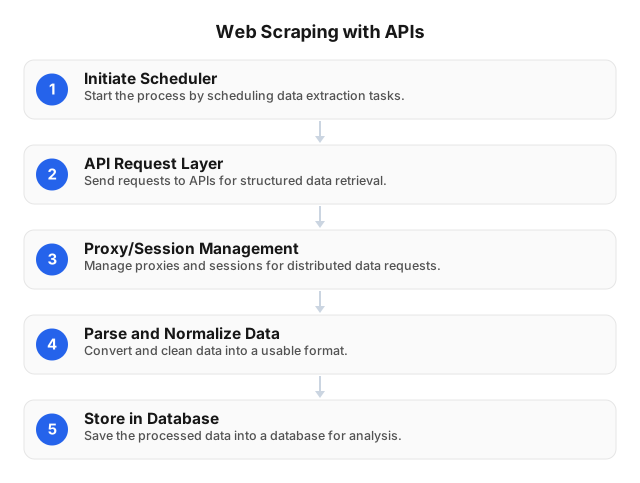
Turning that decision into a production workflow usually requires five layers:
Scheduler
→ API/page request router
→ proxy and session layer
→ parser and schema validator
→ storage, alerts, and reporting
The router decides whether to call an API or collect a public page. The validator checks required fields, types, currencies, timestamps, and null rates. The storage layer records data lineage so analysts know whether a value came from an API endpoint, a public page, or a fallback run.
Example: Localized Price Monitoring
Suppose a pricing team tracks the same product in the US, UK, Germany, and Japan.
- The API provides SKU, base price, seller ID, and inventory status.
- Public pages show localized shipping fees, promotions, tax messages, or delivery estimates.
- The workflow calls the API first.
- If localized fields are missing, it collects the public page from the relevant region.
- The system stores both records and flags conflicts for review.
This avoids scraping every page while still capturing data the API does not provide.
EProxies fits the proxy layer in these hybrid workflows. Use residential coverage for region-specific public data checks, sticky sessions when a workflow needs continuity, rotating sessions when distribution matters, and HTTP(S) or SOCKS5 depending on your client stack. EProxies provides 72M+ residential IPs across 195+ countries, 98.2% uptime backed by a 99.9% uptime SLA, pay-as-you-go residential traffic from $0.25/GB, volume tiers down to about $0.73/GB at 300GB, ISP SOCKS5 from $0.95/IP, and unlimited plans from $79/month.
Workflow Lessons From Real Proxy-Supported Scraping Projects
In EProxies onboarding and support conversations, one pattern appears often: teams rarely fail because they lack a scraper. They fail because retries, quotas, routing, and session rules were added too late.
One anonymized retail data team originally scraped every product page every hour. A better design was to call available APIs for stable fields, cache unchanged product records, and reserve proxy-backed page checks for regional promotions and missing values. That reduced unnecessary page requests and made errors easier to diagnose because API failures, proxy/network failures, and parser failures were logged separately.
Another common case is market research across cities. API responses may provide structured listings, but visible pages can differ by location, language, or session state. In that setup, city-level routing and sticky sessions are valuable for verification, not for every request in the pipeline.
The lesson: proxy infrastructure improves reliability when paired with selective collection, not when used to brute-force a poorly designed workflow.
Best Practices for Maximizing Efficiency
1. Route by Field, Not by Habit
Before building a scraper, list the fields you need and choose the best source for each one.
| Field | Best source | Why |
|---|---|---|
| Product ID | API | Stable identifier |
| Current price | API or page | Depends on freshness and region |
| Promo banner | Public page | Often not exposed by API |
| Review count | API | Easier pagination |
| Local shipping message | Public page | Region-specific |
This prevents over-scraping and makes the system easier to maintain.
2. Treat Rate Limits as Architecture Requirements
Do not wait for 429 Too Many Requests errors to design throttling. Build request queues by endpoint, region, account, and priority. Use exponential backoff for temporary failures, and stop retrying when errors are caused by authentication, permissions, or invalid parameters.
Track:
- Requests per endpoint
- Success rate
- Retry count
- Cost per successful record
- Token expiration events
- Schema validation failures
- Records rejected by business rules
3. Validate Schemas Continuously
APIs are structured, but not permanent. Add checks for missing fields, unexpected nulls, new enum values, currency changes, timestamp formats, and duplicate IDs.
A schema alert is cheaper than discovering three days later that a dashboard was built on broken data.
4. Use Proxies Where They Add Value
Residential proxies are useful for compliant public web data collection, localization testing, and session-sensitive workflows. They are not a substitute for respecting robots.txt, site terms, privacy rules, or API limits.
If your workflow needs broader proxy architecture decisions, compare options in Residential or Datacenter Proxies? 2026 Guide. For automation controls, see how to automate web scraping without getting blocked.
5. Measure the Full Pipeline
Do not optimize only for request speed. Measure the metric that matters:
Successful validated records ÷ total attempted records
Then break failures into categories: API quota, authentication, network/proxy, parsing, schema mismatch, duplicate, and business-rule rejection. This gives engineering, data, and operations teams the same language for improvement.
Future Trends in API and Web Scraping Integration
Web data collection is becoming more selective, automated, and compliance-aware. The strongest teams will not simply scrape more; they will decide better.
API-First Routing Will Become Standard
Pipelines will increasingly check whether a permitted API exists before launching browser automation. Scraping will remain important, but more often as a fallback, verification layer, or localization layer.
AI Will Assist Extraction and Monitoring
AI-assisted systems can help detect page structure changes, infer fields from semi-structured pages, and flag suspicious data shifts. The best use is not “AI scrapes everything,” but “AI identifies when the source changed and what needs review.” Industry forecasts for AI-driven scraping point to high-teens annual growth, which reflects how quickly teams are adding automation to extraction and monitoring workflows.
Schema and Quota Observability Will Matter More
Teams will monitor API schemas the way they monitor uptime. Expect more dashboards for field drift, endpoint latency, token health, quota burn, retry volume, and cost per usable record.
Hybrid API, Browser, and Proxy Workflows Will Mature
A single data product may use APIs for core records, headless browsers for JavaScript-only pages, and residential proxies for region-specific public verification. Proxy selection will become more precise: rotating sessions for distributed collection, sticky sessions for continuity, and ISP SOCKS5 where stable identity is required.
Compliance Will Become a Design Constraint
Privacy laws, platform terms, consent rules, and internal audit requirements will continue shaping scraping architecture. Expect more logging, access controls, retention limits, and reviews before data enters production systems.
FAQ
What are the best practices for integrating APIs into web scraping?
Start with an API-first field map: identify which fields should come from official or permitted endpoints and which require public-page collection. Build throttling, authentication handling, retries, schema validation, and audit logs before scaling volume. Use proxies on the scraping side when you need compliant regional routing, session continuity, or localization checks.
How can APIs be strategically used to enhance web scraping?
Use APIs to collect stable, structured fields such as IDs, prices, inventory, reviews, or listing metadata, then scrape public pages only for gaps such as localized messages, visual content, or promotional elements. This reduces page loads, browser rendering, selector maintenance, and bandwidth waste. Strategically, APIs should act as the primary data source, while scraping becomes a targeted enrichment and verification layer.
What future trends are expected in the integration of APIs and web scraping?
Future workflows will be API-first, using official or permitted endpoints where possible and scraping public pages only when APIs are incomplete or unavailable. AI will increasingly help detect schema drift, page changes, and extraction errors, while observability tools will track quota use, cost per record, latency, and data freshness. Hybrid systems combining APIs, browser automation, and proxy routing will become more common, with stronger compliance controls built into the pipeline.
Are APIs always better than traditional web scraping?
No. APIs are usually better when they provide complete, fresh, and permitted access to the data you need. Traditional scraping is still useful for public pages, localization checks, visual content, promotional fields, or data not exposed through an API.
How do APIs reduce scraping costs?
APIs reduce costs by cutting unnecessary rendering, bandwidth, parsing, and selector maintenance. However, teams still need to track API fees, quota limits, pagination volume, and retries. The most useful metric is cost per successful, validated record, not raw request count.
Where do proxies fit in API-based scraping?
Proxies are most useful when workflows need regional routing, session continuity, or compliant public-page collection alongside API calls. In hybrid data pipelines, they support the location-aware scraping and verification layer rather than replacing API access.
What is the safest way to combine APIs and scraping?
Start with API documentation, site terms, and applicable laws. Use APIs for structured access, scrape only permitted public data when necessary, throttle requests, validate schemas, and keep audit logs. A responsible workflow should minimize load on target sites and avoid collecting sensitive or restricted data.
This article was written by the EProxies team and reviewed against our editorial quality standards before publishing.