
How Proxy Sharding Can Enhance Performance in 2026
TL;DR: Proxy sharding divides traffic into isolated pools by target, location, session type, or workload. Start with 3–6 shards, give each its own concurrency and retry budget, and canary 5%–10% of traffic. Success means higher valid-result throughput and lower p95/p99 latency, queue age, retry volume, bandwidth per valid result, and cost per valid result—not merely more HTTP 200 responses.
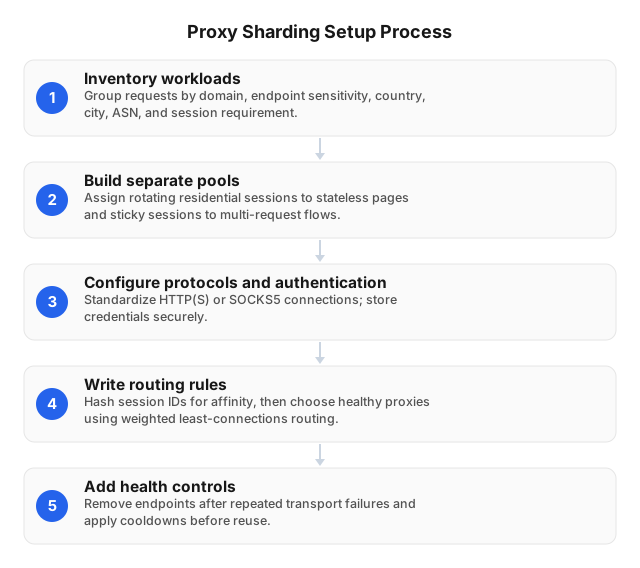
How Proxy Sharding Works
A sharded proxy system makes two routing decisions:
- Select a shard based on the target, required geography, session type, and workload priority.
- Select a route within that shard based on health, latency, active connections, and recent failures.
Useful shard keys include:
- Target domain or endpoint group
- Country, region, city, or ASN
- Rotating, sticky, or static session
- Interactive, batch, or retry traffic
- Public-page or authenticated workflow
A retail pipeline might use catalog-us-rotating, catalog-fr-rotating, and checkout-us-sticky. If the French catalog begins returning HTTP 429 responses, its queue, retries, and circuit breaker remain isolated, while US catalog and checkout workers continue processing.
For stateful traffic, derive a stable key:
shard_key = hash(target + geography + account_id)
Use rendezvous or consistent hashing instead of hash % shard_count. Adding a shard under modulo routing changes assignments broadly, whereas consistent hashing limits movement. Bind the cookie jar, locale, account identity, and shard assignment together so failover cannot silently change the country or session identity.
Where Sharding Improves Performance
With those routing boundaries in place, sharding improves fleet performance by containing contention and assigning capacity to compatible work. It does not reduce the network time of an individual proxy.
Capacity and retry isolation
Assume 500 workers share three workloads. If one target stalls for 20 seconds, it can occupy all 500 connections even when the other targets normally complete in two seconds.
Allocating 100, 200, and 200 workers caps the stalled target at 100 connections. Each shard should have independent limits for:
- Active requests and requests per second
- First attempts and retries
- Maximum queue age
- Per-account concurrency
- Circuit-breaker state
Reserve retry capacity. A 200-worker shard could allocate 160 workers to first attempts and 40 to retries; once those 40 are occupied, additional retries wait or fail instead of displacing new work.
Location and session control
Geographic shards keep location-sensitive requests on compatible routes. This matters for localized prices, inventory, search rankings, language, and availability.
EProxies lists 72M+ residential IPs across 195+ countries. Treat that figure as the scope of the network rather than a sizing value for a particular target-location pair: benchmark each required country, city, or ASN against the actual target before reserving capacity.
Define fallback based on the data requirement:
| Requirement | Fallback policy |
|---|---|
| Exact city required | Queue or fail closed |
| Country required, city preferred | City → country |
| Region acceptable | City → country → approved region |
| Authenticated session | Same geography and compatible sticky route |
Silent geographic fallback can produce a valid page with the wrong currency or inventory. Application validation must reject that result.
Use rotating sessions for independent requests. Bind authenticated workflows, carts, and multi-step transactions to a sticky or static identity until completion. See How to Avoid IP Bans When Web Scraping in 2026 for request-rate and identity controls.
Main Design Risks
The same boundaries that provide isolation can also fragment capacity, create hotspots, or complicate session and retry handling.
Fragmentation and hotspots
A fixed shard can queue work while a compatible shard sits idle. Give each shard a reservation and a borrowing ceiling—for example, 100 reserved workers plus up to 30 idle workers borrowed from compatible pools.
Hashing balances keys, not traffic. One account producing 20% of all requests remains a hotspot even under a uniform hash. Track throughput, active connections, and queue age by routing key; split search-us into interactive and batch traffic before creating shards for individual URLs.
Session movement
Rebalancing can move a sticky session to a different identity. Drain stateful routes before removal: stop new assignments, wait for existing sessions to finish or reach a deadline, and then remove the route.
Retry amplification
Application and proxy retries can multiply attempts. Assign retry ownership to one layer or pass a shared attempt counter between layers. Use jittered backoff, with delays near 1, 2, and 4 seconds as a practical starting point.
Do not retry invalid credentials, malformed requests, or permanent authorization failures. For rate-limit handling, see How to Mitigate Proxy Speed Throttling in 2026.
False success signals
An HTTP 200 response may contain a CAPTCHA, login redirect, empty dataset, or wrong locale. Classify results as:
- DNS, TCP, TLS, or timeout failure
- HTTP 403, 429, or 5xx
- Challenge or login response
- Structurally invalid payload
- Wrong geography or locale
- Valid result
Validate a required JSON field, page marker, currency, locale, or minimum record count. How to Avoid CAPTCHA with Proxies: 2026 Guide covers challenge-specific controls.
Implementation Runbook
The following runbook turns those routing, capacity, and validation requirements into an initial deployment.
1. Inventory measured demand
Record each workload’s target, location requirement, session behavior, peak requests per second, peak concurrency, request duration, timeouts, retryable outcomes, and maximum queue age. Size for measured peaks rather than daily averages: 20 requests per second on average is irrelevant if the workload reaches 150 for ten minutes.
2. Create 3–6 coarse shards
Start with operational boundaries such as:
retail-us-rotatingretail-fr-rotatingaccounts-us-stickysearch-uk-interactivesearch-uk-batch
Create a shard only if it needs separate capacity, session handling, fallback, retry policy, or monitoring.
3. Configure routing and budgets
EProxies supports HTTP(S) and SOCKS5. Use HTTP(S) for web clients with native proxy support; use SOCKS5 for protocol-agnostic TCP routing or proxy-side DNS.
For a 100-worker shard, an initial policy could be:
- 80 first-attempt workers and 20 retry workers
- 10-second connect timeout
- 30-second read timeout
- 60-second maximum queue age
- Three total attempts
- Circuit opening after 20 transport failures in 60 seconds
- Five half-open probe requests before recovery
Tune thresholds to shard volume. Twenty failures are meaningful at 100 requests per minute but may be noise at 10,000.
4. Canary before rebalancing
Route 5%–10% of eligible traffic through the new shard map while keeping the control group’s targets, locations, payloads, headers, concurrency, and timeouts equivalent. Increase through 10%, 25%, 50%, and 100% only if predefined thresholds hold through peak traffic and a route-rotation cycle.
How to Measure Proxy Sharding
During and after the canary, compare sharded traffic with an unsharded control and report results by shard; fleet averages can hide a failing country or target.
| Metric | Calculation |
|---|---|
| Valid-result rate | Valid results ÷ completed jobs |
| Valid-result throughput | Valid records completed per minute |
| p95/p99 latency | End-to-end time, including queueing |
| Retry rate | Retried jobs ÷ total jobs |
| Queue age | Enqueue time to first attempt |
| Block rate | 403, 429, challenge, and policy-denied responses |
| Bandwidth per valid result | Transferred GB ÷ valid results |
| Cost per valid result | Proxy, compute, and retry cost ÷ valid results |
| Affinity violations | Stateful jobs moved to incompatible identities |
| Fallback rate | Jobs served by a less-specific location or network |
Example: increasing valid-result throughput from 800 to 920 records per minute while reducing retries from 18% to 9% is a useful gain. If traffic rises from 20 GB to 35 GB per 10,000 valid records, investigate duplicate attempts, large challenge pages, and overlapping retry layers before scaling further.
Use 15-minute windows for incidents and seven-day windows for capacity changes. Roll back if the valid-result rate falls beyond the agreed margin, p99 exceeds the control, affinity violations appear, or cost per valid result rises materially.
Operations and Cost
These measurements should continue after rollout. Expose queue age, active connections, retry utilization, breaker state, valid-result rate, fallback events, and affinity violations per shard. Keep shard, country, target class, and outcome as metric labels; send account IDs, session IDs, and full URLs to logs or traces to avoid uncontrolled time-series cardinality.
EProxies reports 98.2% uptime, backed by a 99.9% uptime SLA. Provider availability does not measure target-specific acceptance, so retain per-shard application probes.
Listed service options include pay-as-you-go residential traffic from $0.25/GB, volume tiers down to approximately $0.73/GB at 300GB, ISP SOCKS5 from $0.95/IP, and unlimited plans from $79 per month. Compare plans using bandwidth and cost per valid result because retries and invalid responses consume traffic without producing usable data.
Store credentials in a secrets manager, redact proxy URLs from logs, and collect only data you are authorized to access. For identity and exposure controls, see Choosing Proxies for Online Anonymity: 2026 Guide.
FAQ
How can I measure the success of proxy sharding?
Run sharded and unsharded traffic against equivalent targets, locations, payloads, concurrency, and timeout policies. Compare valid-result rate, valid-result throughput, p95/p99 latency, queue age, retries, bandwidth per valid result, affinity violations, and cost per valid result for every shard. Count a result only after validating its payload, locale, and required fields—not from HTTP status alone.
What challenges might arise with proxy sharding?
The main risks are fragmented capacity, hot shards, sticky-session movement, multiplied retries, and high-cardinality monitoring. Control them with bounded capacity borrowing, consistent hashing, route draining, one shared retry budget, and low-cardinality metric labels.
Does proxy sharding guarantee lower latency?
No. It reduces queue contention and isolates slow workloads, but target response time, network distance, payload size, and session constraints still determine latency. Verify the effect against a control using p50, p95, and p99 rather than average latency alone.
How large should each shard be?
Calculate capacity from peak concurrency, observed request duration, retry allowance, target limits, and maximum queue age. Add capacity when queue age and utilization remain above defined thresholds; do not infer shard capacity from the provider’s total advertised IP pool.
This article was written by the EProxies team and reviewed against our editorial quality standards before publishing.