
Proxy Usage and Compliance With Global Laws: 2026
TL;DR: A proxy subscription authorizes network access, not the activity carried through it. Before launch, document the purpose, targets, access authority, data fields, jurisdictions, retention, request limits, and provider sourcing; enforce those decisions with allowlists and automatic stop rules. Pause on CAPTCHAs, revoked permission, cease-and-desist notices, or repeated 401, 403, and 429 responses rather than rotating IPs to defeat them.
A proxy changes the source IP and route. It does not create consent, establish a lawful basis for processing personal data, grant access rights, or override contracts and technical restrictions.
Where Proxy Use Creates Legal Risk
Legality depends on what the operator does, not merely whether a proxy is present. Testing a public product page once per day differs materially from distributing thousands of requests across residential IPs after the target returns a 403.
| Risk area | Concrete trigger | Required control |
|---|---|---|
| Unauthorized access | Bypassing authentication, account suspension, an IP block, or CAPTCHA | Stop automatically; resume only after documented authorization |
| Privacy | Collecting names, IP addresses, account IDs, precise locations, or behavioral histories | Record a lawful basis, minimize fields, restrict access, and set deletion dates |
| Contract | Exceeding API limits or violating website, account, or data-license terms | Translate applicable terms into rate, target, and field restrictions |
| Copyright and database rights | Copying protected images, descriptions, reviews, or substantial database segments | Limit content and volume; obtain a license when required |
| Telecommunications | Using restricted proxy, VPN, encryption, or cross-border services | Review rules in both the operator and exit-node countries |
| Sanctions | Serving prohibited parties or routing through restricted territories | Screen customers, beneficiaries, and destinations beyond IP geolocation |
| Endpoint sourcing | Residential devices enrolled without effective notice or authorization | Verify enrollment, withdrawal, audit, and abuse-response records |
Public visibility is not blanket permission for automation. robots.txt can inform crawler behavior, but it does not replace terms review, privacy analysis, access authorization, or direct instructions from the site owner.
Which Laws Can Apply?
No worldwide “proxy law” governs every request. A single job can implicate the operator’s country, exit-node country, target server, data subjects, service provider, and storage destination.
Privacy and cross-border transfers
Under the EU GDPR, identifiers such as IP addresses, cookie IDs, and account IDs can be personal data when linked to an identifiable person. Articles 5 and 6 govern processing principles and lawful bases, while Chapter V covers transfers outside the European Economic Area.
Other relevant frameworks include:
- The UK GDPR and Data Protection Act 2018.
- Brazil’s Lei Geral de Proteção de Dados Pessoais.
- Canada’s Personal Information Protection and Electronic Documents Act.
- China’s Personal Information Protection Law, Cybersecurity Law, and Data Security Law.
- U.S. state privacy laws, including California’s CCPA as amended by the CPRA.
Before collection, specify each retained field, its purpose, lawful basis, recipients, transfer mechanism, and deletion date. Large-scale monitoring, sensitive data, or profiling may require a data-protection impact assessment.
Computer-access laws
The U.S. Computer Fraud and Abuse Act, 18 U.S.C. § 1030, and comparable laws address unauthorized access, although their thresholds differ. High-risk conduct includes using another person’s credentials, entering account-only areas without permission, continuing after access is revoked, or rotating IPs specifically to defeat a technical refusal.
Treat response codes as control signals:
- 401 Unauthorized: stop and verify the account and permission.
- 403 Forbidden: stop; do not evade the refusal through rotation.
- 429 Too Many Requests: honor
Retry-Afterand the approved retry ceiling. - CAPTCHA: pause and send the event for human review.
- Cease-and-desist notice: suspend the entire workflow, not just one IP.
A 429 may permit a delayed retry. It does not authorize immediate distribution of the same workload across 1,000 residential addresses.
Contracts and content rights
Website terms, API agreements, confidentiality clauses, copyright, and database rights can apply even where criminal access laws do not. Record which version of the terms was reviewed, the review date, and the restrictions implemented in code.
The U.S. litigation in hiQ Labs, Inc. v. LinkedIn Corp. illustrates the distinction. The Ninth Circuit found that accessing publicly available profiles did not, on those facts, constitute access “without authorization” under the CFAA, but that ruling did not make public-data scraping universally lawful; contract, copyright, privacy, and other claims remained separate issues.
See Legal Boundaries of Proxy Server Usage in 2026 for a jurisdiction-focused assessment framework.
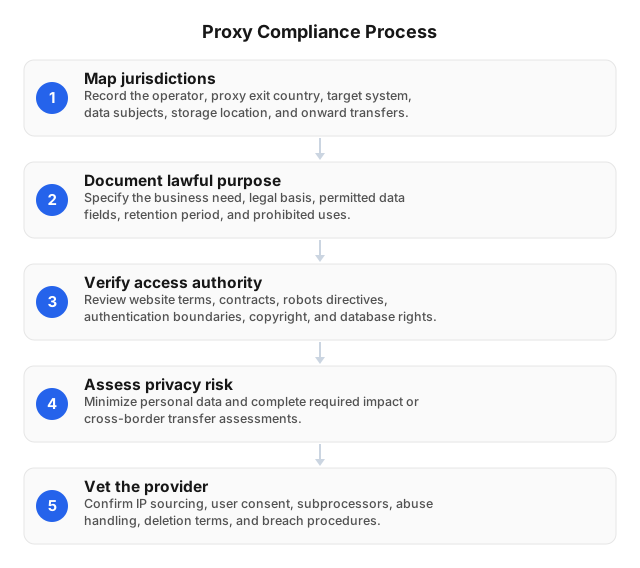
Seven Steps for a Compliant Proxy Workflow
Reapprove the workflow whenever its targets, fields, credentials, provider, routing countries, request pattern, or storage destination change.
1. Map the complete request path
Record the operator, proxy provider, relevant subprocessors, exit country or ASN, target system, account, represented individuals, and storage locations.
For example, a U.S. company using a French exit node to collect information about German residents and store it in Singapore may face obligations in several jurisdictions. The exit IP does not determine the governing law by itself.
2. Define a narrow, testable purpose
Approve “check public product prices in France once every 24 hours,” not “competitive research.” The approval should specify:
- Permitted domains and URL patterns.
- Exact fields to retain.
- Countries, cities, or ASNs.
- Requests per minute, concurrency, and retry ceiling.
- Retention and deletion dates.
- Business, legal, and technical owners.
- Explicitly prohibited actions.
Bind the approval ID to the executable configuration. A user should not be able to add a domain or country during a run.
3. Verify access authority
Review contracts, website terms, API rules, licenses, credentials, authentication boundaries, and previous notices. Use a domain allowlist and fail closed when a redirect reaches an unapproved hostname.
Document whether the workflow uses public pages, authorized accounts, or an API. Never reuse credentials obtained for a different customer, environment, or purpose.
4. Minimize data before storage
Discard unnecessary fields in the collection pipeline rather than storing everything and deleting selected fields later. Exclude names, reviews, account IDs, precise locations, and persistent identifiers unless the approval expressly covers them.
Use TLS, encryption at rest, named accounts, least-privilege roles, key rotation, and automated deletion. Keep completion logs showing that scheduled deletion actually ran across primary storage, exports, and backups.
5. Vet endpoint sourcing
Ask the provider to document:
- How residential endpoints enter the network.
- What notice participants receive.
- How authorization is recorded and withdrawn.
- Which subprocessors handle traffic or account data.
- Connection-log retention periods.
- Abuse, complaint, and incident procedures.
- Location-blocking and customer access controls.
- Breach-notification commitments and available audits.
EProxies offers 72M+ residential IPs across 195+ countries, HTTP(S) and SOCKS5, and 98.2% uptime backed by a 99.9% uptime SLA. Options include pay-as-you-go residential access from $0.25/GB, an approximately $0.73/GB 300GB tier, ISP SOCKS5 proxies from $0.95/IP, and unlimited plans from $79/month. Network coverage and pricing do not replace approval of each target and purpose.
6. Encode rate and stop controls
A public-price policy might permit one request per product URL every 24 hours, two concurrent connections per domain, one delayed retry after a 429, and no retry after a 403. Set these controls in the client or gateway rather than relying on operator judgment during a run.
For field-selection and collection architecture, see how proxy servers facilitate data mining efforts.
7. Log evidence and investigate exceptions
Record the approval ID, operator, timestamp, target domain, exit country and IP, HTTP method, response class, request count, retries, retained fields, stop events, and deletion events. Alert on new domains, unapproved countries, credential failures, traffic spikes, and repeated denials.
High-risk jobs should use tamper-resistant logs and prevent operators from disabling stop rules. A complaint must be traceable to the exact request, configuration version, and approval.
Workflow-Specific Controls
Regional software testing
Approve the exact environment, test account, exit location, expected request count, and retained evidence. Keep screenshots and response metadata, but remove customer identifiers unless a documented test case requires them.
Target-side IP allowlisting and named credentials provide stronger authorization evidence than unrestricted proxy access. Do not use production customer accounts for localization tests.
Social media operations
Assign separate credentials and least-privilege permissions to each authorized team. Platform terms and written account authority should define permitted posting, moderation, and analytics actions.
Do not rotate residential IPs to conceal prohibited automation or operate unauthorized accounts. Scaling social media campaigns safely explains account separation, request limits, and escalation controls.
Audit-Ready Checklist
| Control | Evidence to retain |
|---|---|
| Purpose | Specific use case, owner, targets, and prohibited actions |
| Jurisdictions | Operator, exit, target, data-subject, storage, and transfer locations |
| Authority | Contract, license, terms review, credentials, and access boundaries |
| Data | Approved fields, lawful basis, recipients, retention, and deletion logs |
| Provider | Endpoint sourcing, notice, withdrawal, subprocessors, and abuse handling |
| Routing | Approved countries, cities, ASNs, and blocked locations |
| Security | Named accounts, least privilege, encryption, allowlists, and key rotation |
| Requests | Rate, concurrency, retry ceiling, and stop conditions |
| Monitoring | Request records, response codes, complaints, alerts, and incidents |
| Reapproval | Review date, configuration version, and change triggers |
If a target, field, account, or route is absent from the approval, the system should not send the request.
FAQ
What steps should I take to comply with proxy laws?
Map every jurisdiction and data flow, define a narrow purpose, verify access authority, identify applicable privacy and content rules, and vet how the provider sources residential endpoints. Then enforce domain and country allowlists, field minimization, rate limits, retention schedules, auditable logs, and automatic stops for CAPTCHAs, access denials, or revoked permission. Have qualified counsel review high-risk workflows involving personal data, restricted jurisdictions, authenticated systems, or large-scale collection.
What are the legal risks of using proxies?
Exposure can arise under computer-access, privacy, contract, copyright, database, telecommunications, sanctions, and consumer-protection laws. Consequences may include account termination, injunctions, damages, regulatory penalties, breach-notification duties, and criminal investigation where unauthorized-access statutes apply.
How can I ensure my proxy usage is compliant?
Convert the legal approval into technical controls: approved targets, fields, locations, credentials, request rates, retries, retention periods, and stop conditions. Reapprove the workflow after any change to the provider, target, routing, data, authentication, volume, or storage destination.
What are the global laws regarding proxy usage?
There is no single global proxy statute. Depending on the workflow, relevant rules may include the EU or UK GDPR, the U.S. CFAA and state privacy laws, Brazil’s LGPD, Canada’s PIPEDA, China’s privacy and cybersecurity laws, sanctions, telecommunications restrictions, copyright, database rights, and contracts.
Is using a residential proxy legal?
Residential proxies are not inherently legal or illegal; legality depends on endpoint sourcing, authorization, purpose, target, data handling, and jurisdiction. Verify that endpoint participants received clear notice, validly authorized participation where required, and can withdraw.
Does IP rotation make web collection compliant?
No. Rotation changes request distribution but does not create permission, establish a lawful basis, or override access controls. A denied request should trigger a stop or review, not faster rotation.
What should happen after a CAPTCHA or access denial?
Pause the workflow and preserve the response, timestamp, target, exit IP, request history, and approval ID. Resume only after confirming that further access is authorized; do not automate CAPTCHA solving or switch identities to bypass the denial.
How often should proxy workflows be reviewed?
Review high-risk workflows involving personal data or multiple jurisdictions at least quarterly. Trigger immediate reapproval after changes to terms, authentication, fields, routing, provider sourcing, subprocessors, storage, or request volume, and suspend the job after a complaint or security incident.
This article was written by the EProxies team and reviewed against our editorial quality standards before publishing.