
How Proxy Servers Facilitate Data Mining Efforts in 2026
TL;DR: Proxy servers route authorized data-mining requests through alternate IP addresses, enabling regional collection, controlled request distribution, and stable sessions. Use rotating residential proxies for independent localized pages, sticky residential or ISP proxies for stateful workflows, and datacenter proxies only where the target accepts them. Choose by valid-record rate, location accuracy, latency, and total bandwidth cost—not pool size alone.
Proxies do not authorize access to authenticated pages, paywalls, or protected systems. Before collecting public web data, review the source’s terms, robots directives, contractual restrictions, and applicable privacy laws.
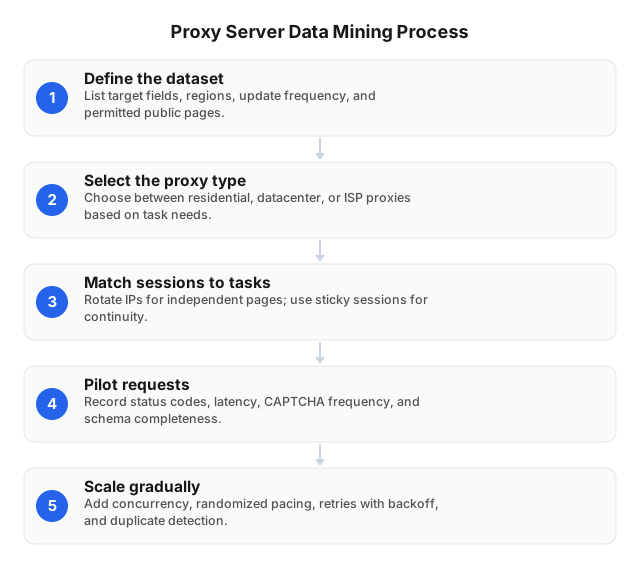
How Proxy Servers Support Data Mining
A proxy forwards a crawler’s request through another IP address. The destination sees the proxy IP rather than the worker’s direct address, which provides three practical controls:
- Request distribution: Divide permitted collection jobs across multiple connections instead of sending an entire crawl through one IP.
- Geographic routing: Request public content from the country or city being researched.
- Session management: Rotate IPs between independent pages or retain one IP for cookies, pagination, and other stateful sequences.
For example, a retailer comparing public product pages in France, Japan, and Canada may receive different currencies, inventory, languages, and shipping options in each market. Country-targeted residential proxies let the crawler request each storefront from the relevant region and store the requested and observed locations separately.
Residential proxies fit sources that localize content or distinguish consumer networks. ISP proxies provide persistent IPs for longer sessions. Datacenter proxies can deliver lower-cost throughput where residential routing is unnecessary and the source accepts datacenter traffic.
Rotating vs. Sticky Sessions
Use rotating sessions when every request can succeed independently:
- Unrelated product detail pages
- Separate public search queries
- Stock checks across different SKUs
- Sampling URLs from multiple regional storefronts
Use sticky sessions when later requests depend on earlier ones:
- Paginated category pages
- Cookie-based currency or language settings
- Multi-step public search forms
- Regional journeys that must retain one network identity
Set continuity to the job’s actual duration. A ten-page category sequence may need a five-minute session, while a browser-based research workflow may need longer. Switching IPs midway through either sequence can reset localization, invalidate cookies, or create duplicate records.
Rotation does not replace rate limiting. Apply per-domain concurrency limits, honor Retry-After, and pause queues that repeatedly return HTTP 403 or 429 responses.
Steps to Set Up a Proxy for Data Mining
- Define the permitted dataset. Record the source URLs, required fields, target regions, refresh interval, and retention period. Exclude personal or protected data the project does not require.
- Choose the proxy type. Start with residential proxies for localized content, ISP proxies for persistent identity, or datacenter proxies for compatible high-throughput sources.
- Configure the protocol. Use HTTP(S) for standard crawlers and browser automation. Use SOCKS5 when the client needs a general-purpose proxy connection; SOCKS5 does not encrypt application traffic by itself.
- Add authentication securely. Load the proxy host, port, username, and password from environment variables or a secrets manager—not source code.
- Set the session policy. Rotate between independent URLs. Reuse one session identifier for pagination, cookies, or multi-step journeys.
- Set domain controls. Configure concurrency, request deadlines, exponential backoff, and a finite retry budget.
- Pilot 100–500 URLs. Include every required country, page type, and rendering method.
- Validate records. Measure HTTP status, latency, transferred bytes, parser success, location accuracy, duplicate rate, and required-field coverage.
- Scale gradually. Increase concurrency in stages while monitoring 403, 429, timeout, and incomplete-record rates.
- Checkpoint completed work. Store URL IDs and page tokens so interrupted workers resume without repeating a full batch.
Calculate efficiency with:
cost per valid record = total proxy cost ÷ complete, correctly localized, deduplicated records
An HTTP 200 response containing a consent page, login prompt, empty template, or wrong-market storefront is not a valid record.
Choosing the Best Proxy Type
No proxy category is best for every data-mining target. Match the connection to the source’s localization, session, and throughput requirements.
| Requirement | Practical starting point | Pilot validation |
|---|---|---|
| Country-specific prices or inventory | Rotating residential | Currency, inventory region, language |
| City-level public search results | City-targeted residential | Requested city vs. observed location |
| Pagination or cookie-based workflow | Sticky residential or ISP | Cookie continuity, duplicates, page tokens |
| Persistent network identity | ISP SOCKS5 | IP stability and client compatibility |
| Non-localized, compatible public source | Datacenter | Throughput, block rate, TLS handling |
| Many independent regional pages | Rotating residential | Valid-record rate and GB per record |
EProxies provides 72M+ residential IPs across 195+ countries with HTTP(S) and SOCKS5 support. Coverage still needs market-level testing: a global pool count does not establish available capacity or performance in a particular city, network, or target domain.
For a broader selection framework, see the Guide to Choosing the Best Proxy for Your Needs: 2026.
Performance, Reliability, and Cost
Log these fields for every attempt:
| Field | What it diagnoses |
|---|---|
| Domain and URL class | Source-specific failures |
| Requested and observed region | Localization mismatches |
| Session ID | Breaks in stateful journeys |
| HTTP status | Throttling, denials, and server errors |
| Total latency | Slow connections or rendering |
| Transferred bytes | Bandwidth cost |
| Parser result | Transport success vs. usable data |
| Retry reason | Waste and retry loops |
EProxies has 98.2% uptime and is backed by a 99.9% uptime SLA. An SLA does not remove the need for durable queues, request deadlines, checkpoints, and multiple workers; production crawlers must tolerate temporary connection and target-side failures.
Handle failures by cause:
- 429: Honor
Retry-After, lower concurrency, and use exponential backoff. - 403: Pause the queue and inspect authorization, request headers, region, and session behavior.
- 5xx: Retry a limited number of times because the destination may be unavailable.
- Timeout: Check page weight and rendering time before opening a fresh connection.
- Parser failure: Save a sanitized response sample; changing IPs will not repair obsolete selectors.
The How to Avoid IP Bans When Web Scraping in 2026 guide covers request pacing and throttling controls in more detail.
Estimate bandwidth with a pilot
Measure compressed transferred bytes rather than HTML size alone. Browser automation may load scripts, fonts, images, analytics endpoints, and video.
A job covering 500,000 pages at 400 KB per page transfers about 200 GB before retries. If 10% of requests are repeated at the same size, retries add approximately 20 GB.
EProxies pricing options include:
- Pay-as-you-go residential traffic from $0.25/GB
- Residential tiers at approximately $0.73/GB for 300 GB
- ISP SOCKS5 proxies from $0.95/IP
- Unlimited plans from $79/month
Compare plans using cost per valid record. Cheap traffic becomes expensive when wrong-region pages, consent screens, or incomplete responses increase retries.
Data-Quality Failure Modes
HTTP 200 with unusable content
Validate page-specific markers before storage. A retail record might require a matching SKU, expected currency, numeric price, stock field, correct storefront, and collection timestamp.
Location mismatch
Currency alone is insufficient because a site may retain a previous market in a cookie. Start a clean session and verify the shipping destination, language, country selector, and storefront domain.
Duplicate or broken pagination
Keep one sticky session for the sequence and save each page token after a successful response. Rotate only after the sequence ends or the session fails.
Excessive retries
Set a retry budget per URL—for example, one retry after a timeout and two delayed retries after temporary 5xx responses. Send exhausted jobs to a review queue instead of retrying indefinitely.
Parser changes mistaken for proxy failures
If the correct document arrives but fields disappear, inspect the HTML, embedded JSON, and JavaScript execution. A changed schema requires a parser update, not another IP.
For retail-specific validation patterns, read Best Practices for E-Commerce Web Scraping in 2026.
Security and Compliance Controls
Store proxy credentials in a secrets manager and rotate them after staff changes or suspected exposure. Redact passwords, authentication headers, cookies, session tokens, sensitive query strings, and unnecessary response bodies from logs.
HTTPS protects client-to-destination traffic when certificate validation is configured correctly. SOCKS5 routes traffic but does not provide encryption by itself. Infrastructure guidance is available in How-to-Secure-Your-Data-with-Datacenter-Proxies.
Document each job’s purpose, sources, fields, retention period, and deletion schedule. Stop collection when the source requires authentication, presents an access restriction, or prohibits the planned use.
FAQ
What are the steps to set up a proxy server for data mining?
Choose a residential, ISP, or datacenter proxy based on localization and session requirements; then configure its host, port, protocol, and credentials in the crawler. Set rotation or sticky-session rules, add per-domain concurrency limits and finite retries, and test 100–500 representative URLs. Scale only after validating location accuracy, parser completeness, latency, and cost per valid record.
Which proxy server is best for data mining?
A rotating residential proxy is the strongest default for independent pages that require country or city localization. Use a sticky residential or ISP proxy for pagination and cookie-dependent workflows, and use a datacenter proxy for compatible non-localized sources where throughput and cost matter more than consumer-network routing. The final choice should be based on target-level pilot results rather than advertised pool size.
What challenges arise when using proxies for data mining?
Common problems include HTTP 403 or 429 responses, wrong-region content, broken sticky sessions, CAPTCHA or consent pages, bandwidth-heavy browser traffic, and parser failures misdiagnosed as network failures. Control them with domain-level rate limits, location validation, finite retry budgets, session-aware queues, and required-field checks. Legal restrictions and data-retention obligations also apply regardless of the proxy used.
What is a proxy server in data mining?
A proxy server forwards a crawler’s authorized request through another IP address before it reaches the destination. It can distribute requests, return location-specific public content, or preserve one network identity during a stateful sequence. It does not grant permission to bypass authentication, paywalls, access controls, or website restrictions.
Which proxy protocol should a crawler use?
HTTP(S) is the standard option for web requests and browser automation. SOCKS5 supports additional traffic types and clients, but applications must still use HTTPS or another secure protocol because SOCKS5 does not encrypt application data.
How should proxy performance be tested?
Run representative URLs through the planned regions, crawler, rendering mode, and concurrency settings. Measure complete-record rate, observed location, latency, transferred bytes, 403 and 429 rates, duplicate frequency, and parser coverage. Use those results to calculate cost per valid record before committing to production volume.
This article was written by the EProxies team and reviewed against our editorial quality standards before publishing.