
Best Practices for E-Commerce Web Scraping in 2026
TL;DR: Build e-commerce scraping around documented collection rights, a typed product schema, conservative per-domain request limits, and field-level validation. Measure cost per fresh, validated record—not requests or gigabytes—and stop on CAPTCHAs, repeated 403s, or authentication barriers. Preserve source context, separate raw captures from normalized data, encrypt both, and enforce retention automatically.
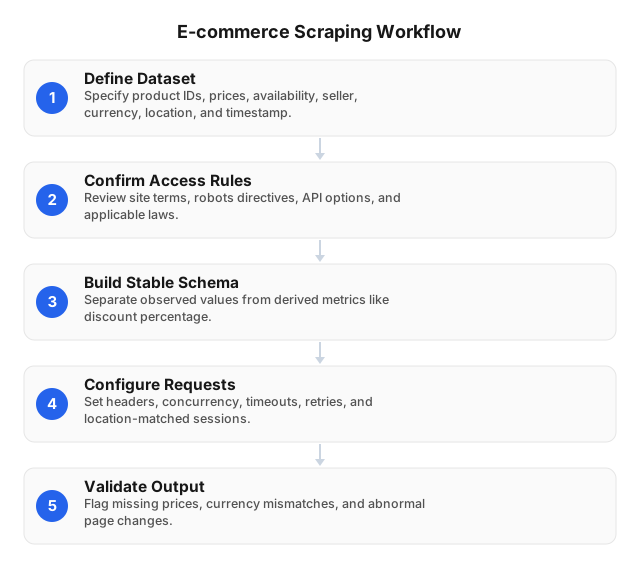
What E-commerce Web Scraping Collects
E-commerce scraping converts authorized storefront content into structured observations for price monitoring, inventory tracking, assortment analysis, and regional research. Each observation needs enough context to distinguish a genuine commercial change from a different seller, variant, locale, delivery destination, or parser version.
A practical record contains:
- retailer, canonical URL, and collection timestamp;
- SKU, product ID, or another stable identifier;
- title, brand, category, seller, and variant;
- current price, reference price, currency, and unit;
- stock status and delivery destination;
- country, city, language, and storefront locale;
- parser version, raw-response reference, and validation status.
A 200 OK response proves only that the server returned content. JavaScript rendering, variant selectors, marketplace sellers, promotions, regional catalogs, and template changes can still produce plausible but incorrect records.
Define the decision before defining the crawler. Daily comparisons across 10 retailers require a different schedule and schema from 15-minute availability checks for 500 limited-stock SKUs.
Confirm Collection Rights Before Building
Public visibility does not automatically permit unrestricted collection, storage, or republication. Review site terms, robots directives, documented API conditions, copyright and database rights, privacy obligations, and applicable computer-access rules for every target and jurisdiction.
Create a written collection specification with:
- approved purpose, domains, and page types;
- fields that may be collected;
- personal, account-only, and other excluded data;
- permitted locations, frequency, and concurrency;
- retention and deletion periods;
- an owner for legal and access escalations.
Treat robots.txt as an operational instruction, not a complete legal determination. Do not bypass authentication, paywalls, CAPTCHAs, or technical access controls. Repeated 401 or 403 responses should stop the target queue; 429 responses should reduce concurrency and extend the schedule.
Collect only fields required by the analysis. Product specifications may be necessary, while reviewer profiles and free-text comments often add privacy risk without improving price or inventory models. See ethical proxy use for web scraping for request controls and data-minimization practices.
Choose the Smallest Effective Stack
Start with a documented API or direct HTTP request. Add browser automation only when permitted data requires client-side execution; browsers consume more memory, bandwidth, and maintenance time than parsing HTML, JSON-LD, or embedded application state.
| Layer | Use it for | Acceptance test |
|---|---|---|
| Documented API | Structured catalog, price, or inventory data | Confirm permitted use, quotas, fields, and regional behavior. |
| HTTP client | HTML, JSON-LD, or embedded JSON | Extract required fields across variants and locales. |
| Browser automation | JavaScript-only content or approved interactions | Measure browser minutes, memory, traffic, and timeout rate. |
| Parser and validator | Typed, normalized records | Test promotions, missing fields, and localized numbers. |
| Proxy layer | Authorized regional storefront views | Verify targeting, protocol, session behavior, latency, and billing. |
| Queue and scheduler | Concurrency, frequency, retries, and budgets | Enforce domain limits, retry caps, and stop conditions. |
If JSON-LD already contains price, currency, availability, and SKU, parse it instead of downloading images, fonts, and unrelated scripts. For permitted API targets, use the implementation patterns in Creating Effective Web Scraping Strategies Using APIs.
Steps to Scrape E-commerce Data
A production workflow should make collection, validation, and failure handling explicit. The following seven steps prevent common defects such as overwritten variants, locale-mismatched prices, infinite retries, and silent record loss.
1. Define a typed schema
Keep observed and calculated values separate. Store source values for current_price, reference_price, currency, unit, seller, and variant; calculate discounts and currency conversions downstream.
Represent size, color, pack quantity, subscription status, and seller explicitly. A page with three sizes and two sellers may require six observations rather than one mutable product row.
2. Build a representative fixture
Select 30–50 pages covering:
- in-stock and out-of-stock products;
- full-price and discounted items;
- multiple variants and marketplace sellers;
- decimal commas, currency symbols, and regional formats;
- subscription, range, and per-unit prices;
- redirected, removed, and temporarily unavailable pages.
Save permitted fixtures with expected field values. Run them after every parser change so a selector update for one template cannot silently corrupt another.
3. Configure request controls
Set connection and read timeouts separately. Retry network timeouts and selected 5xx responses with exponential backoff, jitter, and a fixed attempt cap; do not retry every non-200 response.
Begin with one concurrent request per domain. Increase only after measuring latency, 429 frequency, response size, extraction success, and the target’s stated rules.
4. Match proxy sessions to the task
Use rotating sessions for independent product pages. Use a sticky session when an authorized workflow depends on a stable country, language, cart, or delivery location, and test the available session duration rather than assuming a 24-hour window.
EProxies configurations support HTTP(S) and SOCKS5. The provider-reported network figure is 72M+ residential IPs across 195+ countries; treat that as network-level coverage, not a guarantee that every city, carrier, or target will be available at a given moment. Run a workload-specific trial for the required locations.
Service information for EProxies includes 98.2% uptime backed by a 99.9% uptime SLA. These figures can use different scopes and calculation methods, so review the applicable service, measurement window, exclusions, and credit terms in the current SLA before setting pipeline targets.
5. Extract and normalize
Convert source text into typed values:
$1,299.00becomes amount1299.00and currencyUSD;1.299,00 €requires locale-aware parsing;- availability maps to
in_stock,out_of_stock, orunknown; - unit prices retain displayed quantity and normalized unit;
- prices identify their seller, variant, range, or subscription condition.
Never infer zero inventory from a missing element. Record unknown, attach an extraction error, and quarantine the row for inspection.
6. Validate before loading
Check every batch for:
- required-field null rates;
- currency, language, and location mismatches;
- negative, zero, or implausibly large prices;
- duplicate retailer-SKU-seller-variant-region keys;
- unexpected changes in record count;
- selector, JSON-path, and template failures;
- stale timestamps or unknown parser versions.
Use explicit codes such as PRICE_PARSE_FAILED, VARIANT_MISSING, and LOCALE_MISMATCH. Silent deletion makes parser failures look like genuine product removals.
7. Preserve lineage and history
Link every normalized observation to its source URL, timestamp, locale, delivery context, parser version, validation result, and raw-response identifier where raw retention is permitted. Append observations instead of overwriting them so analysts can reconstruct when a price changed and which parser produced the value.
Handle Failures Without Masking Defects
Proxy rotation can support authorized regional collection and replace failed network sessions. It cannot repair a broken selector, correct a wrong locale, or authorize restricted access.
| Failure | Response |
|---|---|
| DNS, connection, or timeout error | Retry with backoff, then replace the session within the retry cap. |
| 429 response | Reduce per-domain concurrency and increase the interval. |
| 401 or 403 response | Stop the queue and review authorization and target rules. |
| CAPTCHA or challenge page | Stop collection; do not automate circumvention. |
| 200 response with missing fields | Inspect rendering, locale, template, and parser version. |
| Correct product with wrong currency | Pin country, language, destination, and session state. |
| Sudden price collapse across many SKUs | Quarantine the batch and check parsing before publication. |
Do not rotate IPs after extraction failures. A broken CSS selector will fail on every address while consuming more traffic. See Integrating Rotating Proxies in E-commerce: 2026 Guide for session and retry patterns.
EProxies plan options include pay-as-you-go residential traffic from $0.25/GB, tiered residential pricing of approximately $0.73/GB at 300GB, ISP SOCKS5 from $0.95/IP, and unlimited plans from $79/month. Because these products use different commitment and billing models, verify current plan terms and compare cost per validated, fresh record.
Control Cost, Load, and Freshness
Set schedules by field and business deadline. Price and availability may need 15-minute, hourly, or daily checks; dimensions and descriptions may remain useful for a week unless a content hash changes.
Reduce unnecessary work by:
- deduplicating canonical URLs before queueing;
- caching permitted responses during parser development;
- using conditional requests when supported;
- comparing content hashes before expensive parsing;
- fetching only overdue or changed products;
- capping response size and redirect depth;
- disabling images, fonts, and video unless required;
- enforcing daily request, byte, and browser-minute budgets.
Track transport success, extraction success, validation success, and freshness compliance separately. A job with 98% transport success is still defective if only 70% of records contain the correct seller and variant price.
Use How to Automate Web Scraping Without Getting Blocked for additional queue, scheduling, and backoff controls.
Store Scraped Data Securely
Separate raw HTML or JSON from normalized analytical tables. Raw captures may contain incidental personal data, session identifiers, tracking parameters, or headers that are absent from the product dataset, so retain them only when collection and storage are authorized.
Apply these controls:
- TLS in transit and managed encryption keys at rest;
- separate buckets, databases, or schemas for raw and normalized data;
- role-based access with read-only analyst permissions;
- a secrets manager for proxy credentials, cookies, and API tokens;
- audit logs for exports, permission changes, and deletion actions;
- retention periods by data class, enforced with lifecycle rules;
- encrypted backups tested through scheduled restoration.
Strip URL query tokens and unnecessary headers before storage. Maintain a canary set of 10–20 stable products; alert on null-rate spikes, duplicate keys, currency changes, or implausible price movements before a full-catalog run writes corrupted records.
Related Reading
FAQ
What are the steps to scrape e-commerce data?
First, confirm collection rights and define the exact products, fields, locales, and update schedule. Next, build a 30–50-page test fixture, choose an API, HTTP client, or browser, configure request limits, extract typed fields, and validate each batch. Finally, store source context and parser versions, monitor freshness and errors, and stop on CAPTCHAs or repeated access denials.
What challenges might I face in web scraping?
Common problems include JavaScript-only content, markup drift, multiple sellers and variants, localized prices, rate limits, CAPTCHAs, and records that return successfully but contain the wrong currency or delivery context. Legal restrictions, data minimization, storage security, proxy traffic, and browser compute also constrain the design. Address them with representative fixtures, per-domain limits, explicit stop conditions, field-level validation, and versioned observations.
How can I choose the best web scraping tool?
Test candidates against representative products, variants, locales, redirects, and failure states rather than relying on feature lists. Compare field accuracy, JavaScript requirements, retry controls, browser minutes, proxy traffic, validation support, and maintenance time. Choose the simplest tool that consistently meets the required freshness and produces validated records.
What legal issues apply to e-commerce web scraping?
Collection may involve contractual restrictions, copyright, database rights, privacy law, and computer-access rules. Review target terms, robots directives, API conditions, data types, jurisdictions, retention plans, and access controls before collection. Seek qualified legal advice for account-gated pages, personal data, or disputed datasets.
How often should prices and inventory be collected?
Set frequency from product volatility and the decision deadline. Fifteen-minute or hourly checks may suit limited-stock items, while daily price checks and weekly specification refreshes may be sufficient for stable catalogs. Schedule by category and field instead of recrawling every page at the shortest interval.
When should residential proxies be used?
Use residential proxies for authorized research that requires location-specific storefront prices, inventory, or shipping options. Pin country, language, currency, and delivery context to the session, then store those values with every observation. Benchmark coverage, latency, and validation success on the actual permitted targets.
How do I store scraped data securely?
Encrypt data in transit and at rest, separate raw captures from normalized tables, and grant minimum role-based permissions. Remove credentials, cookies, query tokens, and unnecessary personal data before storage; keep secrets in a dedicated manager. Enforce retention through lifecycle deletion, audit exports and permission changes, and test backup restoration.
What should happen after a CAPTCHA or access denial?
Pause collection for the affected target. Record the URL, status code, timestamp, session type, and recent request rate, then review authorization and site rules. Do not treat CAPTCHAs, repeated 403 responses, or authentication barriers as defects to bypass.
This article was written by the EProxies team and reviewed against our editorial quality standards before publishing.