
Web Scraping for Real Estate Insights in 2026
TL;DR: Real estate web scraping works best when you define the market question first, collect only permitted public fields, match proxy geography to the target market, validate every record, and track failures separately from listing changes.
Introduction to Web Scraping for Real Estate
Web scraping for real estate insights turns public listing pages, rental pages, broker inventory, price-history snippets, and neighborhood search results into structured data. The first decision is not the crawler library; it is the analytical question.
Examples:
- Track weekly asking-rent changes for 2-bedroom apartments by ZIP code.
- Monitor price cuts on single-family homes between 1,500 and 2,500 square feet.
- Compare listing velocity across three metro areas.
- Detect relisted properties by matching address, unit number, price, and listing URL.
Useful fields usually include property facts, market fields, source metadata, and collection metadata:
- Property facts: address, beds, baths, square footage, lot size, year built
- Market fields: price, rent, listing status, listing date, price cuts, days on market
- Source fields: listing URL, broker or agent name, page type, timestamp
- Collection fields: proxy country/city, HTTP status, parse status, first seen, last seen
Residential proxies help because real estate sites often return different inventory by city, session, language, and traffic pattern. A rental search from Phoenix may not match the same query from New York. For market research, that difference is data quality, not only access.
Why Residential Proxies Help Real Estate Data Collection
Residential proxies route requests through IPs associated with consumer networks. For real estate scraping, the main benefit is cleaner local sampling: the request path should resemble the market being measured.
Use rotating residential sessions for broad discovery, such as collecting the first page of results across 200 ZIP codes. Use sticky sessions for workflows where continuity matters, such as search page → listing detail → agent panel. Use city-level targeting when search results or inventory counts change by location.
EProxies supports HTTP(S) and SOCKS5, rotating sessions, 24h+ sticky sessions, city and ASN targeting, and 72M+ residential IPs across 195+ countries. The network delivers 98.2% observed uptime, backed by a 99.9% uptime SLA. Pricing includes pay-as-you-go residential traffic from $0.25/GB, tiered residential plans around ~$0.73/GB at 300GB, ISP SOCKS5 from $0.95/IP, and unlimited plans from $79/month.
Do not treat proxy pool size as a substitute for workload testing. Search pages, listing-detail pages, sold-history pages, and agent pages can trigger different throttling and rendering behavior. Measure success rate, response time, CAPTCHA rate, soft-block rate, and parse completeness per page type before scaling.
How to Set Up a Real Estate Scraping Pipeline
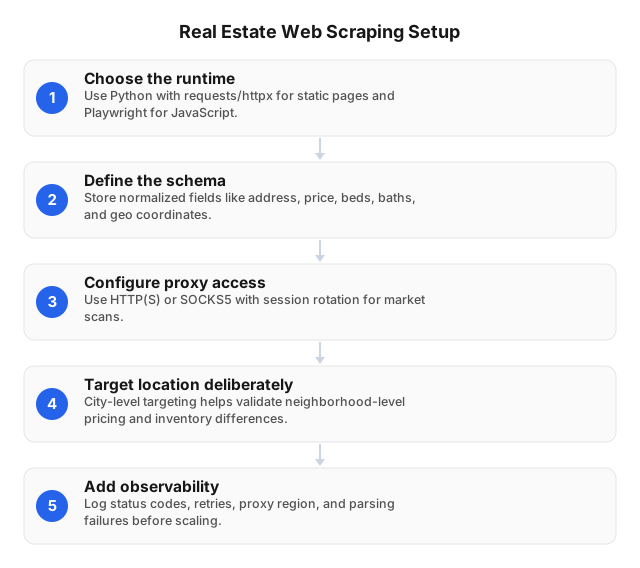
Build the system in four layers: crawler, proxy/session routing, parser, and storage. Keeping these layers separate makes it easier to fix a selector change without rewriting network logic or database code.
1. Define the data contract
Create the schema before writing selectors. At minimum, store:
source_urlproperty_idor normalized listing IDaddresscity,state,zippriceorrentbeds,baths,square_feetlisting_statusfirst_seen_at,last_seen_at,scraped_atproxy_countryorproxy_cityhttp_statusparse_status
A missing price should be recorded as a parse failure, not interpreted as a zero-price listing. This distinction prevents scraper errors from becoming false market signals.
2. Choose the crawler
Use requests, httpx, or another lightweight HTTP client for static HTML pages. Use Playwright only when the target requires JavaScript for map pins, pagination, lazy-loaded listings, or detail panels. Browser automation consumes more CPU, memory, and bandwidth, so reserve it for pages that cannot be collected reliably through direct HTTP.
For reusable automation patterns, see Proxy Scripts for QA Automation: Practical 2026 Guide.
3. Configure proxy routing
Match proxy location to the market when pages are location-sensitive. Use rotating sessions for independent searches and sticky sessions for multi-step paths. Keep headers, cookies, proxy location, and concurrency stable during tests so failures can be traced to one variable.
For broader crawl architecture, EProxies’ guide to Creating Effective Web Scraping Strategies Using APIs covers request design, data flow, and scaling controls.
4. Add observability before scale
Log the fields that explain collection quality:
- HTTP status code
- response time
- proxy country/city
- page type
- retry count
- timeout reason
- CAPTCHA or soft-block detection
- parse completeness
A 200 response is not enough. A page may return a consent screen, empty results, or a soft block while still using HTTP 200. Validate expected fields such as address, price, listing ID, and status before accepting a record.
Legal and Compliance Checks
The proxy is not the legal risk by itself. Risk depends on what you access, whether you are permitted to access it, what fields you collect, and how the dataset is used.
Before collecting real estate data, document:
- Access status: public page, login-required page, paid database, or restricted portal
- Rules: site terms, robots.txt guidance, API availability, contractual limits
- Data sensitivity: names, phone numbers, emails, photos, floor plans, homeowner details
- Use case: internal analysis, pricing model, lead generation, resale, or enrichment
Public listing facts such as price, beds, baths, and square footage carry different risk from personal contact details, copyrighted photos, or account-restricted records. If scraped data will be combined with CRM profiles, advertising audiences, or lead scores, apply privacy review before collection.
A compliant workflow should include rate limits, audit logs, field minimization, access controls, retention limits, and a takedown process. For policy framing, see the ethical use of proxies for web scraping.
Step-by-Step Workflow for Real Estate Scraping
1. Start with one market and one question
Use a narrow test such as: “Track weekly asking-rent changes for 2-bedroom apartments in Phoenix by ZIP code.” Required fields might be rent, beds, baths, square footage, address, ZIP code, listing date, listing URL, and timestamp.
2. Review access rules
Check whether pages are public, whether robots.txt contains crawl guidance, and whether terms restrict automated access or downstream use. Recheck when the source changes its layout, login model, or API availability.
3. Run a small collection sample
Collect 100–500 pages before scaling. Measure response codes, median response time, parse completeness, duplicate rate, and missing-field rate. If 12% of pages lack a price because the selector is brittle, scaling to 100,000 pages only multiplies bad records.
4. Use localized residential sessions
For city-level rental analysis, use city-targeted sessions where available. Rotate between independent searches. Keep sticky sessions for paths that depend on the same session context.
5. Normalize and deduplicate
Standardize prices, dates, square footage, addresses, and status labels. Deduplicate by stable listing IDs when available; otherwise combine normalized address, unit number, price, and source URL. Store first_seen_at and last_seen_at so analysts can distinguish new listings from relisted inventory.
6. Separate scraper failures from market signals
Timeouts, CAPTCHA pages, empty HTML, and missing fields belong in a failure table, not the market table. A sudden inventory drop may be a real market shift, a layout change, a block page, or a broken parser. Logs determine which explanation is supported.
Best Practices for Effective Data Extraction
Treat search pages, listing-detail pages, sold-history pages, and agent pages as separate pipelines. They change at different speeds and expose different fields. A search page may support inventory counts; a listing-detail page may be needed for square footage, amenities, and price history.
Use stable fields first: address, price, beds, baths, square footage, status, listing URL, and timestamp. Add fragile fields, such as amenity text or page-position labels, only after the core dataset is reliable.
Set request rates by source behavior, not crawler capacity. A crawler that can run 50 requests per second may need to run at 1 request per second or lower for a specific source. Build pauses, exponential backoff, concurrency caps, and stop conditions into the job.
Benchmark your own workload. Third-party benchmarks often depend on target mix, test date, request rate, and block-detection method. For real estate scraping, track:
- validated records produced
- complete parses
- duplicate rate
- timeout rate
- soft-block rate
- median and p95 response time
- cost per 1,000 usable records
The metric that matters is validated records produced, not raw requests completed. For block reduction tactics that stay within acceptable-use boundaries, see ethical proxy use for web scraping and How to Automate Web Scraping Without Getting Blocked.
Common Challenges and Fixes
Changing listing layouts
Real estate sites frequently change HTML around price, address, status, and agent fields. Use page-type detection, schema validation, and impossible-value checks. Reject records with a negative price, a ZIP code in the wrong state, or a listing marked both active and sold.
Local inventory mismatch
Search results can vary by user location, saved filters, language settings, and map viewport. Use consistent query parameters and location-matched residential proxies. Store proxy location with each record so analysts can audit mismatched results.
Pagination and map-result limits
Many real estate sites cap visible results per query. Split large markets into smaller searches by ZIP code, price band, property type, or map bounding box. Track overlap so the deduplication layer can remove repeated listings.
Rate limits and soft blocks
Do not rely only on HTTP status codes. Detect soft blocks by checking for listing elements, expected result counts, canonical page titles, and required fields. Lower concurrency, add backoff, and rotate sessions responsibly.
Data drift
A model trained on stale listings will overstate supply or miss price cuts. Store first_seen_at, last_seen_at, and scraped_at. Use change detection so unchanged listings are not reprocessed on every run.
FAQ
What is web scraping in real estate?
Web scraping in real estate is the automated collection of public property and market data from websites. Common fields include price, rent, beds, baths, square footage, listing status, days on market, address, ZIP code, and source URL.
How do I set up a web scraping tool?
Define the data fields first, then choose a crawler, configure proxy routing, write parsers, and store results in a database or warehouse. Start with 100–500 test pages, validate fields such as price and address, and log HTTP status, proxy location, response time, and parse status. Use lightweight HTTP requests for static pages and browser automation only when JavaScript rendering is required.
What are the best practices for web scraping?
Collect only permitted public data, respect site rules, set conservative rate limits, and avoid account-restricted or access-controlled sources without authorization. Validate every record, separate scraper failures from market data, use backoff on errors, and monitor cost per usable record. For real estate, match proxy location to the target market and deduplicate by listing ID or normalized address.
Why use residential proxies for real estate scraping?
Residential proxies help collect location-sensitive public pages through IPs associated with consumer networks. For real estate analysts, that matters when inventory, prices, or search results vary by city, ZIP code, or network context.
How should I set up a real estate scraper?
Start with a schema, then build a crawler, parser, proxy router, and storage layer. Test on a small sample, log every failure, validate parsed fields, and scale only after you can produce complete records consistently.
What legal issues should I check first?
Check whether the pages are public, whether terms or robots.txt restrict automated access, whether the data includes personal or copyrighted content, and whether your intended use is permitted. Avoid account-restricted, paid, or access-controlled sources unless you have authorization.
Are residential proxies better than datacenter proxies for this use case?
Residential proxies are usually better for location-sensitive collection and consumer-facing page behavior. Datacenter proxies can be faster and cheaper for low-sensitivity sources, but they often do not reflect local user access patterns. EProxies offers 72M+ residential IPs across 195+ countries, HTTP(S)/SOCKS5 support, city and ASN targeting, and rotating or 24h+ sticky sessions.
How often should analysts scrape listing data?
Match frequency to the decision. Daily or weekly refreshes may fit pricing and inventory monitoring. One-off market studies may need a snapshot plus a validation pull. Use last_seen_at and change detection to avoid repeatedly requesting unchanged pages.
What metrics should I monitor?
Track validated records, parse completeness, duplicate rate, timeout rate, soft-block rate, median response time, p95 response time, proxy location, and cost per usable record. These metrics show whether the pipeline is producing market data or just traffic.
This article was written by the EProxies team and reviewed against our editorial quality standards before publishing.