
How to Ensure Web Scraping Compliance Globally in 2026
TL;DR: How to ensure web scraping compliance globally starts with a jurisdiction-by-jurisdiction review of access permissions, privacy obligations, database rights, and cross-border data transfers—not the location of your proxy IP. Document the collection purpose, permitted fields, retention rules, and approval conditions before launching.
For data analysts preparing scraping projects in 2026, the regional checklist below separates EU and UK privacy and database-rights checks, US access and state privacy considerations, and jurisdiction-specific requirements elsewhere. Use it to identify what to document and when to escalate to counsel.
Understanding Web Scraping Compliance
Web scraping compliance is the practice of collecting, storing, and using website data within applicable laws, contractual obligations, and access permissions. A publicly visible business directory may still contain protected personal information, while permission to access a page does not necessarily authorize copying, redistribution, or cross-border processing. Public accessibility is not blanket permission to collect or reuse data.
For a data analyst, the review unit should be the dataset and its intended use, not just the target domain:
- Jurisdiction: Map where affected individuals, the website operator, your organization, and processing vendors are located; server location alone does not determine applicable law.
- Data rights: Separate personal data from nonpersonal facts, copyrighted content, and potentially protected databases.
- Access and purpose: Assess site terms, authentication boundaries, collection methods, and downstream uses separately.
Key Global Regulations Impacting Web Scraping
These checks take different forms across jurisdictions. Applicable law depends on whose data you collect, where processing occurs, and your organization’s activities.
In the EU, scraping covered by the GDPR requires a lawful basis. Legitimate interests require a documented necessity and balancing assessment—not merely a commercial purpose. Indirect collection can trigger transparency duties; sensitive data requires an additional legal condition. Database rights may separately restrict extraction.
The UK applies UK GDPR alongside its Data Protection Act. In the US, assess applicable state privacy laws, contractual restrictions, and federal and state unauthorized-access rules.
Brazil’s LGPD and China’s PIPL also impose personal-data obligations, including requirements to assess before transferring scraped personal data internationally. The regional checklist below translates these frameworks into pre-launch checks and evidence requirements.
Steps to Ensure Compliance in Web Scraping
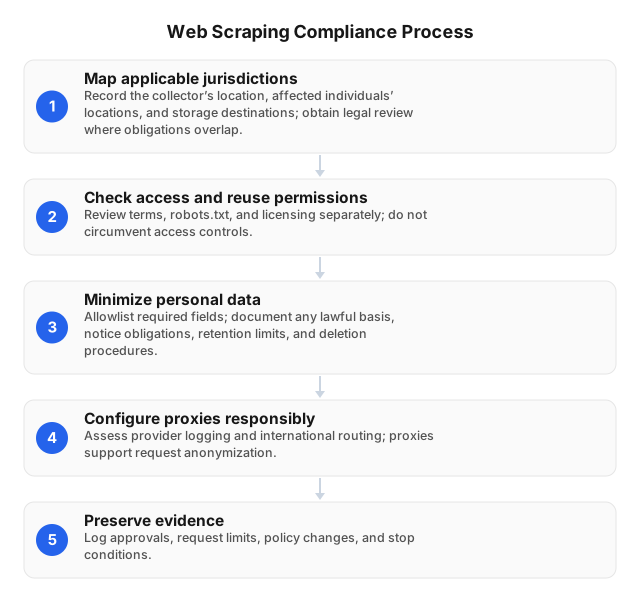
Turn the legal review into a documented decision for each target, data category, and jurisdiction before collection starts, then translate approvals into enforceable crawler settings.
- Map applicable jurisdictions. Record the collector’s location, affected individuals’ locations, and storage destinations; obtain legal review where obligations overlap.
- Check access and reuse permissions. Review terms, robots.txt, and licensing separately. Treat robots.txt as an operational signal, not legal authorization; do not circumvent access controls.
- Minimize personal data. Allowlist required fields; document any lawful basis, notice obligations, retention limits, and deletion procedures.
- Configure proxies responsibly. Proxies mask originating IPs, supporting request anonymization—not guaranteed anonymity or legal compliance. Assess provider logging and international routing.
- Preserve evidence. Log approvals, request limits, policy changes, and stop conditions.
Regional Compliance Checklist
Use this checklist to organize the regional review and retain evidence of its outcome. Noncompliance can trigger significant legal penalties, injunctions, and deletion obligations.
| Jurisdiction | Pre-launch checklist | Evidence to retain |
|---|---|---|
| EU/EEA | Establish a GDPR lawful basis; assess transparency duties, database rights, and international-transfer safeguards. | Basis assessment; notice analysis; transfer documentation. |
| UK | Check UK GDPR, database rights, and applicable UK transfer requirements separately. | UK-specific legal assessment and transfer records. |
| US | Review applicable state privacy laws, contractual restrictions, and unauthorized-access risks; public-data exemptions vary. | State-law mapping; terms review; access authorization. |
| China | Assess PIPL applicability, sensitive-information rules, and outbound-transfer requirements. | Processing justification; applicable transfer assessment. |
| Brazil | Establish an LGPD legal basis; assess transparency, rights handling, and international transfers. | Basis assessment; rights workflow; transfer documentation. |
Tools and Resources for Compliance
To put these regional decisions into practice, connect each scraping job to its approved purpose, source permissions, data fields, retention policy, and legal review. Use a versioned approval register as the launch gate, supported by official regulatory guidance and automated checks.
For regional research, bookmark EUR-Lex and European Data Protection Board guidance, the UK ICO, California’s privacy regulator, Brazil’s ANPD, and Singapore’s PDPC. Record the source URL, review date, applicable jurisdiction, and unresolved questions; route interpretation to qualified counsel.
Configure collection pipelines to flag unexpected personal data, restrict exports, and enforce approved deletion schedules. Archive dated terms and robots.txt snapshots as review evidence. Require renewed approval when a target domain, requested field, collection purpose, or processing location changes.
Common Mistakes and How to Avoid Them
Even with these controls in place, mistakes can arise when teams misread routing choices, access signals, or retention needs.
Confusing proxy geography with governing law creates false confidence. An EU exit IP does not settle GDPR applicability; assess establishment, targeting, affected individuals, and processing context.
Treating account access as permission for automation is another risk. Pause when authentication requirements or explicit denials appear rather than assuming an existing login authorizes the planned collection.
Keeping raw responses indefinitely increases exposure. Exclude unnecessary identifiers before storage and propagate deletion to derived datasets, rather than applying retention controls only to the original collection.
Case Studies of Compliance in Action
The following illustrative workflows show how these checks affect collection scope, approval decisions, and evidence retention in 2026; they are not documented customer outcomes. A defensible project records why collection was approved—and which fields, sources, or transfers were excluded.
EU: Retail price monitoring
An analyst collects product prices but excludes reviewer names and profile links. Counsel checks database rights and site terms separately from privacy obligations. The approval record preserves the field allowlist and the rationale for excluding personal data.
US: Public business listings
An analyst proposes collecting listings behind a login. The team pauses collection pending authorization rather than proceeding on the strength of account access alone.
China: Cross-border analytics
An analyst routes a proposed dataset to local counsel before exporting it. Review addresses personal data, data classification, and applicable transfer requirements.
Related reading
- Best Practices for Web Scraping with Anti-Bot Protection
- Common Web Scraping Mistakes and How to Avoid Them (2026)
FAQ
What are the legal risks of web scraping?
Web scraping can create liability under privacy, contract, copyright, database-rights, and unauthorized-access laws, depending on the jurisdiction and collection method. Treat access permission and downstream data use as separate legal checks: a dataset collected lawfully may still create liability when sold, enriched with identifiers, or used for an incompatible purpose.
How can I ensure my web scraping is compliant?
A defensible compliance process documents the collection purpose, applicable jurisdictions, access permissions, personal-data lawful basis where required, and retention limits before collection begins. Keep a source register recording approved URLs, permitted fields, terms reviewed, and the person responsible for approval. Obtain jurisdiction-specific legal review for unresolved risks.
What regulations affect web scraping globally?
Web scraping may fall under the EU GDPR, UK GDPR, California’s CCPA as amended by the CPRA, Brazil’s LGPD, China’s PIPL, and applicable computer-access, copyright, database-rights, and contract laws. Assess each framework’s statutory scope against the proposed collection and use.
What tools help with web scraping compliance?
Data inventories, policy-enforcing crawlers, personal-data detection tools, access logs, and retention automation help analysts enforce scraping compliance. Detection tools require validation because they can miss identifiers; a successful request does not establish permission to collect data.
This article was written by the EProxies team and reviewed against our editorial quality standards before publishing.