
Common Web Scraping Mistakes and How to Avoid Them (2026)
TL;DR: Avoid common web scraping mistakes by checking permissions, limiting target-wide traffic, classifying failures before retrying, and validating extracted records before analysis. Proxies can support authorized collection, but they do not replace access permission or reliable error handling.
For data analysts collecting competitive intelligence, a successful request can still return a challenge page, an incomplete product listing, or a price from the wrong region. Separate collection failures from market changes so a broken parser never becomes a false signal about a competitor’s pricing or inventory.
Introduction to Web Scraping Mistakes
Define scraping success at the record level: the expected product, market, fields, and observation time must all match the collection plan. HTTP status alone is not a sufficient measure.
Before a scraping run, define separate outcomes for:
- Collection failures: unavailable pages or interrupted requests.
- Data failures: missing prices, mismatched currencies, or stale records.
- Compliance stops: collection requiring permission or legal review.
Keep these outcomes separate in dashboards. An inaccessible product page should create a collection gap, not a zero price or an out-of-stock observation. Establish the conditions for permitted collection before configuring the client.
Understanding Robots.txt and Legal Compliance
Use robots.txt to determine which paths a website asks automated crawlers to avoid, then evaluate scraping permission separately. Site terms, access restrictions, privacy law, and content rights can affect whether collection and reuse are permitted. An allowed path does not provide legal clearance, and a publicly visible page does not eliminate those obligations.
Fetch /robots.txt for each target origin and use a standards-aware parser to evaluate the applicable User-agent, Allow, and Disallow rules. Log the evaluated URL, rule, retrieval time, and collection decision. If retrieval fails, pause collection pending review rather than silently treating the failure as permission.
For price monitoring, document approved product fields, retention periods, and reuse purposes. Exclude unnecessary personal data, stop at authentication or CAPTCHA challenges pending review, and retain policy snapshots so analysts can audit why each collection job proceeded. Seek jurisdiction-specific legal advice for sensitive data or substantial content redistribution.
Setting Up Proper User-Agent and Headers
Once collection is approved, use a truthful, stable User-Agent and headers that match your scraping client’s actual capabilities. Client identification does not substitute for authorization. Set the expected response format and language deliberately rather than rotating browser identities.
- Declare the client honestly. Use a descriptive User-Agent with a maintained contact URL where appropriate. Browser automation should retain its browser-generated headers; do not invent browser versions.
- Request supported formats. Set
Acceptfor HTML or JSON as appropriate. Advertise only compression your client can decode, and keepAccept-Languageconsistent within each market-specific run. Store locale settings with each observation so a change in language or market context is not mistaken for a pricing change. - Validate before parsing. Check response content type. Quarantine unexpected responses with sanitized request metadata rather than letting failed extraction overwrite valid observations.
Advanced Error Handling Techniques
With the client configured, define how it should respond when collection fails. Distinguish temporary connection problems, access denials, and malformed data: each requires a different recovery path.
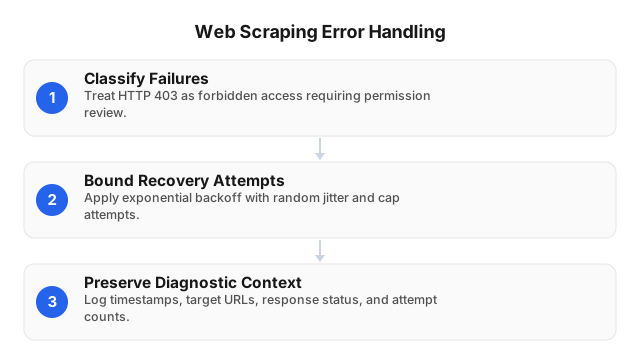
- Classify before retrying. Treat HTTP 403 as forbidden access requiring review, not automatic IP rotation. Route connection timeouts and recoverable temporary server failures to a bounded retry queue; quarantine parsing failures for inspection.
- Bound recovery attempts. Cap attempts and coordinate retries with the shared request scheduler described in the next section. Recovery traffic must remain part of the target’s request budget.
- Preserve diagnostic context. Log timestamps, target URLs, response status, attempt counts, and parser versions. Redact credentials and sensitive query parameters. Trigger a domain-level circuit breaker when failures persist; require review before resuming collection.
Record unsuccessful observations explicitly rather than interpreting missing prices as price drops or unavailable pages as evidence that products have been discontinued.
For a practical implementation checklist, see 12 Steps to Optimize Web Scraping Scripts in 2026.
Managing Rate Limits and Delays
Recovery and routine collection need the same traffic controls. Use a shared per-domain request budget that includes every worker, proxy, pagination request, and retry. Random pauses alone cannot prevent concurrent workers from overwhelming a server. Cap concurrency and reduce unnecessary fetches before adding collection capacity.
- Centralize scheduling. Route initial requests, pagination, and retries through the same limiter. Separate worker queues must not multiply the target’s permitted request rate.
- Make retries delay-aware. Honor server-requested cooldowns and
Retry-Afterwhen supplied. Otherwise, apply capped exponential backoff with random jitter and a finite retry budget. - Reduce unnecessary fetches. Cache pages within an appropriate freshness window and prioritize stale competitive-price records. Reschedule deferred URLs rather than silently dropping them.
- Preserve compliance signals. Log cooldowns and collection gaps. Never rotate IPs to override an explicit rate limit or access denial.
Avoiding IP Blocking with Proxies
Within these traffic controls, residential proxies can route authorized scraping requests through suitable locations. Proxy rotation cannot guarantee access or correct data. For regional price monitoring, keep exit geography and session identity consistent so one collection run does not mix different markets.
EProxies offers 72M+ residential IPs across 195+ countries and supports HTTP(S) and SOCKS5. These options can support location-specific collection.
Changing IPs while retaining session cookies can disrupt continuity. Record the exit location and session context alongside each observation, and verify that the returned currency and market match the job configuration.
Track failures by target, exit IP, and session. Quarantine failing endpoints rather than repeatedly retrying them. If failures span multiple IPs, pause the target and review permissions instead of cycling through the pool.
Ensuring Data Quality and Accuracy
Once responses reach the parser, validate extracted records before they enter competitive intelligence dashboards. Measure usable records rather than completed requests, using field requirements, coverage checks, and source context.
- Define field contracts. Require product identifiers, currencies, observation timestamps, and source URLs. Store missing prices as null—not zero—and distinguish sale prices from installment amounts.
- Quarantine suspicious changes. Flag unexpected missing fields, currency shifts, and price outliers for review. Compare source content with parsed output before treating an anomaly as market movement.
- Verify collection completeness. Detect repeated pagination cursors and incomplete dynamic content. Deduplicate by product, variant, market, and observation window.
- Preserve auditability. Version parsers and retain permitted evidence under a retention policy. Keep analyst exports free of unnecessary personal data.
Related reading
Choose follow-up guidance based on the failure you need to fix. The guides below expand access troubleshooting and large-scale collection workflows. Apply scaling techniques only after the existing scraper produces reliable records within the target’s permitted request limits.
- How to Avoid IP Bans When Web Scraping in 2026
- How to Upscale Web Scraping for Large Datasets in 2026
FAQ
The following answers address common collection decisions, from interpreting crawler rules to checking product coverage.
What is the role of robots.txt in web scraping?
Robots.txt specifies crawler rules, including which paths automated clients should avoid; it does not grant legal permission to collect or reuse data. If a product directory is disallowed, seek an authorized feed or permission rather than changing your crawler identity to sidestep that instruction.
How can I avoid getting blocked while scraping?
Reduce blocking risk by following site rules, limiting concurrency, caching reusable responses, and slowing requests when the server signals overload. Use approved feeds and incremental collection where available.
What are the best practices for setting user-agent headers?
Use a truthful, stable User-Agent and keep other headers consistent with the client actually making the request. Where appropriate, include a crawler information page or contact address.
How do I handle HTTP errors in web scraping?
Handle HTTP errors by classifying their cause before deciding whether to retry, correct the request, or stop collection. Forbidden responses require access review, rate-limit responses require slower scheduling, and temporary server failures may justify bounded retries with backoff.
What are the legal considerations for web scraping?
Review site terms, access permissions, applicable privacy laws, and rights governing collected content and its reuse before scraping. Document collection purposes and retention, and obtain jurisdiction-specific legal advice for sensitive information or substantial content redistribution.
How do I detect missing or duplicate products in scraped data?
Detect missing or duplicate products by checking pagination completion and comparing stable product identifiers across collection runs. Do not deduplicate by product name alone: variants, sellers, and regional listings may share names while representing different offers. Store availability separately from price, then flag unexpected coverage changes for review before publishing competitor price comparisons.
This article was written by the EProxies team and reviewed against our editorial quality standards before publishing.