
12 Steps to Optimize Web Scraping Scripts in 2026
TL;DR: Optimize a scraper by measuring network, parsing, and storage time separately; reusing connections; limiting concurrency; validating every response; retrying only transient failures; and tracking cost per valid record. Benchmark against your actual targets—generic endpoint tests do not predict production performance.
This guide shows data analysts how to improve extraction speed without sacrificing dataset integrity, target availability, or operational reliability.
Understanding Web Scraping Basics
Web scraping converts permitted web resources into structured records through five distinct stages:
- Request: Retrieve an HTML document, JSON response, or other authorized resource.
- Parse: Convert the response into a searchable document or object.
- Extract: Select required fields using stable attributes or keys.
- Normalize: Standardize dates, prices, identifiers, units, and null values.
- Persist: Write validated records while preserving source metadata.
Treat each stage as a separate measurement boundary. A request may take three seconds while parsing takes 40 milliseconds; increasing parser speed will not materially improve that job. Conversely, a large HTML document or browser session can make CPU and memory the actual constraints.
Asynchronous I/O improves throughput by allowing one worker to handle other tasks while a request is waiting. It does not reduce the target server’s response time. Start with a small concurrency limit, such as five requests per target, then adjust it using observed 429 rates, p95 latency, memory use, and published rate limits.
Setting Up a Reproducible Scraping Environment
With those pipeline stages defined, separate dependencies, credentials, network settings, and logs before deployment so production failures are easier to diagnose.
- Isolate the runtime. Use a virtual environment or container, pin dependency versions in a lockfile, and record the browser build when JavaScript rendering is required.
- Keep configuration outside the script. Store target URLs, timeouts, concurrency limits, headers, and proxy endpoints in environment variables or configuration files. Never commit cookies, passwords, API tokens, or proxy credentials.
- Set explicit timeouts. Configure connection, read, write, and pool timeouts instead of relying on library defaults. A 10-second connection timeout and a 30-second read timeout, for example, represent different failure conditions and should be logged separately.
- Create structured logs. Record the request ID, normalized URL, target hostname, response status, content type, latency, retry count, parser version, and validation result. Redact query parameters or headers that contain personal data or credentials.
- Build a replay fixture set. Save sanitized examples of successful pages, throttling responses, empty results, and changed layouts. Parser tests should run against these fixtures without sending new requests to the target.
Choosing Tools and Libraries
Once the environment is reproducible, choose the least resource-intensive stack that reliably returns the required fields. Browser automation adds rendering processes, memory consumption, timing dependencies, and more failure states than a direct HTTP client.
| Workload | Suitable tooling | Main trade-off |
|---|---|---|
| Static HTML, small jobs | requests + BeautifulSoup | Straightforward debugging, but synchronous requests restrict throughput |
| Static HTML, concurrent jobs | httpx or aiohttp + lxml | Efficient network concurrency; requires connection-pool and task limits |
| Large scheduled crawls | Scrapy | Includes queues, throttling, retries, caching, and item pipelines |
| JavaScript-rendered pages | Playwright | Executes page scripts but uses substantially more CPU and memory |
| Supported structured endpoint | Documented API client | Avoids HTML parsing but may impose authentication, quotas, or field limits |
Inspect the response before launching a browser. A product page may render its visible fields from a permitted JSON response or JSON-LD block that can be parsed directly. Use documented APIs where available, and keep transport code separate from field-extraction logic so either layer can be replaced independently.
Implementing Efficient Data Extraction
After selecting the transport and parsing stack, parse each response once and discard unnecessary document nodes as early as possible.
- Prefer authorized structured sources. Documented APIs, JSON-LD, and permitted embedded state usually require fewer transformations than rendered HTML.
- Use scoped selectors. Select a product container first, then query fields within it. Stable attributes such as
data-product-idare generally less sensitive to layout changes than selectors such asdiv:nth-child(4). - Project fields early. If the output schema needs six columns, do not retain the complete DOM in memory after extracting them.
- Separate discovery from detail requests. Put canonical item URLs into a deduplicated queue, then process detail pages with a target-specific concurrency limit.
- Normalize deterministically. Store both the raw value and normalized value when conversions may be disputed. For example, preserve
€1.299,00alongside the decimal amount and detected currency. - Validate before persistence. Reject or quarantine records with missing identifiers, invalid timestamps, unexpected currencies, or duplicate keys. Do not convert an absent price to zero; those values have different meanings.
- Make writes idempotent. Upsert with a stable key such as the source ID plus canonical URL. A retried batch should update the same records rather than create duplicates.
For commerce-specific pagination, deduplication, and schema controls, see Best Practices for E-Commerce Web Scraping in 2026.
Handling Errors Without Creating More Load
Efficient extraction also requires a retry policy that distinguishes temporary transport failures from permanent access denials and parser defects.
Classify failures first
| Failure | Recommended action |
|---|---|
| DNS or connection timeout | Retry a limited number of times with backoff |
| HTTP 429 | Honor Retry-After, reduce concurrency, and pause the target queue |
| HTTP 500, 502, 503, or 504 | Retry selectively with a strict attempt limit |
| HTTP 401 or 403 | Stop and verify authorization or credentials; do not rotate around the denial |
| Unexpected content type | Quarantine the response and inspect routing or session state |
| Selector or schema failure | Send to a dead-letter queue; repeated requests will not repair parser logic |
| Database timeout | Retry the write idempotently without refetching a valid page |
Use exponential backoff with jitter—for example, delays based on one, two, and four seconds plus a random component—rather than synchronized fixed retries. Cap both the number of attempts and total elapsed time.
Preserve diagnostic evidence
For each failure, log:
- Target hostname and sanitized URL
- HTTP status and content type
- Attempt count and elapsed time
- Proxy session identifier, not the credential
- Parser and schema versions
- Validation errors
- A hash of the response body for grouping duplicate failures
Store sanitized response samples separately with a retention limit. Pages can contain names, account details, tokens, or other sensitive data that should not enter general application logs.
Use a target-level circuit breaker
Pause new requests when a rolling window crosses a defined threshold, such as more than 20 failures in 50 attempts. Probe with one request after a cooldown rather than immediately restoring full concurrency. This prevents a failing target, expired session, or broken parser from generating thousands of unnecessary requests.
For implementation patterns covering throttling, session handling, and block prevention, see How to Automate Web Scraping Without Getting Blocked.
Optimizing Script Performance
With failure handling in place, optimize against measurements from the actual workload rather than a generic industry response-time figure. Latency changes with the target, route, geography, page type, cache state, payload size, and whether JavaScript execution is required.
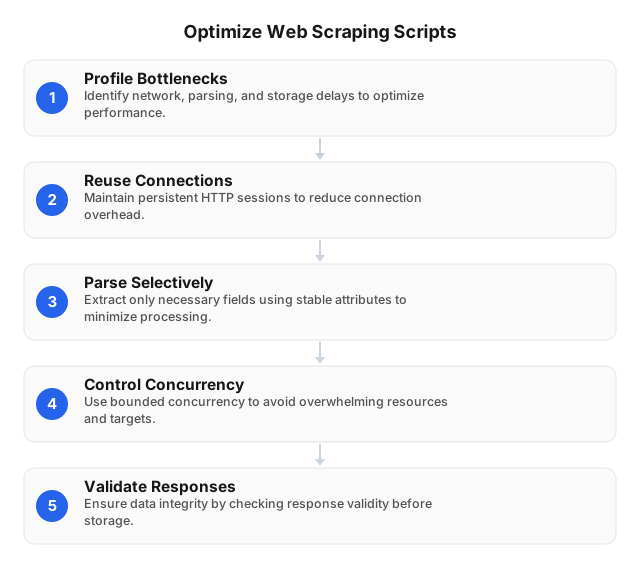
Measure each stage
Record at least:
- DNS lookup time
- TCP and TLS connection time
- Time to first byte
- Response download time
- Parse and extraction time
- Validation time
- Database-write time
- Queue wait time
- End-to-end latency
Report p50 and p95 latency rather than only an average. A median can remain stable while a small share of 30-second requests determines the total batch duration.
Reuse connections
Maintain one long-lived HTTP client per worker or event loop. Connection pooling avoids repeating TCP and TLS setup and preserves legitimate cookies or session state. Set a maximum number of open connections per host so the pool cannot grow without limit.
Bound concurrency by target
Increase concurrency in small steps while monitoring p95 latency, 429 responses, timeouts, and valid-record throughput. If concurrency rises from 10 to 20 but valid records per minute remain flat, the extra tasks add pressure without improving output.
Apply limits per hostname, not only across the entire process. One slow domain should not consume every available worker.
Reduce unnecessary work
- Request compressed responses when supported.
- Avoid loading images, video, fonts, and analytics scripts in browser jobs when doing so is permitted and does not break required page behavior.
- Stream large downloads rather than retaining the full body in memory.
- Cache immutable reference pages where authorization and freshness requirements allow it.
- Batch database writes, but cap batch size to limit replay work after a failure.
- Close browser pages and contexts explicitly to prevent process and memory leaks.
Configuring Proxies for Reliable Automation
Network routing is another performance and reliability variable. A proxy can provide geographic routing and distribute authorized requests, but it cannot fix an unstable selector, invalid credential, or excessive request rate.
Use rotating sessions for independent requests that do not share state. Use sticky sessions for legitimate flows that depend on continuity, such as localized pagination or a consented authenticated session. Keep the same cookies, headers, and IP for the duration of that flow; changing only the IP can trigger state mismatches.
EProxies provides more than 72 million residential IPs across 195+ countries, with HTTP(S) and SOCKS5 support. The service reports 98.2% uptime backed by a 99.9% uptime SLA. Available pricing models include:
- Pay-as-you-go residential traffic from $0.25/GB
- Volume pricing of approximately $0.73/GB at 300GB
- ISP SOCKS5 proxies from $0.95 per IP
- Unlimited plans from $79 per month
Compare plans using cost per valid record, not only cost per gigabyte or IP. A low traffic price can still produce a higher extraction cost if the selected route increases retries, returns the wrong locale, or breaks session continuity.
Proxy rotation must not be used to bypass authentication barriers, CAPTCHAs, explicit denials, or target rate limits. How to Avoid IP Bans When Web Scraping in 2026 explains how request pacing, session consistency, and response classification reduce avoidable blocks.
Benchmarking With Production-Relevant Tests
To compare code, proxy, or network configurations fairly, fix the workload and test conditions in advance.
- Create a representative URL set. Include listing pages, detail pages, small responses, large responses, and any JavaScript-rendered routes used in production.
- Fix the test conditions. Record the request region, time window, concurrency, timeout values, cache policy, session type, and parser version.
- Run warm and cold tests separately. Connection reuse and target-side caching can make repeated runs faster than first-time requests.
- Measure request and data quality independently. An HTTP 200 response is not successful if it contains a block page, login screen, empty result, or invalid schema.
- Report multiple metrics.
- Request success rate
- Valid-record rate
- p50 and p95 end-to-end latency
- Retry rate
- Bytes transferred per valid record
- Parse-failure rate
- Cost per 1,000 valid records
- Compare identical request mixes. Do not compare a cached CDN endpoint with dynamic product, search, or account pages and treat the results as interchangeable.
Run enough requests to expose tail latency and rare failures, but stay within authorization and rate limits. Publish the URL categories and methodology with the results so later tests can reproduce the comparison.
Legal and Ethical Controls
Performance and reliability controls operate within legal and ethical boundaries. Document authorization, data necessity, and jurisdiction-specific handling rules before collection begins. Review the target’s terms, API policy, copyright restrictions, privacy requirements, and applicable contracts. A robots.txt file communicates crawler preferences; it does not by itself grant permission or settle legal questions.
Collect only fields required for the stated purpose. If personal data is involved, define the lawful basis, retention period, access controls, deletion process, and incident-response procedure before storing records. Preserve source URLs, collection timestamps, authorization evidence, and script versions so a dataset can be audited.
Treat authentication barriers, CAPTCHAs, and explicit access denials as stop signals. Proxies change network routing, not the collector’s legal obligations. Review regional scraping legalities before collecting or transferring data across jurisdictions.
FAQ
What tools are best for web scraping?
Use an HTTP client and HTML parser for static pages. Choose httpx or aiohttp for bounded asynchronous workloads, Scrapy for scheduled crawls with queues and pipelines, and Playwright only when the required content depends on JavaScript execution. Test documented APIs and permitted structured responses before adding a browser.
How can I improve scraping speed?
Measure DNS, connection, server wait, transfer, parsing, validation, and storage time separately. Reuse connection pools, increase concurrency gradually, parse only required fields, and batch idempotent writes. Track p95 latency and valid records per minute; raw request volume can rise while usable output remains unchanged.
Which scraping errors should be retried?
Retry connection timeouts, HTTP 429 responses, and selected 5xx responses with exponential backoff, jitter, and a strict attempt cap. Honor Retry-After. Do not repeatedly retry 401, 403, selector failures, schema mismatches, or explicit access denials.
How should large datasets be processed?
Use bounded queues and incremental writes instead of retaining every response and record in memory. Checkpoint pagination or cursor state, deduplicate with stable identifiers, and make writes idempotent. Store failed records in a dead-letter queue with the parser version and validation error.
What legal issues apply to web scraping?
Review terms, contracts, copyright rules, privacy laws, database protections, and restrictions on personal or regulated data. Public visibility does not automatically authorize every form of collection or reuse. Obtain qualified legal advice for authenticated content, sensitive data, cross-border transfers, or high-risk commercial uses.
Should a scraper use rotating or sticky proxy sessions?
Use rotating sessions for independent, stateless requests. Use sticky sessions when an authorized workflow requires consistent cookies, localization, pagination, or login state. Maintain coherent headers and cookies throughout the session; changing the IP alone can invalidate state or trigger additional verification.
How should I benchmark an optimized scraper?
Test the same representative URLs, regions, concurrency limits, timeout settings, and cache conditions for every configuration. Report p50 and p95 latency, request success, valid-record rate, retries, transferred bytes, and cost per valid record. Do not substitute results from stable test endpoints for measurements on the real page types the production job collects.
This article was written by the EProxies team and reviewed against our editorial quality standards before publishing.