
Web Scraping Legalities and Best Practices by Region
TL;DR: Web scraping is not illegal by default, but its legality depends on the region, the type of data collected, website terms, access methods, and privacy laws such as GDPR and CCPA.
For businesses, compliant scraping starts with a simple principle: collect only data you are allowed to access, minimize personal data, respect target site terms, and document your legal basis. This guide explains web scraping legalities and best practices by region, with practical compliance strategies for teams using public web data for market research, price monitoring, localization testing, AI data workflows, and competitive intelligence.
Introduction to Web Scraping Legalities
Web scraping is the automated collection of data from websites, typically using scripts, crawlers, APIs, or proxy-supported request routing. The key legal question is not simply “Can we access this page?” but “Are we authorized to collect, store, and use this data in this region and for this purpose?”
Legality varies significantly across regions. Some jurisdictions focus heavily on data protection and privacy, while others emphasize contract law, copyright, computer access rules, or consumer protection. In the U.S., there is no single web scraping statute; issues may arise under terms of service, copyright, privacy laws, and unauthorized-access theories such as the CFAA. In privacy-forward regimes, scraping personal data can trigger compliance duties even when the data is publicly visible.
Practically, businesses should treat scraping as a governed data process:
- Check access rights: Review terms of service, login requirements, paywalls, and API policies.
- Minimize privacy risk: Avoid scraping personal data unless there is a clear lawful basis and retention plan.
- Respect site operations: Follow robots.txt where applicable, rate-limit requests, and avoid unnecessary server load.
- Document compliance: Keep records of purpose, data fields collected, jurisdictions involved, and permissions obtained.
Residential proxies can support compliant public web data collection and localization testing, but infrastructure does not replace legal review. For implementation guidance, see EProxies’ guide to the ethical use of proxies for web scraping.
Understanding Web Scraping: What It Is and How It Works
In operational terms, a scraper sends HTTP requests, downloads HTML or structured responses, parses the content, and converts selected fields—such as prices, product availability, search results, or public business listings—into a usable dataset. That workflow is straightforward technically, but each step can affect compliance.
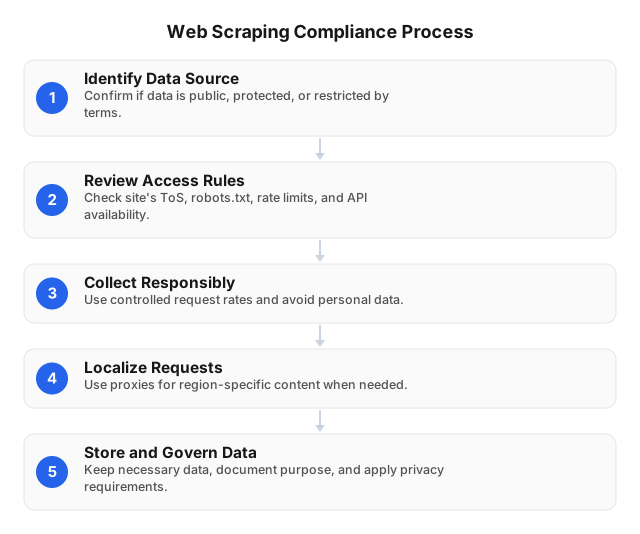
How a typical scraping workflow works
- Identify the data source: Confirm whether the target data is public, protected by login, copyrighted, personal, or restricted by terms of service.
- Review access rules: Check the site’s terms of service, robots.txt, rate limits, and any available API. Unauthorized scraping can create legal exposure, including contract disputes and data protection violations.
- Collect responsibly: Use controlled request rates, avoid personal data where possible, and design crawlers to minimize server load.
- Localize requests when needed: For compliant market research, localization testing, or price monitoring, residential proxies can help businesses view region-specific public web content accurately.
- Store and govern data: Keep only what is necessary, document lawful purpose, and apply regional privacy requirements.
This operational framework connects directly to the legal analysis below: permission, data type, purpose, and jurisdiction determine the risk profile. For a deeper implementation model, see our guide to ethical proxy use for web scraping.
Global Overview: Legal Frameworks Governing Web Scraping
Web scraping is not governed by one universal law. In most regions, collecting publicly available web data can be lawful when done correctly, but legality changes quickly based on what data is collected, how access is obtained, and how the data is used.
Core legal areas businesses must evaluate
- Data protection laws: Frameworks such as the GDPR in Europe and CCPA/CPRA in California make personal data the highest-risk category. Even if information is publicly visible, scraping names, emails, profiles, location data, or behavioral signals may trigger notice, lawful-basis, deletion, and opt-out obligations.
- Computer access laws: Unauthorized scraping can create legal exposure when it involves restricted areas, login barriers, paywalls, technical access controls, or repeated access after a clear denial.
- Contract law and terms of service: Website terms may limit automated collection, reuse, or commercial use of data. Violating terms of service is not always the same as violating criminal law, but it can still create breach-of-contract risk.
- Copyright and database rights: Copying original content, structured databases, images, reviews, or proprietary compilations can raise IP concerns, especially in jurisdictions with database-specific protections.
- Consumer protection and unfair competition: Scraping that misleads users, harms a service, or repackages data deceptively may invite regulatory or civil claims.
Practical baseline
A defensible baseline is to respect robots.txt, minimize server load, avoid personal data unless there is a clear lawful basis, and seek permission or use APIs where available. Proxies, including residential networks, can support compliant localization and request distribution—but they do not remove legal obligations. For implementation guidance, see our guide to ethical proxy use for web scraping.
Regional Differences in Web Scraping Laws
The same scraping workflow can carry different risk depending on where the target site, data subjects, business, and end users are located. The regional overview below highlights the main compliance lens in each market.
United States
The U.S. has no single web scraping statute, so risk is evaluated through a mix of contract law, computer access laws, privacy law, copyright, and unfair competition claims. Scraping public data may be lawful when done carefully, but unauthorized scraping can create exposure if it violates website terms of service, involves restricted-access systems, or collects protected personal data. The CFAA remains relevant where access is arguably “unauthorized” or exceeds permission.
European Union and United Kingdom
GDPR and UK GDPR make personal data the central issue. Even publicly available personal information can trigger obligations around lawful basis, transparency, minimization, retention, and data subject rights. Businesses should avoid scraping personal data unless they can document a valid legal basis and a compliant processing workflow.
California and Other U.S. Privacy States
CCPA/CPRA and similar state laws focus on consumer data rights, notice, sharing, sale, and deletion. If scraped data can identify a person or household, treat it as regulated personal information.
Asia-Pacific and Other Regions
Rules vary widely. Countries with strict data protection regimes may require consent, purpose limitation, or local compliance reviews, while more lenient jurisdictions may still enforce cybercrime, copyright, or contract claims.
Practical Regional Safeguards
- Respect robots.txt and website terms.
- Minimize server load with rate limits and caching.
- Avoid personal data unless legally reviewed.
- Obtain explicit permission for sensitive or high-volume projects.
- Use geo-targeting responsibly for localization testing and compliance validation, not to evade access controls.
Best Practices for Legal and Ethical Web Scraping
The regional analysis becomes practical only when it is embedded into the scraping workflow. The following controls help teams make compliance repeatable rather than ad hoc.
Build compliance into the workflow
- Map the region before you collect. Web scraping legality varies significantly across different regions: GDPR applies strict rules to personal data in the EU/UK, CCPA/CPRA affects California residents’ data, and other markets may rely more heavily on contract, copyright, database, cybersecurity, or sector-specific laws. Treat “publicly accessible” as a starting point—not a free pass.
- Respect site rules and access boundaries. Review terms of service, robots.txt, API availability, rate limits, login requirements, and paywall restrictions. Unauthorized web scraping can lead to legal consequences, including violations of terms of service and data protection laws.
- Avoid personal data unless you have a lawful basis. Leave personal identifiers out when possible. If personal data is necessary, document purpose, lawful basis, retention limits, deletion workflows, and regional data-subject rights procedures.
- Minimize server load. Use conservative request rates, caching, backoff logic, and clear user-agent identification where appropriate. Responsible crawlers should avoid creating unnecessary strain on the target site.
- Use proxies responsibly. Residential proxies can support compliant public web data collection, localization testing, and request distribution—but they should not be used to evade access controls.
- Create an internal scraping policy. Require legal review for new targets, permission where appropriate, audit logs, data minimization, and escalation rules. For deeper operational guidance, see ethical proxy use for web scraping.
Case Studies: Legal Precedents and Compliance Success Stories
Legal precedent reinforces the same compliance pattern: authorization, contracts, data type, and jurisdiction matter. These examples are practical lessons rather than a substitute for legal advice.
1. Public data is lower risk—but not risk-free
U.S. scraping disputes have reinforced a practical lesson: web scraping is not per se illegal, but authorization, contracts, and data type matter. Publicly accessible data generally carries lower access-risk than content behind logins, paywalls, or technical gates. However, unauthorized scraping can still trigger legal consequences when it violates terms of service, copyright, privacy laws, or data protection obligations.
Compliance takeaway: document whether the target data is public, review the site’s terms of service, respect robots.txt, and avoid collecting personal data unless you have a lawful basis.
2. Terms of service can turn into contract exposure
Several legal analyses emphasize that contract law becomes relevant when a website’s terms of service prohibit automated collection. Even if data is visible, scraping after accepting restrictive terms can increase risk.
Compliance takeaway: if the data is business-critical, seek explicit permission, use an API or data access agreement where available, and keep records of approvals.
3. Regional privacy rules change the scraping plan
A workflow acceptable for non-personal product pricing data may become high-risk in GDPR or CCPA contexts if names, identifiers, profiles, or behavioral data are collected.
Compliance takeaway: use regional data maps, minimize fields, exclude personal identifiers by default, and apply retention limits.
4. Compliance success pattern: controlled, localized collection
Compliant public web data projects pair infrastructure with policy: throttle requests, minimize server load, monitor errors, and follow ethical proxy use practices. Localization and market validation workflows should use region-aware routing to confirm how public content appears in specific markets, not to bypass restrictions.
Tools and Resources for Compliant Web Scraping
A compliance-first stack combines legal review, technical controls, permission workflows, and responsible infrastructure.
Build a compliance-first scraping stack
- Legal review workflow
- Map each target by region before collection: web scraping legality varies significantly across different regions, with some countries having strict regulations while others are more lenient.
- Review terms of service, copyright exposure, database rights, and applicable privacy laws such as GDPR/CCPA-style rules.
- Document your lawful basis, data minimization approach, retention period, and opt-out process.
- Technical controls
- Respect
robots.txt, rate limits, and site performance constraints. - Avoid scraping personal data unless you have a clear legal basis and can meet notice, deletion, and security obligations.
- Use monitoring to detect error spikes, excessive request volume, or unexpected collection of sensitive fields.
- Respect
- Permission and data access resources
- When possible, use official APIs, licensed datasets, or written data access agreements.
- Businesses can mitigate legal risks by obtaining explicit permissions and adhering to regional data protection laws.
- Responsible proxy infrastructure
- Residential proxies can support compliant public web data collection, localization testing, and request distribution when used within site terms and applicable laws.
- EProxies offers 72M+ residential IPs across 195+ countries, HTTP(S) and SOCKS5 support, rotating and sticky/static sessions, city- and ASN-level targeting, and username-password or IP whitelist authentication.
- Published EProxies specs report a 99.95% success rate and response times under 0.6 seconds, with 98.2% uptime backed by a 99.9% uptime SLA.
For policy design, see our guide to the ethical use of proxies for web scraping.
FAQ
What are the legal risks associated with web scraping?
Web scraping is not automatically illegal, but risk increases when a scraper collects personal data, copies copyrighted content, ignores website terms of service, overloads a site, or accesses data behind logins, paywalls, or technical access controls. In the U.S., unauthorized access can raise issues under the Computer Fraud and Abuse Act, while contract law may apply when a site’s terms prohibit automated collection. Privacy laws such as GDPR and CCPA/CPRA can also apply if scraped data identifies or can reasonably be linked to a person.
How do web scraping laws differ by region?
The U.S. has no single web scraping law, so legality depends on a mix of federal statutes, state privacy laws, contract law, intellectual property rules, and case law. The EU and UK place heavier emphasis on personal data protection under GDPR-style frameworks, meaning lawful basis, minimization, transparency, and data subject rights are central. Other regions vary widely: some jurisdictions focus on cybersecurity and unauthorized access, while others emphasize data localization, consumer privacy, copyright, database rights, or sector-specific rules.
What are the best practices for ethical web scraping?
Ethical scraping starts with collecting only the data you need, avoiding sensitive personal data where possible, and respecting robots.txt, rate limits, site stability, and published terms. Scrapers should identify legitimate business purposes, avoid deceptive behavior, honor opt-out or removal requests, and avoid republishing content in ways that infringe copyrights or mislead users. Using residential proxies for compliant public web data collection should support responsible request distribution and localization testing—not attempts to ignore access rules or legal obligations.
How can businesses ensure compliance with web scraping laws?
Businesses should create a written scraping policy that defines approved data sources, prohibited categories such as sensitive personal information, review steps for terms of service, rate-limit standards, retention periods, and escalation paths for legal review. Before launching a project, teams should document the lawful basis for collection, assess whether personal data is involved, check copyright and database rights, and confirm that the target data is public and not protected by authentication or contractual restrictions. For operational controls, businesses should monitor request volume, keep audit logs, train developers, and use tools such as EProxies’ rotating or sticky residential sessions, city- and ASN-level targeting, and HTTP(S)/SOCKS5 support in ways that align with applicable laws and site terms.
What are some examples of legal precedents in web scraping cases?
U.S. web scraping disputes often turn on whether data was public, whether the scraper violated a binding contract, and whether access was “unauthorized” under laws such as the CFAA. Courts have treated publicly accessible data differently from data behind logins or technical restrictions, while terms-of-service violations may still create contract or business tort claims even when criminal access laws do not apply. The practical lesson is that “publicly viewable” does not automatically mean “free to collect and reuse,” especially when personal data, copyrighted content, database rights, or platform restrictions are involved.
Is scraping public data always legal?
No. Public accessibility reduces some access-control risks, but it does not remove obligations under privacy, copyright, contract, consumer protection, or cybersecurity laws. A compliant assessment should ask what the data is, how it was accessed, whether the site’s terms restrict automated collection, whether personal data is involved, and how the scraped data will be stored, used, and shared.
Can proxies be used for compliant web scraping?
Yes, proxies can support compliant web scraping by distributing requests responsibly, enabling geo-specific testing, and reducing unnecessary load from repeated requests from a single route. EProxies offers 72M+ residential IPs across 195+ countries, HTTP(S) and SOCKS5, rotating and sticky/static sessions, and city- and ASN-level targeting; these features should be used for lawful public web data collection, QA, localization, and market research while respecting target site terms and applicable laws.
This article was written by the EProxies team and reviewed against our editorial quality standards before publishing.