
Proxies for Scaling Secure API Calls: 2026 Guide
TL;DR: Residential proxies can add geographic routing, egress isolation, and route diversity to authorized API workloads, but they do not increase account quotas or replace TLS, authentication, or access controls. Scale safely with bounded connection pools, per-token rate limits, sticky sessions for stateful flows, selective caching, idempotent retries, and measurements from the target API.
API Proxies and Residential Proxies Solve Different Problems
An API proxy or gateway enforces application policy: authentication, quotas, request validation, caching, logging, and backend routing. A residential proxy controls the outbound network route, presenting an IP associated with a residential network to the destination.
A production request may pass through both layers:
Client → API gateway → queue/rate limiter → residential proxy → target API
         auth/policy       backpressure       route/session
The gateway can keep /v1/catalog stable while services change behind it, while the residential layer can select a country-specific route for an authorized localization test. Neither layer replaces HTTPS, request signing, audit logs, or least-privilege credentials; see Building a Secure Network With Proxies.
Where Residential Routing Helps
With those roles separated, residential routes are best suited to authorized tasks whose results depend on source geography. Concrete examples include checking localized prices, currencies, inventory, shipping eligibility, language variants, or region-specific advertising responses.
Route diversity also reduces reliance on a single egress address, but it does not multiply an API account’s quota. A token limited to 100 requests per minute remains limited to 100 requests per minute even if traffic uses ten proxy routes.
On 429 Too Many Requests, reduce concurrency and honor Retry-After where supplied. Changing IPs to evade a token, account, or application quota breaches the control rather than solving the capacity problem. HTTP 429 and Retry-After behavior are defined in RFC 6585 and RFC 9110.12
EProxies’ current plan materials advertise 72M+ residential IPs across 195+ countries, with HTTP(S) and SOCKS5 support.3 These are provider-published specifications, not an independent benchmark; verify country targeting, session duration, protocol support, and product eligibility for the selected plan.
Choose Rotation by Workflow State
Once geographic requirements are clear, choose a session policy based on whether requests share state.
Rotate independent jobs
Rotation fits requests that do not share cookies, pagination cursors, or server-side state. Independent product lookups, one-page availability checks, and isolated localization tests can receive a new route for each job.
Avoid changing the route on every retry. Retaining the original route and session identifiers in logs helps separate proxy failures from DNS, TLS, target-server, and application errors.
Pin stateful transactions
Use a sticky session when several calls must appear as one continuous interaction:
- OAuth or login sequences
- Cursor-based pagination
- Shopping-cart and checkout tests
- Cookie-dependent APIs
- Multi-step writes or transactions
Session persistence and rate limiting must remain separate. Key rate-limit counters by target host, account or token, and endpoint—for example, 20 concurrent calls to /catalog but only five to /orders for the same account.
Secure Setup, Step by Step
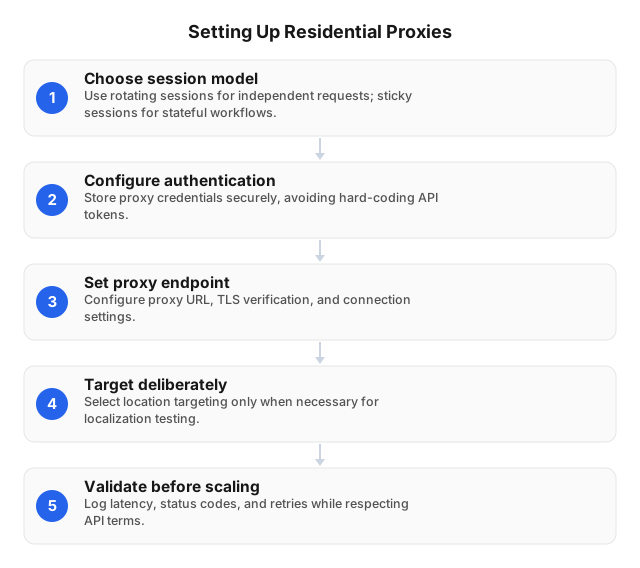
After selecting the session policy, begin with one representative endpoint at low concurrency. Validate the complete route before adding workers.
- Choose the protocol. HTTP(S) fits most REST and GraphQL clients. SOCKS5 is useful when the client needs protocol-agnostic TCP routing.
- Separate credentials. Store API tokens and proxy credentials as distinct secrets. Do not put either in source code, container images, shell history, or request logs.
- Configure the proxy endpoint. Add the proxy host, port, username, and password without replacing the target API URL.
- Preserve destination TLS. Verify the target certificate and hostname. Never disable certificate checks to hide a routing or trust-store error.
- Set staged timeouts. Use separate connection, TLS-handshake, and response-read limits so telemetry identifies the failed stage.
- Bound the connection pool. Reuse keep-alive connections, but cap active and idle sockets to prevent file-descriptor exhaustion.
- Apply the session policy. Rotate independent jobs; keep stateful sequences on sticky sessions.
- Enforce quotas before dispatch. Rate-limit by API host, account, token, and endpoint rather than by proxy IP.
- Add bounded retries. Retry only eligible failures, respect
Retry-After, and require idempotency protection for writes. - Run a staged load test. Capture status, application validity, p50/p95/p99 latency, bytes, attempts, route ID, and session ID while redacting secrets.
A controlled deployment path looks like this:
Application
  → authenticated API gateway
  → per-target queue and token bucket
  → bounded connection pool
  → HTTP(S) or SOCKS5 residential proxy
  → authorized API endpoint
For broader credential, network, and route controls, use the Guide to Choosing the Best Proxy for Your Needs.
Optimize the Full Request Path
Once the route works correctly, benchmark end-to-end behavior rather than proxy latency alone. A proxy adds another network route, but performance still depends on the entire request path.
- Reuse connections: Keep TCP and TLS sessions open when the target and proxy permit it. Match pool size to worker concurrency rather than creating one connection per request.
- Test route placement: Compare target-country and nearby routes. Physical distance is only a proxy for latency; peering and congestion can make a farther route faster.
- Cache eligible reads: Cache repeated
GETresponses only when authorization,Cache-Control,Vary, and expiration rules permit it. RFC 9111 defines HTTP caching semantics.4 - Request less data: Use field selection, pagination, and conditional requests where the API supports them. Compression reduces transferred bytes but consumes CPU at both ends.
- Increase concurrency in stages: Test 5, 10, 20, and 40 workers instead of jumping directly to the projected peak. Stop when p95 latency,
429frequency, timeout rate, or cost per valid response exceeds the service objective. - Reserve retry capacity: If the system has 100 worker slots, a starting limit of 20 retry slots prevents failed requests from displacing all new work.
- Validate response content: A
200response containing an error object, stale result, or incomplete page must count as a failed application response.
API gateways can further improve performance through response caching and payload compression, subject to the target’s cache and content rules.5
Worked Capacity-Planning Case
The effect of payload and retry controls becomes clearer in a capacity model. Consider an authorized catalog API workload with 1,000,000 original requests per month. Assume each request and response transfer 50 KB combined, and transient failures produce 20% retry amplification.
Total attempts = 1,000,000 × 1.20 = 1,200,000
Traffic        = 1,200,000 × 50 KB ≈ 60 GB
If field selection lowers the average transfer to 35 KB and controlled retries reduce amplification to 8%, usage falls to approximately 37.8 GB:
1,000,000 × 1.08 × 35 KB ≈ 37.8 GB
This is a transparent planning example, not a claimed customer benchmark. It shows why payload size and retry discipline can matter more than adding proxy routes: the two changes reduce modeled traffic by roughly 22.2 GB without altering the original job count.
Rate Limits, Backpressure, and Retries
To keep that retry amplification under control, partition queues by API host, account, region, and business priority. A throttled analytics endpoint should not consume connection and retry capacity reserved for inventory or payment operations.
A conservative starting policy is at most three attempts with exponential backoff and random jitter. Retry selected connection resets, timeouts, 429 responses, and temporary 5xx responses only when the operation is safe to repeat.
Do not automatically retry:
400 Bad Request401 Unauthorized403 Forbidden- Schema or validation failures
- Non-idempotent writes without an idempotency key
Stop immediately on invalid credentials. Sending the same rejected token through additional residential IPs wastes traffic and can trigger account-level security controls.
Security Controls
Operational controls must sit alongside retry and capacity controls. Residential proxies can help isolate outbound API traffic, separate routes by workload or region, and centralize proxy authentication and egress logs. This reduces direct exposure of the application server’s egress address and gives operators a control point for disabling compromised proxy credentials.
Those benefits depend on configuration. Keep destination TLS verification enabled, scope API and proxy credentials independently, restrict proxy access by service identity or network policy, and redact Authorization, Cookie, and Proxy-Authorization headers.
Residential exits may rotate, so destination-side IP allowlisting can be difficult or unsuitable. If stable allowlisting is mandatory, evaluate a fixed-egress product instead of assuming a rotating pool will satisfy the control. Additional network-security patterns are covered in Building a Secure Network With Proxies.
Compliance and Acceptable Use
Technical controls do not establish authorization. Geographic availability does not grant permission to access an endpoint or collect its data. Confirm the API’s terms, account permissions, data-use restrictions, rate limits, privacy obligations, and retention rules before routing production traffic.
Review the applicable legal boundaries before deployment. Recheck the legal boundaries of proxy usage whenever the workload adds a country, data source, personal-data category, or collection purpose.
Monitoring, Availability, and Cost
After confirming authorization, monitor technical reliability and economic efficiency together. Segment metrics by target, account, region, route, and session policy:
| Metric | Operational decision |
|---|---|
| Valid-response rate | Whether returned content passes application checks |
| p50, p95, and p99 latency | Typical and tail performance |
429 rate | Whether dispatch exceeds an upstream quota |
401 and 403 rate | Whether credentials, permissions, or policies are wrong |
| Connection-stage errors | Whether DNS, TCP, TLS, proxy auth, or the target failed |
| Retry amplification | Total attempts divided by original requests |
| Transferred GB | Usage-based traffic cost |
| Cost per valid response | Economic efficiency after retries and invalid results |
EProxies service materials list 98.2% uptime and a 99.9% uptime SLA.6 Because those figures can use different scopes or measurement methods, review the SLA window, exclusions, service credits, and eligible products instead of treating either number as guaranteed application availability.
Published EProxies pricing includes pay-as-you-go residential traffic from $0.25/GB, a volume tier of approximately $0.73/GB at 300GB, ISP SOCKS5 from $0.95/IP, and unlimited plans from $79 per month.7 These products use different billing units, so compare them by cost per valid response under the expected payload, retry rate, concurrency, and session policy.
FAQ
What are the steps to set up a proxy for API calls?
Choose HTTP(S) or SOCKS5, obtain the proxy endpoint and credentials, and configure them without changing the destination API URL. Keep TLS verification enabled, separate connection and read timeouts, use a bounded connection pool, and select rotating or sticky sessions. Test one endpoint at low concurrency while recording validity, latency, retries, route ID, and transferred bytes.
How can I optimize API call performance with proxies?
Reuse connections, test routes near the target, cache only eligible reads, reduce payload size, and enable compression where supported. Raise concurrency in measured stages while watching p95 latency, 429 frequency, retry amplification, and cost per valid response. Avoid route rotation unless the workflow needs geographic diversity or independent sessions.
How do residential proxies enhance API security?
They can isolate outbound API traffic from the application’s direct egress address, separate routes by workload, and centralize proxy credentials, access controls, and connection logs. They do not encrypt an unsafe connection or repair weak authentication, so destination TLS, least-privilege API tokens, secret rotation, and log redaction remain mandatory. Rotating residential IPs may also conflict with destination-side allowlists.
What challenges might arise when scaling API calls?
Higher concurrency can trigger token or account quotas, 429 responses, socket exhaustion, longer tail latency, retry storms, session breakage, and rapidly increasing bandwidth costs. Scaling also makes failures harder to classify because the client, proxy route, DNS, TLS handshake, and target API can each become the bottleneck. Use per-target queues, bounded pools, backpressure, idempotency keys, and staged load tests to locate the limit before production traffic reaches it.
What is a residential proxy?
A residential proxy routes outbound traffic through an IP associated with a residential network, causing the destination to see that address rather than the application server’s direct IP. It can support authorized geographic testing and route separation, but it does not grant API access or override authentication, quotas, terms, or laws.
Should I use HTTP(S) or SOCKS5?
Use HTTP(S) for most REST and GraphQL clients because their proxy, TLS, and connection-pool controls are usually straightforward. Choose SOCKS5 when the application needs protocol-agnostic TCP routing or provides native SOCKS support. Test authentication and DNS-resolution behavior with the exact client library before deployment.
Should API requests use rotating or sticky sessions?
Rotate independent, idempotent jobs that do not share cookies, cursors, or transaction state. Use sticky sessions for OAuth, pagination, carts, and multi-step transactions. A 429 is not a reason to rotate; comply with the documented quota and Retry-After.
How should I test proxy performance?
Use the expected method, payload, target region, session policy, and concurrency against an authorized endpoint. Measure valid-response rate, p50/p95/p99 latency, connection-stage errors, 429 frequency, retry amplification, transferred gigabytes, and cost per valid response. Increase load in stages and stop at a predefined reliability, latency, or cost threshold.
Sources
Footnotes
- IETF, RFC 6585: Additional HTTP Status Codes, Section 4. ↩
- IETF, RFC 9110: HTTP Semantics, Section 10.2.3. ↩
- S1 — EProxies residential-network plan materials used for this guide: 72M+ residential IPs across 195+ countries; HTTP(S) and SOCKS5 availability. Accessed August 2026. ↩
- IETF, RFC 9111: HTTP Caching. ↩
- AWS, Optimize performance of REST APIs. ↩
- S3 — EProxies service and SLA materials used for this guide: 98.2% uptime and a 99.9% uptime SLA. Accessed August 2026. ↩
- S4 — EProxies pricing materials used for this guide: residential pay-as-you-go from $0.25/GB; approximately $0.73/GB at 300GB; ISP SOCKS5 from $0.95/IP; unlimited plans from $79/month. Accessed August 2026. ↩
This article was written by the EProxies team and reviewed against our editorial quality standards before publishing.