
Legal Boundaries of Proxy Server Usage in 2026
TL;DR: The Legal Boundaries of Proxy Server Usage in 2026 depend on jurisdiction, authorization, intent, data handling, access methods, and contractual terms—not on proxy technology alone.
This guide is for IT compliance officers responsible for proxy deployments, vendors, and users across multiple jurisdictions. It provides a practical framework for distinguishing lawful routing and public-data research from unauthorized access, privacy violations, security-control circumvention, and breaches of platform terms—then translating those distinctions into procurement, approval, logging, and audit controls.
Introduction to Proxy Server Legality in 2026
Proxy server legality in 2026 is the legal and contractual status of routing internet traffic through an intermediary IP address. Proxy use is generally lawful, but legality depends on the user’s purpose, the governing jurisdiction, authorization to access the target system, and compliance with the platform’s terms of service.
A proxy is infrastructure, not legal permission. Free and paid services receive the same basic legal treatment; payment does not authorize restricted data collection, account misuse, or circumvention of security controls.
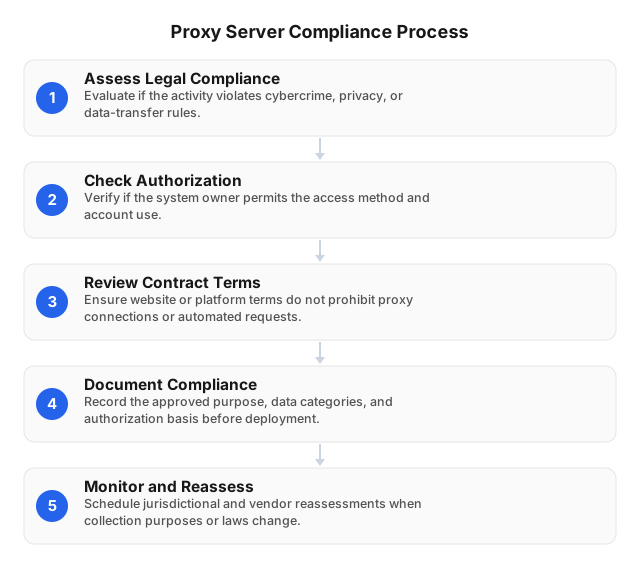
Compliance officers should separate three questions:
- Law: Does the activity violate cybercrime, privacy, copyright, consumer-protection, or data-transfer rules?
- Authorization: Has the system owner permitted the access method, account use, and automation?
- Contract: Do website or platform terms prohibit proxy connections, automated requests, location masking, or shared credentials?
A lawful business purpose can still breach platform terms, creating suspension, termination, or civil-litigation exposure without necessarily constituting a criminal offense.
Understanding the Legal Framework for Proxy Servers
Proxy-server legality in 2026 depends on four separate layers: national restrictions on proxy services, cybercrime law governing conduct, privacy and data-protection rules governing information processed, and contracts governing access to online platforms. A lawful proxy connection does not make the activity conducted through it lawful.
Some countries specifically restrict or prohibit proxy services, while others permit the technology but penalize unauthorized access, credential abuse, fraud, or interference with security controls. Compliance teams should therefore map both user location and target-system location; provider location alone cannot resolve governing law.
Platform terms form a separate control layer. Prohibited automation or location-routing may trigger account suspension or a contract claim even where no proxy-specific statute applies; deliberate circumvention of authentication or technical controls can create more serious exposure. Record the approved purpose, data categories, authorization basis, target terms, jurisdictions, retention period, and incident owner before deployment.
Jurisdictional Analysis: Where Are Proxies Legal?
Proxy servers are generally legal across the jurisdictions below, but legality depends on authorization, data handling, purpose, and the target service’s rules. No jurisdiction treats a proxy as permission to defeat authentication, rate limits, account controls, or geographic restrictions. Compliance officers must assess both the operator’s location and affected users’ location.
| Jurisdiction | Legal baseline | Primary compliance check |
|---|---|---|
| United States | Lawful for authorized business use | Review the CFAA, state privacy laws, contracts, and access-control notices. |
| European Union | Lawful, subject to data and cybercrime rules | Establish a GDPR lawful basis; minimize IP addresses and other personal data. |
| United Kingdom | Lawful for legitimate purposes | Apply UK GDPR and assess authorization under the Computer Misuse Act. |
| China | Tightly regulated | Review PIPL obligations, cross-border transfers, cybersecurity controls, and licensing requirements. |
| Russia | Restricted in regulated contexts | Check localization, prohibited-content, and communications requirements. |
| UAE | Use requires caution | Confirm cybercrime, privacy, monitoring, and content-access rules. |
Platform terms can prohibit proxy access even where local law permits it; bypassing security controls creates materially higher civil and criminal exposure.
Common Legal Risks and How to Mitigate Them
Common proxy-related legal risks in 2026 arise from unauthorized access, contract breaches, unlawful personal-data processing, intellectual-property misuse, and residential IPs obtained without informed consent. Compliance officers should approve the purpose, data source, target jurisdiction, provider, and retention period before traffic begins—not merely confirm that proxy software is legal.
Treat access controls, login barriers, rate limits, and explicit prohibitions as legal stop signs. Rotating IPs to defeat lockouts can indicate unauthorized access; platform restrictions may also create breach-of-contract exposure even when public data is involved.
Require a documented lawful basis for personal-data collection, minimization rules, deletion schedules, and cross-border transfer review. Preserve target terms, approval records, request logs, and incident evidence.
Vendor diligence should verify IP sourcing, user consent, abuse handling, authentication, and subprocessors. Use IP allowlists and named credentials rather than shared access.
Future proxy regulation may tighten as privacy concerns grow, so schedule jurisdictional and vendor reassessments whenever collection purposes or laws change.
Future Trends in Proxy Server Legislation
Residential proxy legislation in 2026 is moving toward stricter provider due diligence, device-consent verification, and accountability for abusive traffic rather than blanket proxy bans. A March 2026 FBI alert linking rotating residential IPs to rate-limit and lockout evasion signals greater scrutiny of how networks source endpoints and investigate misuse.
Compliance officers should expect proxy provenance to become as important as proxy purpose. Procurement records should document informed endpoint consent, applicable local laws, data-processing roles, retention practices, and abuse-response procedures across every operating jurisdiction.
Regulators are also likely to separate ordinary IP routing from conduct involving unauthorized access, security-control circumvention, privacy violations, or compromised devices. Platform restrictions remain contractual terms—not legislation—but violations can still trigger account termination or civil disputes.
For 2026 planning, monitor cybercrime, privacy, consumer-protection, and platform-governance rules separately. Review each deployment after legal changes, market expansion, or a new data source; responsible use in one country does not establish legality elsewhere.
Best Practices for Legal Proxy Usage
Legal proxy usage in 2026 requires a documented purpose, jurisdiction-by-jurisdiction approval, provider due diligence, and controls that bind every request to an authorized employee or service account. Treat the proxy as governed data-processing infrastructure—not merely a networking tool—and preserve evidence from authorization through deletion.
- Approve the use case. Record purpose, domains, data fields, legal basis, countries, retention, and owner; obtain counsel approval for sensitive data or ambiguous access.
- Vet the supply. Require written evidence of IP sourcing and consent, subprocessors, security, incident notice, deletion, and audit rights; apply identical scrutiny to free services.
- Enforce least privilege. Use named credentials or IP allowlists, destination restrictions, rate caps, and change approval; prohibit unauthorized accounts and circumvention of security controls.
- Log and reassess. Record account IDs, domains, timestamps, and configurations. Reassess after changes to law, platform terms, vendors, or routing; stop unverified geography.
Conclusion: Navigating the Legal Boundaries of Proxy Usage
In 2026, lawful proxy use depends less on the proxy itself than on authorization, purpose, data handling, and the laws of every affected jurisdiction. IT compliance officers should approve each deployment only after documenting the target, account permissions, collection basis, geographic route, retention period, and provider sourcing controls.
The controlling rule is evidence before execution: map applicable privacy, cybercrime, consumer, contract, and sector rules to a named owner.
Treat platform terms separately from statutes: a contractual breach is not automatically a criminal offense, but access-control circumvention, credential misuse, personal-data violations, or continued access after revocation can materially change the analysis. Escalate those facts to counsel before traffic begins.
Finally, retain approvals, configuration changes, authentication logs, data-deletion records, and periodic reassessments; suspend the workflow when purpose, target, route, or law changes.
Related reading
- Choosing the Right Proxy Server for Secure Browsing
- Proxy Server Implementation Guide for Small Businesses
FAQ
Proxy legality depends on the full transaction: jurisdiction, purpose, data collected, authorization, access method, and downstream use. Compliance officers should evaluate those elements separately because lawful proxy infrastructure can still support conduct that violates privacy law, computer-misuse statutes, contracts, platform terms, or internal security policy.
What makes a proxy server legal?
A proxy server is generally legal when its operator obtains IP resources and user consent legitimately, while the customer uses it for an authorized purpose without defeating authentication, rate limits, or other technical controls. The decisive test is conduct: localization testing or approved security monitoring differs legally from concealing credential attacks or accessing data without permission.
Are proxies legal in all countries?
No; proxy availability, permitted purposes, licensing rules, data-retention duties, and government restrictions differ by jurisdiction. For multinational use, apply the laws of the user’s location, proxy endpoint, target system, and affected data subjects—and route traffic only after local counsel or a documented compliance owner approves the relevant country combination.
How can I ensure compliant proxy usage?
Create a use-case register that records the business purpose, target systems, data fields, endpoint countries, legal basis, applicable terms, retention period, and accountable owner before credentials are issued. Enforce approved destinations through allowlists, separate rotating from sticky sessions by purpose, retain access logs under a defined schedule, and reassess authorization whenever a site changes its terms or technical controls.
What are the risks of using proxies illegally?
Misuse can trigger account termination, IP blocking, contractual claims, privacy enforcement, computer-misuse liability, fraud allegations, and internal disciplinary action; deliberate concealment or repeated access after revocation can worsen the risk. A March 2026 FBI cyber alert also identified residential proxy rotation as a technique attackers use against rate limits and account-lockout mechanisms, making unexplained rotation patterns a security-escalation signal.
How will proxy laws change in the future?
Proxy regulation is likely to focus less on the relay technology itself and more on IP sourcing, device-owner consent, cybersecurity abuse, identity verification, transaction records, and cross-border data handling. Compliance teams should monitor enacted rules rather than market forecasts, add contract-change triggers to vendor reviews, and require providers to document how residential endpoints enter and leave their networks.
Does a website’s public accessibility make proxy-based data collection legal?
No; public visibility does not automatically settle contractual, privacy, copyright, database-right, or computer-access questions. Review the site’s current terms, robots directives, authentication boundaries, requested fields, request rate, and intended reuse, then obtain legal approval for sensitive data or any collection that continues after an explicit objection.
Are free proxies subject to different legal rules than paid proxies?
Payment does not determine legality; free and paid proxies are generally judged by the same rules governing authorization, intent, data processing, and system access. Free services create additional due-diligence concerns because an organization may be unable to verify endpoint consent, logging practices, security controls, or the operator responsible for incident response.
This article was written by the EProxies team and reviewed against our editorial quality standards before publishing.