
How to Upscale Web Scraping for Large Datasets in 2026
TL;DR: Scale web scraping by increasing validated records per dollar—not worker count. Start with an authorized pilot, use HTTP before browser rendering, coordinate rate limits across workers, and make storage replay-safe. Manage proxies as session-bound resources, then measure retries, bandwidth, completeness, and queue age before adding capacity.
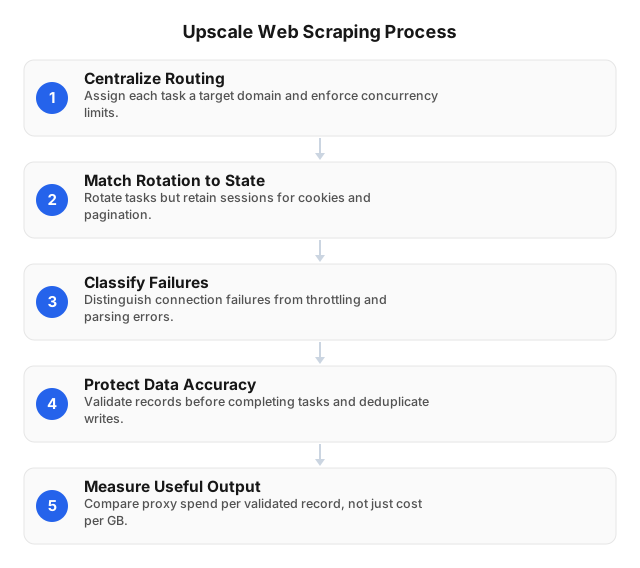
Define Success Before Adding Workers
Count a task as complete only after its record passes validation and reaches durable storage. An HTTP 200 containing a challenge page is not a successful extraction.
For product collection, define required fields explicitly: source product ID, numeric price, currency, availability, and collection time. Treat an explicit “out of stock” value differently from a missing availability field. Include region in the record identity if prices or inventory vary geographically.
Check permission, site terms, privacy obligations, and crawl instructions before scheduling requests. RFC 9309, Section 3 states that robots exclusion rules are not access authorization. Use our guide to web scraping legalities by region to identify obligations that require separate review.
Run a representative pilot before a full collection. A proposed 1,000-task test might include 600 detail pages, 200 listing pages, 100 pagination boundaries, and 100 regional or JavaScript-dependent pages; adjust that mix to your workload.
| Metric | Calculation | Decision it supports |
|---|---|---|
| Accepted-record yield | Validated records ÷ initial tasks | Whether fetching produces usable output |
| Retry amplification | Fetch attempts ÷ initial tasks | Whether failures inflate traffic |
| Bandwidth efficiency | Transferred bytes ÷ accepted records | Whether rendering or retries waste bandwidth |
| Field completeness | Records containing each required field ÷ accepted records | Whether parsers silently lose data |
| Fetch latency | Median and p95 by page and worker type | Where latency limits capacity |
| Queue age | Age of oldest unfinished task | Whether collection meets freshness deadlines |
Separate metrics by hostname, page type, region, and parser version. A high aggregate success rate can hide a broken regional parser.
Build Two Fetch Paths Around One Durable Queue
Use this processing sequence:
Discovery → durable queue → shared target limiter → fetch → validate → persist → acknowledge
First check for an authorized API, feed, or export. Otherwise, inspect the HTTP response: if it already contains the required data, launching a browser adds rendering work without improving extraction.
| Layer | Practical implementation | Operational requirement |
|---|---|---|
| HTTP crawling | Scrapy, or aiohttp with lxml | Connection reuse, timeouts, bounded concurrency |
| JavaScript rendering | Playwright | Separate queue, worker budget, rendering deadline |
| Task scheduling | Durable queue with delayed delivery | Recovery after crashes and duplicate delivery |
| Record storage | PostgreSQL | Unique keys, upserts, batched writes |
| Response archive | Compressed object storage | Retention limits and restricted access |
Scrapy’s architecture documentation describes its scheduler, downloader, spiders, and item pipelines. Those components do not replace coordination between separately deployed crawler instances.
Route tasks by extraction requirements, not by website alone. Product details may be available in HTML even when an interactive search interface requires JavaScript. Keep those workloads separate so a slow browser session cannot occupy every fetch slot.
Test resource blocking against saved fixtures. Removing images may reduce traffic; removing scripts can prevent the required data from appearing. For profiling and connection reuse, follow 12 Steps to Optimize Web Scraping Scripts in 2026.
Coordinate Rate, Concurrency, and Retries
Apply three independent controls per target:
- Start rate: requests allowed to begin per second.
- Concurrency: requests allowed to remain in flight.
- Retry budget: additional attempts allowed after failures.
Ten workers limited locally to two requests per second can collectively send twenty. Use a shared limiter keyed by hostname, with additional account or endpoint limits where required. Proxy rotation must not reset that target-level allowance.
Estimate useful concurrency with:
concurrency ≈ permitted requests/second × average response duration
At an authorized rate of two requests per second and an average duration of three seconds, about six in-flight requests can sustain the rate. This is a planning calculation, not a performance guarantee; test long-tail latency without exceeding the target’s allowance.
Add workers only when existing workers are saturated and permitted capacity remains unused. If database writes are the bottleneck, more fetchers increase backlog rather than accepted output. Bound the result queue and pause fetching when it fills.
Manage Proxies as Session-Bound Resources
Maintain a proxy registry rather than passing arbitrary endpoints into workers. For each route, record its identifier, region, protocol, session assignment, recent transport failures, latency, and transferred bytes. Keep credentials in a secret store and redact them from logs.
Use the following assignment rules:
| Workflow | Proxy policy | Reason |
|---|---|---|
| Independent, stateless detail pages | Rotate between tasks if appropriate | No session continuity is required |
| Cookie-dependent pagination | Keep the same proxy session and cookie jar | Changing identity can invalidate state |
| Regional price collection | Pin the intended region | A successful request can still return the wrong market |
| Multi-step authorized workflow | Preserve identity until completion | Intermediate state may depend on the session |
Diagnose failures before changing routes. Repeated connection failures may justify quarantining a route; a 429 requires reducing target traffic. Missing prices across healthy routes point toward extraction or page changes, not necessarily a proxy problem.
EProxies Specifications and Pricing
According to EProxies’ published service specifications, the advertised network includes 72M+ residential IPs across 195+ countries, with HTTP(S) and SOCKS5 support. EProxies also advertises 98.2% uptime, backed by a 99.9% uptime SLA. These are provider-reported figures, not a benchmark for your target; review the SLA’s scope and remedies separately from application-level extraction success.
According to EProxies’ published pricing, residential pay-as-you-go offers start from $0.25/GB, while the listed 300GB tier is approximately $0.73/GB. ISP SOCKS5 starts from $0.95/IP, and unlimited plans start at $79/month. Treat these as separate advertised offers—not one descending price schedule—and confirm eligibility, billing units, and plan conditions before budgeting.
Test the chosen protocol in your actual client. For example, HTTP(S) proxy configuration and SOCKS5 configuration may require different libraries or connection settings. Measure accepted-record yield and latency by route without using additional IPs to exceed authorized traffic limits.
Our guide to avoiding IP bans when web scraping covers traffic controls and session hygiene.
Eliminate Duplicate Downloads and Duplicate Records
Discover URLs through permitted sitemaps, feeds, or documented cursors before crawling navigation. Deduplicate before enqueueing, but preserve parameters that select currency, language, pagination, or another meaningful variant.
For repeat collection, use source update timestamps where available. Store ETag or Last-Modified validators and issue conditional requests when supported. RFC 9110 defines conditional request semantics: a 304 Not Modified avoids another response body, but still consumes a request.
Choose persistence keys deliberately:
- Current state:
(source, product_id, region). - Historical snapshots: add a scheduled snapshot ID.
- Task identity: use a stable collection-run ID plus the normalized task parameters.
Generate the snapshot ID when scheduling, not on each retry. Otherwise, replaying one task can create several historical observations.
Persist before acknowledging the queue message. If a worker crashes after persistence but before acknowledgment, the repeated task should update or conflict with the existing record—not create a duplicate.
Retain the source URL, collection time, parser version, validation result, and response reference where permitted. Reprocessing archived HTML after a selector fix avoids another download and preserves the original observation time.
Use Failure-Specific Recovery
Set a request timeout, a task deadline, and a maximum attempt count. An initial policy of one attempt plus two retries caps each task at three attempts; tune it using pilot results rather than increasing retries indefinitely.
| Failure | Response |
|---|---|
| Timeout or connection reset | Retry with capped backoff; inspect recurring transport failures |
| Temporary server error | Delay retry; follow valid server guidance |
429 Too Many Requests | Reduce the shared target rate and honor Retry-After |
| Access denial | Pause collection and review authorization |
| Parser or validation failure | Archive the response; fix extraction before refetching |
| Attempt budget exhausted | Send the task and error metadata to a dead-letter queue |
Retry-After can contain either an HTTP date or a delay in seconds. Support both formats.
Without server guidance, an illustrative two-retry policy could use randomized delays around two and four seconds, subject to the task deadline. Put retries back into a delayed queue instead of sleeping inside workers.
Track retry budgets across the target as well as per task. Otherwise, thousands of individually bounded tasks can still produce a retry surge during an outage. Pause the target when failures become widespread, then resume with a small test batch.
Budget From Accepted Output
Consider this hypothetical workload—not an EProxies benchmark:
- 100,000 initial tasks.
- 200 KB average response per attempt, using decimal units.
- 1.10 attempts per task.
- 95,000 accepted records.
- An authorized allowance of two request starts per second.
| Quantity | Calculation | Estimate |
|---|---|---|
| Total attempts | 100,000 × 1.10 | 110,000 |
| Response traffic | 110,000 × 200,000 bytes | 22 GB |
| Rate-limited start window | 110,000 ÷ 2 ÷ 3,600 | 15.3 hours |
| Traffic per accepted record | 22 GB ÷ 95,000 | About 232 KB |
The duration excludes startup, scheduling gaps, outages, and final response completion. Traffic excludes request overhead and browser assets; billed usage may differ.
If retry amplification rises from 1.10 to 1.30 while response size stays constant, response traffic rises from 22 GB to 26 GB. Fixing the failure mechanism removes 4 GB of response traffic without adding workers.
Calculate costs using the applicable offer:
proxy charge = billable GB × applicable per-GB rate
cost per 1,000 accepted records = total collection cost ÷ accepted records × 1,000
Include proxy traffic, browser compute, storage, and processing. Compare HTTP-first and browser-heavy pilots using the same completeness and freshness requirements; cheaper requests are not cheaper records if validation fails.
FAQ
What are the best tools for large-scale web scraping?
Use Scrapy for structured HTTP crawling, aiohttp with lxml for custom asynchronous extraction, and Playwright when JavaScript execution is necessary. Pair the fetch layer with durable scheduling, shared target limits, and idempotent storage. Select the combination using representative authorized pages, not a tool’s advertised request throughput.
What strategies improve data collection efficiency?
Deduplicate tasks, prefer authorized feeds or incremental updates, reuse connections, and avoid unnecessary browser rendering. Cache response validators and reprocess archived responses after parser fixes where permitted. Compare changes using bytes and cost per accepted record.
How can I manage proxies effectively?
Keep a central registry of proxy routes, regions, session assignments, latency, transport failures, and bandwidth usage; store credentials separately and redact them from logs. Bind cookies and geographic routing to the same sticky session for stateful workflows, rotating only between independent tasks. Quarantine repeatedly failing routes, reduce target traffic after 429 responses, and monitor accepted-record yield rather than treating every failure as a reason to change IPs.
How do I handle errors in web scraping?
Classify transport failures, throttling, access denials, and extraction failures separately. Retry temporary failures with bounded backoff, honor Retry-After, and enforce a shared retry budget. Pause denied workflows, retain malformed responses for debugging, and move exhausted tasks to a dead-letter queue.
What are common challenges in scaling web scraping?
Target limits, browser resource consumption, duplicate delivery, parser drift, and storage backlogs constrain different parts of the pipeline. Address them with shared limiters, separate browser workers, replay-safe writes, and fixture-based parser tests. Monitor queue age and field completeness so healthy HTTP traffic does not conceal stale or unusable data.
How many concurrent requests should I run?
Start with the permitted request rate multiplied by average response duration, then test within explicit concurrency caps. At two requests per second and three-second average latency, approximately six in-flight requests can sustain the rate. Do not increase concurrency when throttling or storage backlog is already rising.
Should I rotate proxies on every request?
Rotate between independent tasks only when changing identity does not disrupt state. Keep cookie-dependent pagination and multi-step workflows on a consistent session and region. Rotation does not authorize higher request rates or resolve parser errors.
Which metric best captures scraping efficiency?
Track total cost per accepted record alongside completeness and freshness. Include retries, proxy traffic, browser compute, and storage in the numerator. A configuration is only more efficient if it lowers that cost without weakening the dataset’s requirements.
This article was written by the EProxies team and reviewed against our editorial quality standards before publishing.