
Best Practices for Web Scraping with Anti-Bot Protection
TL;DR: Best practices for web scraping with anti-bot protection start with authorized access, controlled request rates, consistent residential proxy sessions, and record-level validation—not constant IP rotation. Measure usable data, distinguish throttling from access denials, and stop when a workflow requires permission you do not have.
For analysts, the useful metric is cost per valid, usable record—not the number of requests returning a successful HTTP status. A product page that returns a challenge, an empty price, or the wrong regional currency is a failed collection even if the connection succeeds. Build diagnosis and validation into the workflow before increasing throughput.
Understanding Anti-Bot Protection
Anti-bot systems evaluate network reputation, request patterns, browser signals, and session behavior to distinguish acceptable traffic from suspected abuse. A residential connection changes the request’s network origin; it does not guarantee acceptance or usable content. Diagnose the layer that failed before adjusting your scraper, because a connection timeout, a rate limit, and a challenge page require different responses.
Separate the signals into three groups:
- Network origin: IP reputation and geography can affect request handling. An unexpected location change can also alter currency, language, or product availability.
- Request behavior: Synchronized workers, repeated paths, and excessive concurrency can trigger throttling even when each worker appears modest in isolation.
- Client consistency: Cookies, HTTP headers, browser execution, and transport characteristics can expose contradictions between the client a request claims to be and its actual behavior.
Check content as well as status. A successful response containing a verification form should enter a diagnostic queue, not your product table. Validate expected fields, content type, and page structure before counting a request as successful.
Choosing the Right Residential Proxy
Choose residential proxies by testing authorized target workflows, session requirements, and cost per validated record—not pool size alone. A provider’s connectivity does not establish whether your target returns complete, correctly localized data. Run a small permitted pilot with representative pages, then compare usable output, session stability, bandwidth consumption, and failure categories before committing to larger collection jobs.
| Selection criterion | What to evaluate | Decision rule |
|---|---|---|
| Session behavior | Rotating versus sticky routing | Use sticky sessions for stateful workflows; consider rotation between independent, permitted jobs. Confirm available session duration before deployment. |
| Geographic coverage | Coverage in the markets your dataset requires | EProxies offers 72M+ residential IPs across 195+ countries; verify the location returned by your actual requests. |
| Protocol support | Compatibility with your HTTP client or browser | EProxies supports HTTP(S) and SOCKS5. Test authentication, TLS connectivity, and timeout handling in your chosen client. |
| Effective cost | Bandwidth spent on valid records, retries, and unusable pages | Compare cost per usable record rather than advertised bandwidth price alone. |
| Operational assurances | Observed availability and contractual commitments | EProxies lists 98.2% uptime, backed by a 99.9% uptime SLA; distinguish the reported metric from the contractual commitment. |
| Sourcing and controls | Participant consent, acceptable-use terms, and credential handling | Request sourcing documentation and confirm that your intended collection complies with provider and target requirements. |
Keep the pilot representative: include pages with pagination, regional variations, and JavaScript-loaded fields if those appear in production. Testing only a lightweight connectivity endpoint will not reveal extraction failures.
Setting Up Your Web Scraping Environment
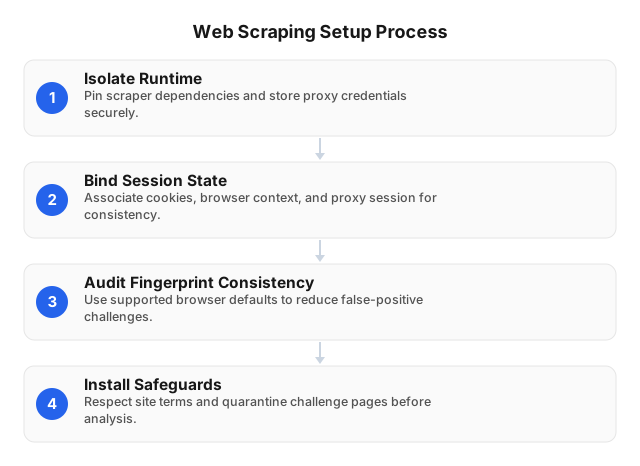
Separate scheduling, proxy routing, browser state, and extraction so failures remain diagnosable. Configure target-wide request limits before adding workers, and bind each cookie jar to its browser context and proxy session. Store credentials outside code and notebooks, then verify connectivity against an endpoint you control before testing an authorized target.
- Pin the runtime. Record scraper, parser, and browser versions so a dependency update does not silently change rendering or extraction. Keep proxy credentials in environment secrets and redact them from exceptions.
- Bind session state. Store the cookie jar, browser context, proxy session identifier, and intended geography together. Changing network location halfway through pagination can invalidate state or mix regional datasets.
- Use consistent clients. Prefer supported browser defaults over contradictory user-agent headers. Use a browser only when permitted content requires JavaScript; direct HTTP fetching usually consumes fewer resources for static pages.
- Add ingestion gates. Reject challenge pages, unexpected content types, and records missing required fields. Cache unchanged responses where permitted, and retain enough sanitized metadata to reproduce failures.
Before scaling, follow these script optimization steps to inspect unnecessary requests, repeated downloads, and parser overhead. Fixing duplicated work can reduce both bandwidth spend and target load without changing proxy strategy.
Handling Anti-Bot Responses in Authorized Workflows
Improve authorized collection by controlling demand and preserving session continuity, not by attempting to defeat access restrictions. Start with documented APIs where available, fetch static content directly when possible, and reserve browser rendering for fields that require it. Treat explicit denials and verification barriers as review points rather than reasons to cycle through residential identities.
- Coordinate request budgets centrally. All workers targeting the same origin should share a scheduler. A per-worker delay is insufficient if several jobs collectively exceed the target’s permitted request rate.
- Interpret the response before retrying. For HTTP 429, honor
Retry-Afterand reduce aggregate concurrency. For access denials, review permissions and request details; do not assume another IP is the appropriate remedy. - Preserve workflow continuity. Keep cookies and routing stable through authorized pagination or multistep navigation. Rotate only between independent jobs where doing so is consistent with the target’s rules.
- Render selectively. If product descriptions exist in the initial HTML but stock information requires JavaScript, avoid rendering every page by default. Use the least expensive permitted method that returns the required fields.
Set retry ceilings and a stopping condition before deployment. An unattended queue should not turn a temporary failure into an endless sequence of requests.
Monitoring and Adapting to Changes in Anti-Bot Systems
Monitor valid-record yield by target, geography, and session rather than treating successful connections as successful scraping. Track transport failures separately from challenges and extraction errors so configuration changes address the right cause. A sudden increase in missing prices may indicate a template change, while widespread rate-limit responses point toward scheduling pressure rather than parser logic.
Log response status, latency, transferred bytes, parser version, proxy geography, and a non-sensitive session identifier. Exclude credentials, raw cookies, and unnecessary personal data. Record validation failures explicitly: “missing price” is more actionable than “scrape failed.”
Compare failure patterns before intervening:
- Across all session groups: Check target changes, parser releases, and shared scheduling behavior.
- Within one geographic group: Inspect localization, regional availability, and targeting configuration.
- After a deployment: Compare browser dependencies, selectors, and required-field rules with the previous version.
- During concurrent jobs: Check aggregate demand across workers, not just individual request delays.
Test one permitted adjustment against an unchanged control. Changing routing, rendering, and concurrency simultaneously may restore output without revealing which change mattered.
Ethical Considerations and Legal Compliance
Check collection rights, privacy obligations, and site restrictions before scheduling requests; public visibility does not automatically authorize automated collection or reuse. Residential proxies alter routing, not legal permissions. For each target, document the permitted purpose, fields, access method, retention period, and stopping conditions, while treating robots.txt as crawling guidance rather than legal authorization.
Pause affected jobs when authentication requirements, CAPTCHA challenges, or explicit access denials make permission uncertain. Preserve sanitized response metadata and seek an approved API or written authorization rather than repeatedly changing identities.
For a pricing dataset, allowlist product identifiers, prices, currencies, and collection timestamps. Exclude reviewer profiles and contact details unless they are necessary and separately justified. Where GDPR or CCPA/CPRA applies, assess processing obligations, deletion procedures, retention, and international transfers with counsel.
Procurement also deserves scrutiny. Ask proxy providers how participants consent, withdraw participation, and report abuse. Keep the answer in your vendor review rather than assuming a residential address proves responsible sourcing.
Troubleshooting Common Issues
Classify failures as connectivity, throttling, access restrictions, or extraction problems before changing configuration. Test the failing layer in isolation and keep retries bounded, because repeated requests can amplify load without improving the dataset. Diagnose against a known-good permitted page or controlled endpoint, then confirm that the proposed fix restores valid records rather than merely successful responses.
| Symptom | First check | Appropriate response |
|---|---|---|
| Proxy authentication or connection failure | Credentials, protocol, DNS, and TLS errors | Test against an endpoint you control; correct configuration before retrying the target. |
| HTTP 429 | Retry-After and aggregate request volume | Pause the affected queue and lower target-wide concurrency. |
| HTTP 403 or CAPTCHA | Permissions, access requirements, and response body | Stop automated retries and review the approved access method. |
| Timeout or intermittent server error | Latency, response timing, and failure frequency | Use bounded backoff with jitter where retries are permitted. |
| HTTP success but missing fields | Challenge indicators, selectors, and regional variants | Quarantine the response; repair extraction or localization before ingestion. |
| Duplicated or inconsistent records | Pagination state, cookie continuity, and record identifiers | Preserve session state and deduplicate by stable identifiers. |
For every incident, retain the hostname, timestamp, session identifier, status, latency, and validation result. Redact secrets and personal data. Re-run a small authorized sample after a fix; do not immediately release the entire backlog.
Related reading
Use the e-commerce guide for product-level validation and the regional legal guide for jurisdiction-specific review before recurring collection. Together, they help turn a generic scraper configuration into a target-specific operating plan: defined fields, permitted access, regional constraints, and explicit conditions for pausing the job.
- Best Practices for E-Commerce Web Scraping in 2026
- Web Scraping Legalities and Best Practices by Region
FAQ
Use the failure type and authorized workflow to choose your next action: proxies address routing, schedulers control demand, and validators protect data quality. None substitutes for permission. The answers below distinguish those responsibilities so a challenge page, rate limit, or missing field does not trigger the same indiscriminate retry strategy.
What is anti-bot protection?
Anti-bot protection detects and manages automated traffic using request behavior, network reputation, session state, and browser signals. Controls may throttle requests, deny access, or return a verification page instead of the requested content. Validate expected fields and page structure, because an HTTP success status alone does not establish successful collection.
How do residential proxies help in web scraping?
Residential proxies route requests through residential IP addresses to support location-specific collection and consistent sessions in authorized scraping workflows. Sticky routing can preserve an exit IP during pagination, while rotation can separate independent permitted jobs. They do not guarantee acceptance, grant permission, or remove account-, session-, or endpoint-level rate limits.
What are the legal considerations for web scraping?
Web scraping requires assessing access permissions, site terms, privacy obligations, and rights governing the collected content and its reuse. Public visibility alone does not authorize every collection or redistribution activity. Document the purpose, permitted fields, retention rules, and deletion procedures, and obtain legal review where access rights or sensitive-data obligations are uncertain.
How can I bypass anti-bot measures effectively?
For authorized scraping, reduce avoidable challenges with approved APIs, permitted request rates, consistent sessions, caching, and selective browser rendering rather than defeating access controls. Coordinate throttling across workers and honor Retry-After. Stop automated retries at CAPTCHA challenges or explicit access denials, then seek an approved access method.
What are common issues in web scraping and how to fix them?
Common issues include rate limits, connection failures, access denials, challenge pages, and broken extraction; fix each by diagnosing its layer before retrying. Honor Retry-After for throttling, check credentials and TLS for connection failures, and review permissions for denials. Quarantine unexpected HTML or missing fields, repair selectors where needed, and use bounded backoff only for transient failures that permit retries.
This article was written by the EProxies team and reviewed against our editorial quality standards before publishing.