
Top Solutions to Avoid Web Scraping Limitations in 2026
TL;DR: Reduce web scraping failures with task-appropriate proxies, controlled request rates, consistent sessions, and record validation—not IP rotation alone. Prefer authorized APIs or feeds, test against permitted targets, and measure usable records rather than completed requests. Treat access restrictions as boundaries, not obstacles to defeat.
For competitive intelligence, a response is useful only when it contains the correct product, market, currency, and timestamp. Proxy selection affects routing and cost. Request settings affect server load and session continuity. Validation determines whether the results belong in a pricing dashboard.
Understanding Web Scraping Limitations
Collection can fail at the connection, access, or extraction stage. Connection success is not dataset quality: check the content before treating a request as successful.
- IP blocking: Log blocked requests separately from connection failures. A reachable proxy does not establish that the target accepted the request.
- CAPTCHAs: Separate challenge pages from product pages so challenge text does not enter the pipeline as missing inventory.
- Rate limits: Identify rate-limit responses separately so they trigger traffic controls rather than extraction fixes.
- Data quality failures: Changed page layouts can break selectors, making extraction errors look like changes in a retailer’s assortment. Even an extracted record may describe the wrong product or market.
These distinctions determine whether a job needs routing changes, lower request volume, or parser repairs.
Advanced Proxy Solutions for Web Scraping
Residential routing can help with location-specific collection and some failures associated with an individual IP. It cannot repair a parser or guarantee target acceptance. Evaluate proxies on permitted pages from your actual collection targets, tracking location consistency and retries rather than relying on infrastructure tests alone.
For a hypothetical retailer-price job, cap request volume at the approved product URL list and avoid duplicate fetches. Use a consistent country, cookie set, and session identity. Limit concurrency according to the retailer’s published rules. Quarantine responses with unexpected currencies instead of silently accepting them as comparable local prices.
According to EProxies’ product information, its residential network includes 72M+ IPs across 195+ countries, and its supported protocols include HTTP(S) and SOCKS5. Those specifications describe network coverage and protocol compatibility—not guaranteed access to a particular website. Confirm that your selected plan supports the location and session controls your workflow requires.
Use the practical guide to IP rotation to plan session boundaries.
Comparison of Proxy Types
With those requirements defined, choose a proxy type by the task’s location needs, session requirements, and cost per validated record. Test each option under the same permitted workload. Count validation failures and retries alongside traffic charges so a cheap connection does not hide expensive data loss.
| Proxy type | Potential fit | Trade-off to validate |
|---|---|---|
| Datacenter | Routine collection from public pages that permit automation | Target acceptance may differ from residential routing |
| Rotating residential | Independent, location-specific price checks | Changing IPs can disrupt session-dependent results |
| Sticky residential | Related page requests within one market | Cookies and location need to remain consistent |
| ISP/static | Repeat monitoring requiring a persistent IP | Verify IP persistence and the cost of retaining addresses |
EProxies’ pricing information lists pay-as-you-go residential traffic from $0.25/GB and ISP SOCKS5 from $0.95/IP. Treat these as starting prices, not a quote for every configuration. Confirm the applicable plan and billing terms before comparing total charges.
Proxy configuration is only one part of the request profile. The client’s headers also need to remain coherent.
Implementing User-Agent Rotation
Assign client identifiers at session boundaries when your workflow requires different profiles; do not randomize them on every request. This can reduce avoidable response differences during comparisons. User-agent rotation does not change the underlying browser fingerprint or replace request limits.
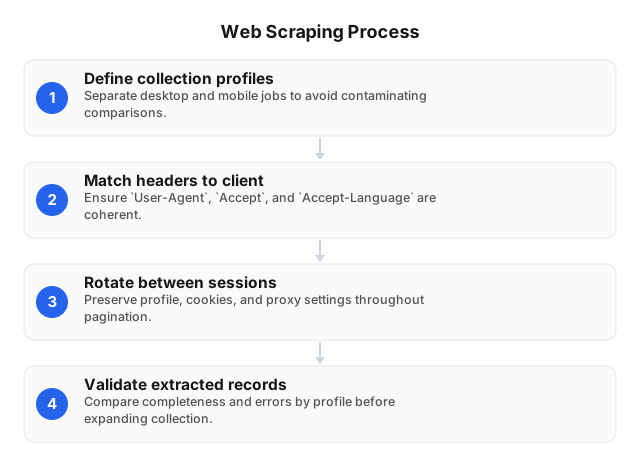
- Define collection profiles. Keep desktop and mobile jobs separate. Their page layouts or offers may differ.
- Match headers to the client. Keep
User-Agent,Accept, andAccept-Languagecoherent. Describe the actual client rather than using random browser identities or claiming capabilities it lacks. - Preserve session settings. Keep the selected profile aligned with cookies and proxy settings throughout pagination.
- Validate by profile. Compare price completeness, currency, and parser errors before expanding collection.
Use a browser-based client only when the permitted workflow needs browser rendering. A header change alone cannot execute JavaScript. The custom headers guide explains how request headers affect collection behavior.
Handling CAPTCHAs and Anti-Bot Measures
Even a consistent request profile may encounter access controls. Pause collection when a target presents a CAPTCHA or explicit access denial. Classify the response before deciding whether any retry is permitted. Repeated challenges can indicate that the workflow needs lower traffic or a site-approved access method.
- Classify failures. Distinguish challenge pages, rate-limit responses, connection errors, and parsing failures in collection logs.
- Reduce pressure. Pause affected queues, honor server retry instructions, and lower per-domain concurrency.
- Review the session. Check whether cookies and proxy identity remained aligned during the authorized session.
- Choose an approved route. Request API access, a licensed feed, or collection permission when public-page access is unsuitable.
Apply request limits across the entire proxy pool, not separately per IP. Do not spread requests across more IPs to defeat a site-wide limit or switch identities to continue after an explicit access denial.
Ethical Considerations in Web Scraping
These operational stop conditions belong within a broader collection policy. Define permission and scope before scheduling collection. Record the approved sources, required fields, collection frequency, and person responsible for reviewing access problems. Proxy rotation and header changes affect requests, not permission. Site terms, privacy obligations, licensing, and applicable laws still need review, even when pages are publicly visible.
Treat robots.txt as an operational signal, not legal authorization. Review site terms separately, and refer unclear permissions, personal data, or restricted content for legal review.
For price monitoring, retain product identifiers, prices, currencies, and collection timestamps. Exclude customer profiles and other personal data the analysis does not need. Document provenance through source URLs, define retention limits, and assign an owner to handle removal requests and stop collection when permission is withdrawn.
Best Practices for Reliable Data Collection
Once scope and access are established, validate records before they reach pricing dashboards. Track required-field completeness, duplicates, timestamps, availability, and retry volume by target. Keep geography, language, currency, and session context stable within each comparison. These checks help analysts separate market changes from extraction failures.
For a hypothetical hotel-rate comparison, cap request volume at the approved property-and-date list. Reuse cached results where their age meets the project’s freshness requirements. Keep dates, occupancy, language, country, and currency fixed across the job. Quarantine records with changed dates or missing fee details rather than comparing different stays.
Maintain representative page fixtures for parser regression tests. When a layout changes, test extraction against those fixtures before restarting the queue. Never replace a missing price with zero.
Preserve collection context alongside source URLs and normalized values. If a retry changes geography, flag the result rather than treating it as a market-wide price change.
Related reading
The same controls apply to workflows with additional extraction or comparison requirements. AI-assisted extraction still needs validation when page layouts change. Travel research requires matching dates, availability, and offer conditions. Use the guide that matches the collection task you are designing.
- The Role of AI in Web Scraping: Pros and Cons (2026)
- Web Scraping for Travel Industry Dynamics in 2026
FAQ
The following answers summarize the main decisions involved in diagnosing collection failures and choosing an appropriate response.
What are common web scraping limitations?
Common limitations include IP blocking, rate limits, CAPTCHAs, browser fingerprint checks, changing layouts, and incomplete data.
How do proxies help in web scraping?
Proxies route requests through intermediary IP addresses and can support location-specific research.
What is the best proxy type for web scraping?
The best proxy type depends on the target’s permitted access methods, location requirements, and session needs.
How can I bypass CAPTCHAs during scraping?
Use a site-approved API, feed, or authorized access method rather than circumventing a CAPTCHA. Before any permitted retry, review request frequency, duplicate fetches, and permission.
What ethical issues should I consider in web scraping?
Review site terms, access restrictions, privacy, intellectual property, and the load your requests place on the source. Public visibility does not automatically authorize unrestricted collection or reuse.
This article was written by the EProxies team and reviewed against our editorial quality standards before publishing.