
The Role of AI in Web Scraping: Pros and Cons (2026)
TL;DR: AI helps web scrapers interpret changing layouts and normalize inconsistent text, but it adds inference costs and can generate unsupported values. Keep deterministic parsers for stable fields, use AI for exceptions, and validate accepted records against source evidence. AI does not establish permission to collect data.
For developers and analysts building scraping pipelines in 2026, the useful comparison is cost per validated record—not pages downloaded or model responses generated. Separate retrieval from extraction, then measure whether AI reduces parser maintenance enough to offset inference, retries, and human review.
Introduction to AI in Web Scraping
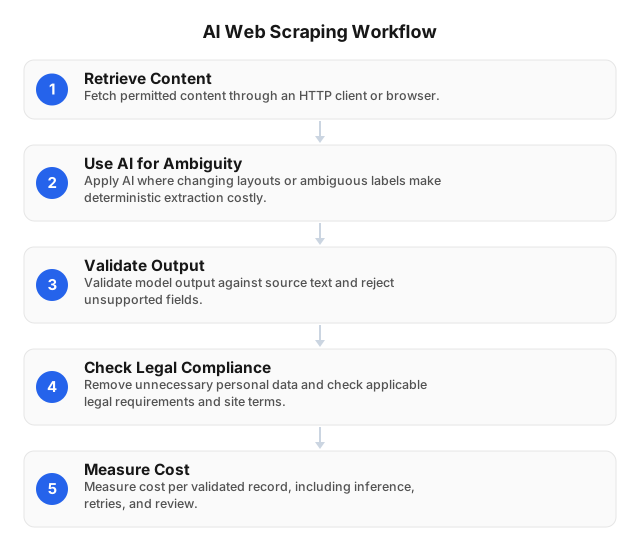
AI-assisted extraction turns retrieved page content into structured fields when fixed selectors are difficult to maintain. Its strongest use case is interpreting inconsistent labels and layouts, not replacing every parser. Fetch authorized content with an HTTP client or browser, then apply AI only where interpretation justifies its additional cost.
A pricing pipeline might map “current price,” “offer price,” and “sale price” into one schema. That mapping still needs rules for currency, product variant, and availability; otherwise, the model may mix a subscription price with a one-time purchase price.
Keep three stages separate: retrieval obtains the page, extraction identifies fields, and validation determines whether those fields can enter the dataset. A successful HTTP response proves only that retrieval worked.
How AI Enhances Web Scraping Efficiency
AI improves scraping efficiency by reducing extraction-rule maintenance and manual interpretation across inconsistent pages. Stable templates usually remain cheaper to parse with selectors; models are more useful when labels change or fields appear in unfamiliar structures. Route those exceptions to AI, then compare the resulting cost per validated record with your existing parser.
For a pricing pipeline, use this sequence:
- Run existing selectors for price, currency, and product identifier.
- If required fields are missing, send the relevant page fragment—not the entire page—to the model.
- Require a schema containing extracted values and supporting source text.
- Reject unsupported values or route them to review.
Measure inference, browser execution, retries, and review time together. A low-cost model call does not save money if its output creates more analyst corrections.
For browser-rendered content, see Web Scraping with AI for Dynamic Websites in 2026. Rendering must expose the required content before a model can extract it reliably.
Ethical Considerations in AI-Powered Web Scraping
Responsible AI-assisted scraping requires a defined collection scope: approved sources, allowed fields, a justified processing purpose, and retention limits. Public visibility does not establish permission for every reuse. Assess applicable privacy obligations and site terms before collection, then prevent the extraction model from expanding the dataset beyond the fields you approved.
For pricing analysis, allow product identifiers, prices, and availability; exclude reviewer names and profile links unless the task has a documented basis for collecting them. Redact unnecessary personal data before submitting content to an external model, and inspect that service’s retention and training settings.
Store source URLs and collection timestamps with accepted records. Set deletion rules for both extracted data and cached pages; deleting a database row does not remove personal information from stored HTML.
Treat login walls and CAPTCHA challenges as stop conditions pending authorization review. Use request limits and backoff to reduce load; operational guidance appears in Best Practices for Web Scraping While Avoiding Bans: 2026.
Challenges and Limitations of AI in Web Scraping
AI-assisted extraction can produce unsupported values, inconsistent interpretations, and inference overhead, and it depends on complete source content. Models cannot reliably extract a price that never appeared in the retrieved page. Evaluate retrieval success and extraction correctness separately, and require missing fields to remain null rather than accepting a plausible substitute.
For prices, check currency, product variant, and sale status against source text. A correctly formatted number can still be wrong if it belongs to a related product or represents a monthly installment.
Dynamic layouts require rendering and session management before extraction. If the browser has not loaded a selected variant’s price, sending the initial HTML to a larger model will not supply that missing evidence.
Log the model version, prompt version, validation failures, and review outcome. When outputs change after a model update, these records let developers distinguish source changes from extraction regressions.
Comparison: AI vs Traditional Web Scraping Methods
Traditional scraping suits stable, explicitly labeled fields; AI-assisted extraction suits ambiguous text or frequently changing layouts. Neither method guarantees correctness: selectors can target the wrong element, and models can invent unsupported values. A hybrid pipeline keeps predictable extraction in code and sends only failed or uncertain cases to a model.
| Decision factor | Traditional methods | AI-assisted methods |
|---|---|---|
| Layout changes | Selectors need repairs when relevant structures change. | Semantic extraction may tolerate changes; field mappings still need validation. |
| Accuracy | Repeatable rules can repeatedly select the wrong element. | Plausible but unsupported values require source checks. |
| Runtime cost | Parsing avoids inference charges. | Model calls, retries, and review add costs. |
| Dynamic content | Browser rendering and session handling require explicit implementation. | AI still depends on content being retrieved and rendered. |
| Access restrictions | Authentication requires authorization. | AI grants no additional access rights. |
| Auditability | Log selectors, source values, and parser versions. | Also log prompts, model versions, and validation outcomes. |
Test both approaches against the same saved pages and expected field values. Include missing prices, multiple currencies, unavailable variants, and changed layouts; an evaluation set containing only clean pages will conceal expensive failure modes.
For a sector-specific example, Web Scraping for Travel Industry Dynamics in 2026 provides context for collecting travel data, where dates, occupancy, and booking conditions can change the meaning of a displayed price.
Future Trends in AI and Web Scraping
Selective automation is a practical direction for AI-assisted scraping: models propose extraction mappings or selector repairs, while tests and approval rules control deployment. Treat this as an engineering strategy, not a guaranteed industry outcome. Track accepted records, review time, and compute use to determine whether each new capability improves the pipeline.
A model-generated selector repair should pass tests against saved pages before deployment. Check field types, missing-value behavior, and source evidence; a selector that fixes one template can break another.
Enforce governance during execution through approved-domain lists, personal-data filtering before model calls, and explicit stop conditions for access barriers. An agent should flag a login wall rather than add an unapproved recovery step.
Cache unchanged pages and version extraction results. Reusing a validated result avoids repeated inference, while a changed content hash can trigger fresh extraction.
Deployment Checklist for AI-Assisted Scraping
An AI-assisted scraper is ready for release only after it meets defined requirements for extraction accuracy, cost, access authorization, and traceability. Compare the hybrid pipeline with your current parser on the same permitted pages. Keep AI only where its reduction in maintenance or review work outweighs model usage, browser execution, and validation costs.
Before expanding coverage, verify these controls:
- Schema: Specify required fields, data types, and allowed null values.
- Evidence: Preserve source snippets for accepted values.
- Evaluation: Count rejected records, review minutes, retries, and total processing cost.
- Privacy: Filter unnecessary personal data before external model calls.
- Fallback: Quarantine unsupported output instead of asking the model to fill gaps.
- Access: Keep login walls and CAPTCHA challenges outside automated recovery logic.
Set a release threshold using your own validated baseline; do not substitute a model provider’s general benchmark for accuracy on your pages.
FAQ
AI-assisted scraping improves interpretation of retrieved content, not access rights or source reliability. A model can map labels into a schema, but it cannot grant permission, guarantee accurate values, or replace browser rendering. The answers below distinguish extraction benefits from collection responsibilities and explain where deterministic parsing remains the better choice.
What is AI web scraping?
AI web scraping uses machine learning or language models to extract and structure information from retrieved web pages. For example, a model can map differently labeled product attributes into a shared schema. It does not replace HTTP fetching, browser rendering, or authorization to access the source.
How does AI improve web scraping?
AI improves web scraping by interpreting inconsistent labels and layouts, reducing manual field mapping and parser maintenance. A model can associate “sale price” and “current price” with the same output field without a separate selector for each template. Validate the value, currency, and product variant against source text before accepting the record.
What are the ethical concerns with AI in web scraping?
The ethical concerns include excessive personal-data collection, unauthorized access, website load, and disclosure of sensitive content to external model services. Define allowed fields before collection, assess applicable laws and site terms, and configure retention rules. Public visibility alone does not justify every collection or reuse.
What are the limitations of AI in web scraping?
AI can misinterpret content, generate unsupported values, and add latency and inference costs. It also depends on the retrieved input: missing elements, incomplete rendering, and inaccessible pages remain upstream problems. Require source evidence, allow null outputs, and send ambiguous records to review rather than accepting guesses.
How does AI compare to traditional web scraping methods?
AI handles varying layouts and ambiguous language more flexibly, while traditional selector-based scraping is generally cheaper and more repeatable for stable templates. AI’s flexibility introduces inference costs and additional validation work; selectors instead require explicit repairs when relevant page structures change. Parse known templates deterministically, reserve AI for exceptions, and compare total cost per validated record—including retries and human review.
This article was written by the EProxies team and reviewed against our editorial quality standards before publishing.