
Best Practices for Web Scraping While Avoiding Bans: 2026
TL;DR: Reduce scraping ban risk by verifying permitted access, pacing requests per destination, preserving session consistency, and stopping when access is denied. Test the scheduler and parser before recurring collection. Residential proxies support request distribution and localization—not permission to override restrictions. Measure usable records, not just successful HTTP responses.
For analysts collecting public web data, blocked requests and parsing failures must not look like missing inventory or discontinued products. Separate access failures from genuine source-data changes, then use those distinctions to control retries, validate output, and decide whether a collection job can continue.
Introduction to Web Scraping and Bans
Web scraping can trigger blocking when automated traffic exceeds a site's limits or violates its access policies. A completed request does not prove that the requested data arrived: the response may contain a challenge, an error, or an unexpected page. Measure usable records rather than completed connections, and distinguish failed access from genuine changes in the source dataset.
Establish distinct outcomes in your logs before scaling collection:
- Access failure: the target refuses the request or returns a challenge.
- Extraction failure: content arrives, but expected fields cannot be parsed.
- Valid absence: the accessible source genuinely contains no matching record.
Require evidence for valid absence, such as the expected page structure and an explicit unavailable-product message. A missing price field on a challenge page is not evidence that a product has disappeared.
Understanding Website Terms of Service
Website terms of service should determine whether a scraping workflow proceeds, not merely how requests are delivered. Review provisions covering automated access, permitted uses, redistribution, and account access before scheduling collection. Public visibility alone does not establish authorization. Resolve ambiguous terms before deploying workers, expanding the dataset, or purchasing additional proxy capacity.
Translate that review into a source-specific collection record: save the terms URL, review date, relevant clauses, approved fields, and intended use. Check robots.txt separately for crawl instructions; it is not a substitute for reviewing the terms.
If automated access is prohibited or the wording is ambiguous, pause deployment and request written clarification or an approved data feed. Recheck permission before expanding collection scope. Changing a proxy address does not resolve a permission problem.
Implementing Ethical Web Scraping Practices
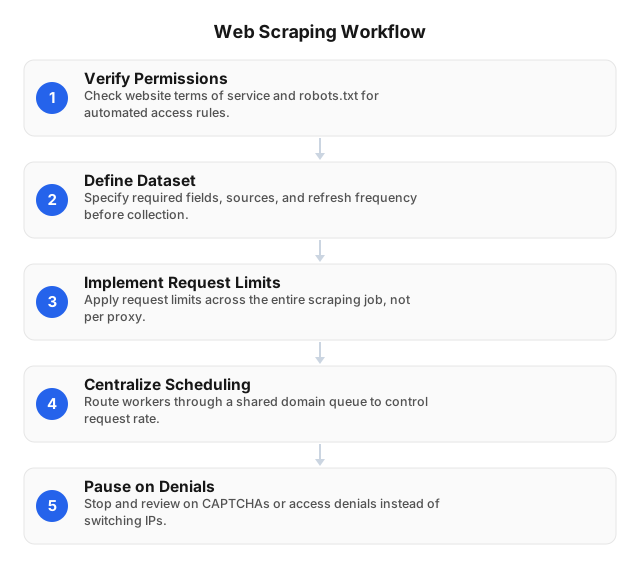
Ethical web scraping limits collection to permitted fields, respects destination-wide traffic limits, and stops when access is restricted. For an approved public electronics catalog, define request volume as the deduplicated product URL list for each scheduled run. Adding workers or proxy addresses must not increase that budget; allowed retries must consume the same shared allowance.
Configuration example: a public electronics catalog
This is an operating plan, not a measured case study.
- Target and volume: Collect approved product-detail pages from a public electronics retailer. The scheduled fetch volume equals the unique approved URLs remaining after cache reuse; reserve any permitted retries within the approved request budget.
- Fields: Extract product identifier, price, currency, and availability. Exclude reviews, customer profiles, and unrelated page content.
- Settings: Use a shared domain queue, the site's permitted pacing, applicable
robots.txtexclusions, and cached responses where reuse is appropriate. Keep currency and locale settings consistent. - Acceptance rule: Publish a record only when the response matches the expected product page and its required fields validate.
- Expected outcome: A price snapshot with explicit collection gaps. Challenges and parser failures remain quarantined rather than becoming “out of stock” entries.
If the approved budget is exhausted, defer remaining work instead of allocating another proxy to finish the run.
Advanced Techniques to Avoid Bans
A shared scheduler and tested stop conditions reduce avoidable scraping traffic more reliably than arbitrary delays. Configure pacing from the target's published guidance or approved access arrangement, then verify that workers and retries obey it. Randomized waiting may spread requests, but it must never shorten the required delay or allow collection to continue after an explicit denial.
Preflight walkthrough: test the controls before the destination
Use saved, lawfully obtained pages and local simulated responses to test failure handling without generating extra target traffic. This walkthrough specifies expected behavior; it does not report test results.
- Load configuration: Set the approved hostname, URL allowlist, request budget, required delay, required fields, and permitted retry policy. Keep proxy credentials outside application logs.
- Test deduplication: Submit duplicate approved URLs through separate workers. Inspect dispatch logs to confirm that the scheduler fetches each queued URL only as intended.
- Test server-directed waiting: Simulate a response with
Retry-After. Confirm that the domain queue waits for the specified interval and that a retry cannot bypass the scheduler. - Test an access refusal: Supply a denial or CAPTCHA fixture. Confirm that collection pauses, no replacement proxy is selected, and the response produces no product record.
- Test extraction: Supply a valid product fixture, a changed-layout fixture, and an explicit unavailable-product fixture. Confirm that the parser distinguishes valid records, extraction failures, and valid absence.
- Check a permitted live sample: Inspect the final URL, content type, page structure, location context, and required fields before enabling the recurring job.
Log dispatch times, retry reasons, pause events, and validation outcomes. Watch for retries appearing outside the shared queue, challenge pages accepted as data, or missing fields classified as valid absence. Each indicates a control failure that must be fixed before scaling.
Effective Proxy Management for Web Scraping
Residential proxy settings should preserve the session and location context required by an authorized workflow. EProxies provides 72M+ residential IPs across 195+ countries with HTTP(S) and SOCKS5 support for geographic routing. Coverage does not guarantee destination acceptance: the collection job still needs permission, shared pacing, content validation, and stop conditions that remain effective across proxy changes.
Configuration example: regional grocery prices
For an authorized grocery-price comparison, use the approved product list and approved regional storefronts as the collection scope.
- Target and volume: Fetch each approved product URL for each approved region per scheduled run, excluding reusable cached pages. Include permitted retries within the agreed budget, not as an unlimited extra allowance.
- Settings: Select the required country, set the storefront's approved delivery region, and retain cookies and a consistent proxy identity throughout each location-dependent session. Route all sessions through the same destination-wide scheduler.
- Validation: Compare the returned delivery region and currency with the requested context before accepting prices.
- Expected outcome: Regional records that remain comparable because each carries its product identifier, currency, delivery region, source URL, and collection time.
This is a configuration example, not observed performance. If the storefront resets the delivery region, quarantine affected records and repair the session before continuing. A country-level proxy selection alone does not establish the store's local pricing region.
Log destination, proxy identity, requested location, latency, response status, and valid records extracted. Measure bandwidth per usable record, including permitted retries, rather than choosing infrastructure solely by connection success.
Use IP rotation practices to plan boundaries between independent jobs, and keep request headers consistent with the workflow. Do not rotate identities to continue after an access refusal.
Legal Considerations in Web Scraping
Legal review for web scraping must cover access permissions, privacy obligations, and downstream reuse—not just whether a page is publicly reachable. Document the intended use, relevant jurisdictions, collected fields, and retention policy for each dataset. Obtain qualified legal advice when authorization, personal-data handling, or redistribution rights are uncertain; proxy routing cannot resolve those questions.
Separate access approval from downstream use. Permission to retrieve a page should not be treated as permission to republish its text or sell its records. Prefer a licensed feed when reuse rights are unclear.
Treat login gates, explicit denials, and revoked permission as stop-and-review signals—not reasons to change proxy addresses. Keep source URLs and permission records alongside extracted data so reviewers can trace provenance.
Preflight Checks for Recurring Collection
A recurring scraping job is ready only when its permission record, request budget, session settings, and validation rules have been checked. Proxy availability cannot compensate for missing authorization or a broken parser. Assign an owner who can pause collection, and block incomplete runs from entering dashboards as though they represented genuine source-data changes.
Before scheduling:
- Confirm permitted URLs, fields, uses, and retention rules.
- Apply throttling across all workers serving the same destination.
- Verify denial and
Retry-Afterhandling with local fixtures. - Preserve location and session context where the workflow requires it.
- Route allowed retries through the original request budget.
- Validate page type and required fields before accepting records.
- Quarantine incomplete runs and record why publication was withheld.
Recheck permissions and parser assumptions whenever the target changes its terms, layout, or access behavior. Require a fresh validation pass before releasing data collected under changed settings.
Related Reading
The IP rotation and custom-header guides address delivery settings for already-authorized collection. Use them to define session boundaries and keep request metadata consistent with cookies and location settings. Neither replaces destination-specific permission checks or pacing rules. After changing routing or headers, verify returned content and session context before accepting new records.
FAQ
Scraping ban prevention depends on permitted access, destination-wide pacing, and enforceable stop conditions—not proxy rotation alone. Troubleshooting must distinguish delivery failures from permission problems and invalid data. Use the answers below to decide whether to adjust a permitted workflow, repair extraction, or stop collection and seek clarification from the source.
What are the risks of web scraping?
Web scraping can lead to IP blocks, account restrictions, legal disputes, and incomplete or misleading datasets. A site may return a challenge page instead of the requested content, causing a scraper to save an error message as a record. Validate page types and required fields before accepting results, and distinguish missing source records from failed retrievals.
How can I scrape data without getting banned?
You can reduce ban risk with permitted endpoints, published crawl rules, controlled request rates, and clear stop conditions, but uninterrupted access is not guaranteed. Schedule requests per target domain rather than per proxy so adding IPs does not multiply traffic. Honor server retry instructions, and pause on denials or CAPTCHAs instead of trying new identities.
What are ethical web scraping practices?
Ethical scraping means collecting permitted, necessary data while respecting privacy, site rules, and server capacity. Read the relevant robots.txt rules without treating an allowed path as legal authorization. Deduplicate URLs before fetching, cache content where appropriate, restrict access to collected records, and delete data that falls outside your documented purpose or retention policy.
How do proxies help in web scraping?
Proxies route requests through intermediary IP addresses, supporting geographic routing and request distribution for permitted collection. EProxies offers 72M+ residential IPs across 195+ countries and supports HTTP(S) and SOCKS5. Choose settings that preserve required session context, then validate the returned content. A proxy does not grant permission or remove the destination's traffic limits.
What legal issues should I consider when web scraping?
Check applicable privacy law, website terms, intellectual-property rights, and restrictions on unauthorized access before scraping. Public visibility alone does not establish permission to collect, retain, or republish information. Obtain jurisdiction-specific legal review before collecting personal data, using authenticated access, or redistributing substantial datasets, and document your permitted purpose, sources, and retention rules.
This article was written by the EProxies team and reviewed against our editorial quality standards before publishing.