
Web Scraping for Travel Industry Dynamics in 2026
TL;DR: Travel web scraping helps companies compare advertised fares, hotel rates, and booking conditions—not measure confirmed bookings or demand. Match six fields before comparing prices: travel dates, occupancy, room or fare category, cancellation policy, currency, and tax treatment. Preserve search location and collection time, and distinguish explicit unavailability from failed requests before issuing alerts.
Introduction to Web Scraping in the Travel Industry
Travel web scraping converts permitted listings into timestamped observations of prices, availability, and booking conditions. Each observation should identify the source, search market, travel dates, and collection outcome. Its evidentiary limit is specific: a displayed offer establishes what the source returned at collection time, not what travelers purchased or how much inventory remains.
Define equivalence before writing extraction code. A nonrefundable room without breakfast is not interchangeable with a flexible rate that includes breakfast, even at the same property.
Keep collection failures outside availability calculations. A timeout, consent screen, or broken selector means the collector lacks evidence—not that the supplier sold out.
Benefits of Web Scraping for Travel Industry Dynamics
Comparable snapshots help revenue teams detect persistent price changes, compare package benefits, and prioritize offers for review. The actionable output is a changed offer with its conditions attached, rather than an isolated price. Booking volume, occupancy, and demand still require transaction or inventory evidence; advertised listings cannot establish those measures independently.
Store total_price, cancellation_deadline, and included_meals as separate fields. If a competing property adds flexible cancellation without increasing its total price, matching that benefit may be more appropriate than discounting.
Require a second successful observation before escalating an unexpected change. Set the confirmation interval from the source’s refresh cadence: minute-by-minute polling adds little evidence when the underlying feed updates hourly.
Key Data Points to Extract for Travel Analysis
Collect price components, booking conditions, availability status, search settings, and provenance in the same record. These fields distinguish a supplier price change from a different room, market, or tax display. For reviews, retain publication date and language so an old complaint or translated duplicate does not become evidence of a current service problem.
| Category | Fields | Interpretation rule |
|---|---|---|
| Prices | Base price, taxes, baggage, resort fees, currency | Compare payable totals; flag unknown mandatory charges. |
| Availability | Dates, room or fare class, minimum stay | Separate explicit unavailability from collection failure. |
| Conditions | Refundability, cancellation deadline, inclusions | Distinguish discounts from reduced benefits. |
| Reviews | Publication date, rating, text, language | Group complaints by theme and reporting period. |
| Localization | Search country, language, currency, point of sale | Separate market-specific offers from conversion effects. |
| Provenance | Source URL, UTC timestamp, extraction version | Trace alerts and identify parser-related changes. |
Use four collection states: available, unavailable, request_failed, and parse_failed. Reserve unavailable for an explicit response reporting no matching offer; an empty HTML panel does not qualify.
Keep the displayed amount and currency alongside converted reporting values. Store the exchange-rate timestamp rather than recalculating historical observations silently with today’s rate.
Step-by-Step Guide to Implementing Web Scraping
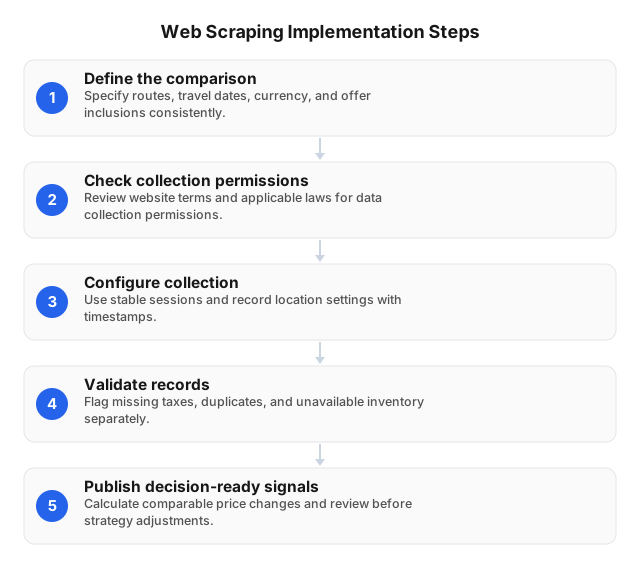
Build the collector around a fixed comparison key, then test whether the source preserves search state throughout the booking flow. Validate the displayed offer against extracted fields before scheduling repeat runs. A reset date picker, omitted tax, or changed baggage allowance can otherwise trigger a pricing alert even though no equivalent offer became cheaper.
- Define the comparison key. Combine property or itinerary ID, dates, occupancy, room or cabin class, cancellation terms, currency, and point of sale. Store collection time separately so successive observations share the same key.
- Verify permitted access. Review source terms, robots directives, privacy obligations, and applicable law. Prefer authorized APIs or licensed feeds; do not bypass access controls.
- Configure a controlled search. In Playwright, set
locale; configure the authorized proxy throughproxy.server; then select the site’s country and currency controls. Preserve the browser context, cookies, and sticky proxy session through date selection and extraction. Browser locale alone does not establish point of sale. - Check state after navigation. Repeat the permitted search and compare selected dates, occupancy, currency, and displayed market with the intended inputs. Watch for consent redirects and room-panel refreshes that reset those values. Capture the source URL and rendered offer when a mismatch occurs.
- Gate alerts on validation. Reject records missing taxes, dates, or cancellation terms rather than copying old values. Publish previous and current totals, UTC timestamps, source URLs, and changed benefits; require analyst review before repricing.
This is a reproducible test setup, not a claim of measured customer results. The API-driven scraping guide covers scheduled collection around authorized endpoints; track endpoint quotas independently of your desired polling interval.
Travel Scraping Scenarios: Hotel Rates and Airline Fares
Compare complete offers within each travel category, and report changes only after successful collection and validation. Hotels require stay-level totals with matched room conditions; flights require matched segments, fare conditions, and baggage allowances. Treat these as validation procedures, not customer case studies: a disappearing listing does not establish a booking, and an available listing does not reveal remaining inventory.
Hotel rate positioning
Use the total stay price for the same property, dates, occupancy, room category, cancellation terms, and tax treatment. Nightly headline rates can hide one-time cleaning or resort charges. Keep minimum-stay requirements attached to the record because an offer available for one search duration may not exist for another.
When the cheapest room disappears, inspect the source response and extraction status together. An explicit “no rooms available” message supports an availability change; an empty room panel following a rendering error requires collector repair.
Airline market monitoring
Match flight segments, departure dates, cabin, baggage allowance, currency, and point of sale before calculating a fare difference. Preserve departure times and connections in the comparison key. Otherwise, a cheaper connecting itinerary or a fare without baggage can appear to undercut a nonstop offer that includes the traveler’s required allowance.
If baggage becomes chargeable, include the fee needed to match the original allowance before reporting savings. Mark carried-forward fares as stale; assigning them a fresh collection timestamp would falsely imply that the source reconfirmed them.
Legal and Ethical Considerations
Review access permission, personal data, and reuse rights for each source before scheduling requests. Public visibility does not authorize unrestricted extraction or republication. Document seven items: source URL, intended use, relevant terms, permissions, jurisdictions, collection method, and retention policy. Reassess the review when the collection method, data fields, or intended use changes.
Prefer authorized APIs or licensed feeds. Treat robots.txt as a crawling directive, not a license; pause on access-denied responses rather than changing IPs to defeat restrictions.
Exclude reviewer names, profile links, and booking references unless necessary and legally justified. Prices, photographs, descriptions, and review text raise different reuse questions: permission to analyze a price does not automatically permit republishing its surrounding listing.
Tools and Technologies for Web Scraping
Start with an authorized API when it supplies the required offer fields; otherwise, use an HTTP parser for server-rendered pages or browser automation for permitted JavaScript-dependent flows. Separate extraction, geographic routing, scheduling, and validation. That separation helps distinguish a network failure from a broken selector and makes cost per validated observation measurable.
| Technology | Travel application | Selection rule |
|---|---|---|
| API client | Licensed fares or hotel inventory | Check coverage, refresh cadence, usage rights, and quotas. |
Python requests and Beautiful Soup | Server-rendered listings | Verify that complete offer fields exist in response HTML. |
| Playwright | Date selectors and dynamic room panels | Wait for the offer element rather than using arbitrary sleep intervals. |
| Residential proxies | Authorized location-dependent comparisons | Match geography and preserve the session throughout a search. |
| Scheduler and schema validator | Repeatable snapshots | Reject missing dates, currency, occupancy, or timestamps. |
EProxies provides 72M+ residential IPs across 195+ countries with HTTP(S) and SOCKS5 support. Keep one session through date selection and offer extraction: changing IPs midway can reset search state or alter the displayed market.
Calculate cost per validated observation as collection spend divided by records passing required-field and offer-equivalence checks. Log HTTP status, rendering failures, and parsing failures separately; additional browser capacity will not repair a selector that targets the wrong room panel.
Apply ban-avoidance best practices to permitted collection, not to bypass access restrictions.
Related reading
Use API collection guidance to structure repeatable observations and source-tracing guidance to verify where market announcements originated. Those solve different problems: stable extraction does not make redistributed information independent evidence. Preserve original URLs when collecting fare announcements; five articles repeating one supplier statement are not five confirmations of a market-wide price change.
- API-Driven Web Scraping for Industry Reports in 2026: design scheduled datasets around authorized endpoints, quotas, and reporting requirements.
- How Web Scraping Reshapes News Distribution in 2026: trace redistributed announcements to their original source.
FAQ
Use scraped travel data to compare advertised offers, not to infer transactions that the source does not expose. Tool choice depends on authorized access and page rendering; reliable comparisons depend on equivalent conditions and preserved search context. Keep source URLs, UTC timestamps, displayed currencies, and collection states attached to every record used in an alert.
What is web scraping in travel?
Web scraping in travel is automated collection of website listings such as advertised airfares, hotel rates, and tour availability. A usable record preserves dates, occupancy, currency, point of sale, and collection time. It describes a displayed offer, not a confirmed transaction or a reliable count of remaining inventory.
How does web scraping benefit travel companies?
Web scraping helps travel companies detect competing price changes, compare package benefits, and prioritize offers for revenue-team review. Matching dates, cancellation terms, taxes, and extras separates genuine discounts from reduced benefits. Repeated successful observations can confirm a persistent advertised change, but cannot independently establish bookings or demand.
What data can be extracted from travel websites?
Travel websites can supply advertised prices, schedules, availability indicators, accommodation details, cancellation policies, fees, and reviews where collection is permitted. Capture baggage, meals, taxes, and refundability alongside headline prices. Label inventory unavailable only when the source explicitly reports that outcome, not when extraction returns an empty field.
Is web scraping legal in the travel industry?
Travel scraping can be lawful, but legality depends on jurisdiction, access methods, applicable terms, and the data collected. Public visibility alone does not establish collection or republication rights. Obtain source-specific legal review, minimize personal data, and do not bypass access controls when a source denies access.
What tools are best for travel web scraping?
Authorized APIs are the best starting point; use Python requests with Beautiful Soup for permitted static pages and Playwright for permitted JavaScript-dependent offers. Choose the lightest method that captures taxes, dates, and cancellation terms correctly. Add residential proxies for authorized geographic comparisons while preserving a sticky session throughout each search.
How can analysts compare travel prices across countries accurately?
Analysts should hold itinerary or room conditions, occupancy, tax treatment, currency basis, and collection window constant while recording each point of sale. Cookies, account status, language, and selected country can affect offers independently of IP location. Preserve original currencies and exchange-rate timestamps to distinguish conversion effects from supplier price changes.
This article was written by the EProxies team and reviewed against our editorial quality standards before publishing.