
Strategies to Avoid IP Bans During Scraping in 2026
TL;DR: Reduce IP-ban risk with session-aware proxy rotation, target-wide request limits, and backoff—not constant IP switching. Use rotating residential proxies for independent regional requests and stable sessions for connected workflows. Validate returned data, respect access conditions, and pause at explicit denials.
A challenge page must never become “product unavailable,” and a regional redirect must not silently enter a local-price comparison. Store collection failures separately from business observations.
Understanding IP Bans in Web Scraping
An IP ban is a website’s refusal or restriction of requests based on their source IP address. Concentrated traffic can trigger restrictions, but failed requests can also reflect expired authentication, broken sessions, or server problems. For price monitoring, an access failure means the collector could not verify the page—not that the product disappeared.
Classify failures before changing proxy settings:
- Access denial: Record the restriction and pause for review. Another address does not establish permission.
- Rate limiting: Inspect retry instructions and aggregate traffic across jobs.
- Session failure: Check credentials, cookies, and expiration.
- Missing fields: Inspect page content for template changes, challenges, or regional redirects.
Retain the last validated price and its timestamp instead of overwriting it with an empty value.
Advanced Proxy Management Techniques
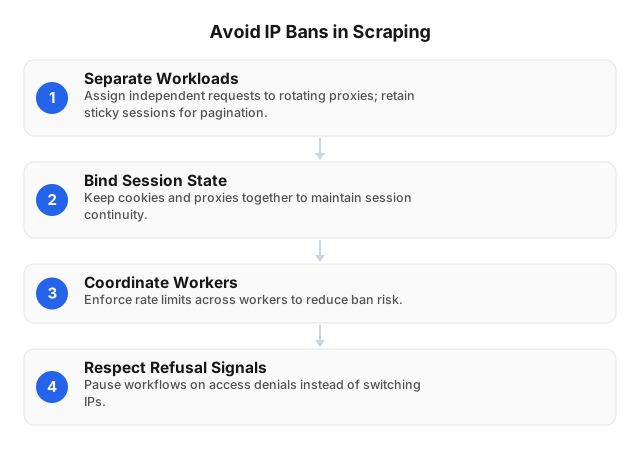
Proxy management should assign addresses according to session requirements while enforcing a shared request budget for each target. Independent public-page requests can use rotation; connected workflows may need a stable address, cookie jar, and location. Measure success through validated records and session continuity, not the frequency of IP changes.
- Define session boundaries: Keep connected pagination or location selection together when the application preserves that state.
- Bind session components: Associate proxy sessions with cookies, geography, and relevant browser state.
- Share scheduling controls: Route workers and retries through one target-level limiter.
- Separate failure scopes: Diagnose gateway connection failures differently from target refusals.
For regional monitoring, record both the requested market and the returned market. A correctly extracted price in the wrong currency remains an invalid observation.
Implementing Rotating Proxies Effectively
Rotating proxies should change exit addresses between independent tasks, while session-dependent workflows retain a consistent address and cookie jar where required. Test routing, geography, and extraction before scaling. A successful gateway connection proves neither target acceptance nor usable data, and rotation cannot repair an incompatible session configuration or authorize collection.
Configuration walkthrough for a permitted pilot
Use a target you own or have permission to test, covering both independent requests and a connected workflow.
- Protect credentials: Load gateway settings from protected environment variables or a secret store; redact them from logs.
- Verify routing: Check the exit address through an authorized IP-check endpoint, then confirm the target’s actual market presentation.
- Choose boundaries: Use documented rotating settings for independent requests and sticky-session settings for connected tasks.
- Test continuity: Inspect cookies, currency, delivery region, and pagination—not just the exit address.
- Test failures: Separate transport errors, target denials, and extraction defects. Return retries through the scheduler.
- Validate output: Reject challenge pages and empty application shells, even when the HTTP status indicates success.
EProxies provides 72M+ residential IPs across 195+ countries and supports HTTP(S) and SOCKS5. Verify the required location and session behavior in your pilot; pool size does not guarantee acceptance by a particular target.
Rate Limiting and Request Throttling
Target-wide rate limiting controls aggregate traffic across workers, sessions, proxies, and retries. No universal request rate prevents bans; use published limits or explicit permission to establish the budget. Set concurrency separately because slow responses can accumulate overlapping requests even when the scheduler starts them at a steady rate.
- Budget by target: Apply stricter endpoint limits where required; do not assume subdomains have independent allowances.
- Count retries: A timeout does not prove the server missed the request.
- Honor backpressure: Follow
Retry-After; otherwise use capped exponential backoff with jitter and bounded retries. - Limit concurrent requests: Faster proxies must not automatically increase traffic.
- Avoid redundant fetches: Deduplicate URLs and reuse permitted cached observations.
Persistent denials require a pause, not faster rotation. Audit duplicate scheduling and retry loops using these common scraping mistakes and fixes.
Ethical Considerations in Web Scraping
Ethical scraping requires defining permitted sources, necessary fields, traffic limits, and stop conditions before collection begins. Review site terms, crawling preferences, access controls, and applicable privacy and data-use laws. Proxy rotation should distribute authorized requests, not override refusals; robots.txt communicates crawling preferences but does not establish legal permission.
Maintain a source register containing reviewed terms, approved scope, review dates, and escalation contacts. Pause at CAPTCHAs or explicit denials rather than automatically switching identities.
For price monitoring, allowlist product identifiers, public prices, availability, and observation timestamps. Exclude incidental personal information and limit diagnostic retention.
Review cross-border compliance before adding regions. Ask residential proxy suppliers how network owners consent, withdraw participation, and learn about permitted traffic.
Comparison of Proxy Types for Scraping
Proxy selection depends on location requirements, session continuity, target acceptance, and cost per validated record. Rotating residential proxies can suit independent regional requests; sticky residential or static ISP configurations can suit connected workflows. Datacenter proxies can fit workloads without residential-location requirements. Address origin and rotation policy are separate decisions: residential does not automatically mean rotating.
| Option | Suitable permitted workload | Trade-off to test |
|---|---|---|
| Datacenter | Public pages without residential-location requirements | Potential cost savings versus target acceptance. |
| Rotating residential | Independent regional product-page requests | Address diversity versus disrupted session state. |
| Sticky residential | Connected regional or pagination workflows | Session duration, cookies, and location continuity. |
| Static ISP | Recurring tasks requiring a consistent address | Stable routing versus dependence on one address. |
EProxies ISP SOCKS5 starts at $0.95/IP. Compare address-based and traffic-based plans using representative workloads, including failed requests and retries. Confirm address sourcing, geography, and session behavior before committing.
Monitoring and Adapting to IP Ban Signals
Scraping monitoring should distinguish transport failures, target restrictions, session problems, and extraction defects before changing proxy behavior. Track response status, page type, latency, and validated records by target and session. Diagnose the scope of each failure first; blindly changing addresses can repeat rejected requests while corrupting downstream datasets.
- Gateway: Connection or proxy-authentication failures suggest configuration or transport problems.
- Session: Workflow-specific failures suggest expired cookies or lost state.
- Target: Restrictions across workers require a shared pause and review.
- Parser: Correct pages with missing fields suggest selector changes.
- Market: Unexpected currencies or delivery regions invalidate otherwise successful extraction.
Log timestamps, endpoint categories, session identifiers, and validation outcomes without credentials or unnecessary personal data. Before resuming, confirm permission and validate replacement observations through the existing limiter. Keep affected records marked stale until they pass.
Related reading
The IP-ban prevention guide can help turn collection policies into an operational runbook. Specify who can pause jobs, which responses require review, and which fields must pass validation before publication. Put those decisions into scheduler and validation settings rather than leaving each worker to interpret them independently.
Include the approved target, permission review, request budget, session policy, and dataset freshness status in the recovery checklist. Operators should distinguish “collection paused” from “product unavailable” without inspecting raw logs.
FAQ
Scraping proxy choices should follow the permitted task: location-sensitive independent requests may benefit from rotation, while connected workflows need continuity. Neither approach replaces shared traffic limits or content validation. The answers below distinguish address selection from permission, explain rotation’s limits, and identify when failures require diagnosis rather than another request.
What is an IP ban in web scraping?
An IP ban is a website’s restriction or refusal of requests based on their source IP address. Failed requests alone do not prove a ban: expired sessions, authentication failures, and server errors can look similar. Inspect the response and affected workflow before classifying the failure.
How do rotating proxies prevent IP bans?
Rotating proxies can reduce IP-ban risk by distributing permitted requests across source addresses, but they cannot guarantee prevention. Websites can also evaluate session state and request patterns. Preserve necessary session continuity, enforce target-wide limits, and pause at explicit access denials.
What are ethical scraping practices?
Ethical scraping practices include reviewing access conditions, limiting server load, minimizing collected data, and following applicable laws. Public visibility is not blanket permission to collect or reuse information. Seek permission or an authorized API when access conditions are unclear.
How can rate limiting help avoid IP bans?
Rate limiting can reduce IP-ban risk by controlling traffic volume and preventing bursts. Apply the budget across every worker and proxy accessing the target, including retries. Honor server retry instructions and pause persistent denials instead of treating another IP as extra capacity.
What types of proxies are best for scraping?
Rotating residential proxies suit independent regional requests; sticky residential or static ISP proxies suit connected workflows; datacenter proxies suit tasks without residential-location requirements. The best choice still depends on target acceptance and permitted scope. Test representative pages and compare cost per validated record before scaling.
This article was written by the EProxies team and reviewed against our editorial quality standards before publishing.