
Comprehensive Guide to Proxy Detection: 2026
TL;DR: Detect proxy traffic by combining IP intelligence, location checks, trusted connection data, and session behavior. A proxy flag indicates a possible intermediary, not proof of abuse. Validate rules against legitimate traffic before challenging or blocking requests.
Security teams must distinguish suspicious activity from corporate gateways, privacy services, and shared household connections. An IP change alone should not trigger a block.
Introduction to Proxy Detection
A proxy detector classifies whether a connection likely passes through an intermediary and records the evidence behind that assessment. It should not automatically reject proxy users. Separate classification from enforcement so your application can distinguish authorized gateways, uncertain connections, and sessions whose account behavior warrants additional verification.
Define the detection contract
Keep these outputs separate:
- Classification: suspected intermediary, direct connection, or unknown.
- Evidence: observed signal, source, and collection time.
- Policy action: allow, investigate, challenge, or deny.
Use “unknown” when evidence is insufficient; a failed lookup should not silently become a clean classification. An approved corporate proxy and a suspicious registration session may receive the same network label but require different actions.
Understanding Proxy Types and Their Detection Challenges
Proxy infrastructure, forwarding protocol, and session persistence require separate classifications because they describe different properties. Residential addresses can carry HTTP(S) or SOCKS5 traffic, with rotating or sticky sessions. Residential ownership does not prove a direct connection, and a stable address does not establish that a session is trustworthy.
Datacenter proxies use hosting networks, making infrastructure classification easier in some cases. Hosting ownership still does not establish malicious intent: corporate gateways and authorized automation can use these networks.
Residential proxies share address space with household connections. ISP proxies likewise require separating network ownership from actual use. Blocking an entire autonomous system number, or ASN, can affect legitimate customers.
HTTP proxies may expose forwarding headers, but those headers are optional and forgeable. SOCKS5 does not require HTTP-specific disclosure. Destination-side HTTP inspection therefore cannot reliably identify the upstream protocol.
Rotating addresses weaken IP-only tracking; sticky sessions make address stability an unreliable reassurance. Compare either pattern with account and session continuity.
For infrastructure and protocol trade-offs, see our guide to choosing the best proxy for your needs.
Key Signals Used in Proxy Detection
IP intelligence, location consistency, trusted forwarding headers, and session patterns provide complementary evidence of intermediary use. None establishes user intent on its own. Combine independent signals, retaining their sources and timestamps, so analysts can distinguish current observations from stale labels and avoid counting related network flags as separate evidence.
IP intelligence: Distinguish hosting networks, residential ISPs, and known intermediary infrastructure. Residential ownership cannot clear a session because household networks can also carry proxy traffic.
Location consistency: Compare estimated exit location with session history. Travel, mobile routing, and corporate gateways can explain changes. Browser timezone supplies context, not proof; collect device location only where lawful and necessary.
Forwarding headers: Trust Forwarded and X-Forwarded-For only when configured ingress systems supply or sanitize them. Client-supplied values can be forged.
Session patterns: Compare address changes with request timing, session continuity, and account activity. Ordinary HTTPS requests do not reliably disclose whether an upstream intermediary uses HTTP CONNECT or SOCKS.
Step-by-Step Guide to Implementing Proxy Detection
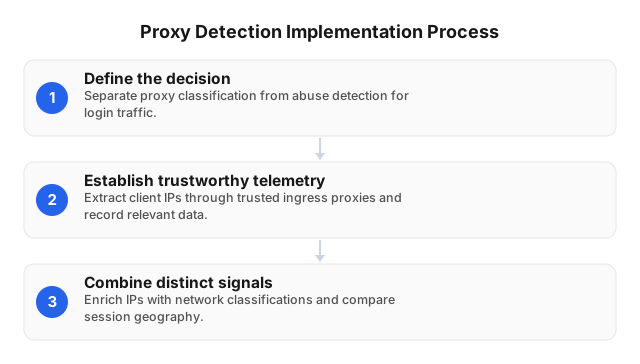
A deployable detector needs trusted client-IP extraction, fresh network intelligence, labeled validation traffic, and explicit outage behavior. Start in observation mode before enabling enforcement. Treat proxy likelihood as an input rather than a verdict, and measure how proposed rules affect legitimate sessions as well as confirmed abusive activity.
- Define the decision. For login traffic, elevated risk may trigger additional authentication rather than deny every intermediary connection.
- Configure the trust boundary. Allow only your ingress gateway to supply the client-IP header, and configure it to overwrite incoming values. Against a staging endpoint, send a request with a forged
X-Forwarded-Forvalue and inspect the extracted address. Watch for applications accepting the forged value or recording only the gateway address. - Attach context. Record lookup freshness, ASN, session identifier, and request outcome. If examining TLS characteristics, collect them where client TLS terminates; an origin behind a CDN may see the CDN connection instead.
- Validate labeled sessions. Include authorized proxies, direct connections, corporate gateways, and mobile networks. Measure precision, recall, and false positives without using the detector’s own labels as ground truth.
- Deploy reversibly. Log proposed actions and reason codes before enforcing them. Set cache freshness limits and a fallback for intelligence outages; review challenge outcomes before expanding blocks.
Our detecting and blocking proxies guide covers the transition from classification to enforcement.
Common Pitfalls and How to Avoid Them
Proxy-related false positives often result from treating a network label as an abuse verdict or trusting stale intelligence. Match enforcement to the protected action and review legitimate sessions before blocking. Additional authentication may fit account recovery, while imposing the same friction on a public reading page may be unnecessary.
Break down challenged traffic by network type and application endpoint. Shared gateways and privacy services can otherwise disappear inside aggregate metrics.
Record each classification’s source, timestamp, and reason code. Refresh disputed labels instead of retaining cached assessments indefinitely.
Track reviewed legitimate sessions that were challenged or denied, challenge completion, and confirmed abuse after enforcement. A failed challenge alone does not prove fraud. Limit log access, define retention periods, and provide a review path for disputed decisions.
Illustrative Proxy Detection Scenarios
Account-abuse and checkout investigations need labeled outcomes, not request-completion statistics, to evaluate detection quality. A completed request says nothing about whether a proxy classification was correct. The hypothetical workflows below combine network evidence with account behavior and preserve decision records so analysts can reproduce disputed outcomes without assuming flags prove abuse.
Account abuse: correlate identities across changing IPs
For suspected credential stuffing, correlate failed logins, targeted accounts, and session continuity across addresses. An IP change should not erase account-level evidence. Apply additional verification when independent signals support concern, then compare confirmed compromises with legitimate verification failures.
Record targeted accounts, triggering signals, and the policy version. Do not recycle earlier detector labels as evaluation ground truth.
Checkout fraud: preserve legitimate shared-network traffic
Combine proxy intelligence with account history and checkout behavior. An ambiguous shared address may justify verification without justifying rejection. Review verified legitimate purchases separately from confirmed fraud.
Log triggering evidence and policy versions. A declining approval rate can reveal excessive enforcement; neither a proxy flag nor a rejected purchase establishes fraud.
Future Trends in Proxy Detection
Recent proxy-detection developments emphasize residential-proxy attribution, session context, active probing, confidence scoring, and machine-learning analysis of network and attack patterns. These approaches can supplement static IP lists, but their availability does not establish accuracy for your application. Evaluate freshness, uncertainty, and legitimate-user impact before turning new signals into blocking rules.
Session-aware assessment can connect activity across changing addresses. Reassess authenticated sessions after an IP change, but do not deny them solely because the address changed.
Active probing and confidence scores offer additional evidence, not certainty. Keep observation, verification, and denial as separate outputs with inspectable reasons.
Evaluate model updates against confirmed abuse, reviewed legitimate traffic, and appeals. Previous blocks are not automatically valid training labels. Minimize retained device data and test changes against corporate gateways and mobile-network transitions.
Related Reading
Proxy enforcement and TLS troubleshooting require separate workflows: a certificate error does not establish intermediary use, and bypassing certificate validation does not prove a connection is secure. Use the enforcement guide to design proportionate responses and the curl guide to diagnose certificate failures without treating a diagnostic workaround as a production security control.
FAQ
Proxy detection assesses intermediary use; abuse prevention decides whether activity warrants intervention. These FAQ answers distinguish network classification from policy decisions and explain the limits of common signals. For disputed outcomes, retain the evidence source, observation time, and policy version rather than relying on an unexplained proxy flag.
What is proxy detection?
Proxy detection identifies connections likely routed through an intermediary server. It does not prove malicious intent. Store the classification and supporting evidence separately from the enforcement decision.
How do proxies affect network security?
Proxies can obscure the originating IP address and weaken controls based only on IP identity or location. Shared exits group unrelated users together, while rotating addresses can split one session across logs. Evaluate account behavior alongside network evidence.
What are common proxy detection methods?
Common methods include IP intelligence, network classification, location checks, trusted header inspection, active probing, and session-pattern analysis. Forwarding headers are reliable only within a configured trust boundary. Their absence does not rule out a proxy.
How can false positives be minimized in proxy detection?
Reduce false positives by validating signals against legitimate traffic and applying proportionate responses. Include corporate gateways, mobile networks, and shared residential connections in validation data. Review overturned decisions and refresh disputed classifications.
What are the latest trends in proxy detection?
Recent trends include residential-proxy attribution, session-context analysis, active probing, confidence scoring, and machine-learning assessment of network and attack patterns. These approaches supplement static IP lists but do not guarantee accurate classifications. Test their decisions against confirmed outcomes and legitimate-user impact before enforcement.
This article was written by the EProxies team and reviewed against our editorial quality standards before publishing.