
How to Effectively Scrape Wikipedia Data With Proxies: 2026
TL;DR: Use Wikipedia’s API for targeted collection and dumps for bulk datasets. If a proxy solves a routing need, reuse connections, keep related requests on a stable session, set explicit timeouts, and control traffic through one shared queue. Optimize for valid records per gigabyte—not requests per second—and never rotate IPs to bypass restrictions.
Choose the Collection Method Before the Proxy
For a study of university founding dates, define institution name, founding date, location, source URL, and revision identifier before writing the collector. Decide whether you need current values or a reproducible historical snapshot; that choice determines the retrieval method.
| Method | Best fit | Main trade-off |
|---|---|---|
| Wikimedia dumps | Large-scale or repeatable offline analysis | Requires local storage and processing; freshness depends on the dump |
| MediaWiki API | Selected articles, revisions, categories, and metadata | Requires pagination and handling API-level errors |
| HTML retrieval | Rendered tables or fields unavailable through your chosen API route | Parsing can break when page structure changes |
Check Wikimedia’s download service before scheduling thousands of live requests. For targeted collection, follow the MediaWiki API etiquette guidance, including batching supported queries and avoiding unnecessary requests.
Preserve raw values alongside normalized fields. A founding date such as “established 1850; chartered 1862” should not silently become a single year without a documented rule.
When a Proxy Helps—and When It Does Not
A proxy gives your pipeline a separate outbound route. It can help diagnose network-specific connectivity problems or separate collection traffic from a workstation, but it adds another connection hop, authentication requirements, and potentially billable traffic.
A proxy does not increase Wikipedia’s permitted request load. The destination sees the proxy’s exit IP, but request headers, account activity, and other identifiers can still identify the collector. An access denial requires investigation, not repeated endpoint switching.
There is no Wikipedia-specific performance benchmark established here. Compare routes against the exact API or page endpoint you intend to use; response times from unrelated targets cannot predict your extraction throughput.
Measure usable output rather than HTTP status alone. A 200 response containing an API error or an unexpected HTML page is not a valid research record.
Set Up Python and Validate One Request
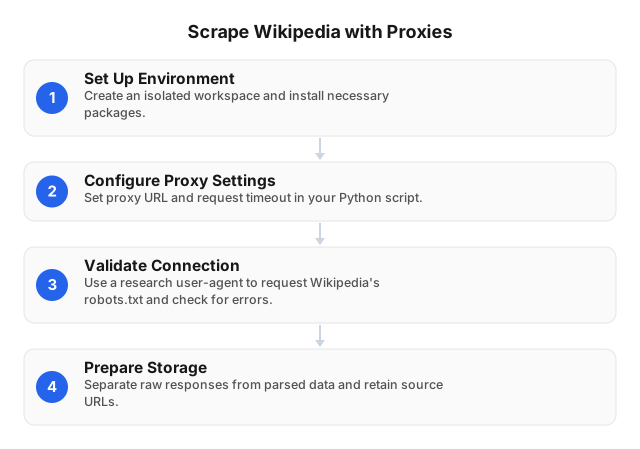
Create an isolated environment and install the HTTP client:
python -m venv .venv
source .venv/bin/activate
pip install requests
pip freeze > requirements.txt
On Windows, activate with .venv\Scripts\activate. Add beautifulsoup4 only if your workflow needs HTML parsing; install requests[socks] if your selected route requires SOCKS support.
Set PROXY_URL to the provider-issued gateway URL and RESEARCH_USER_AGENT to an identifier such as UniversityDataset/1.0 (contact: [email protected]), replacing the example contact. Keep credentials outside source control and redact authenticated proxy URLs from logs.
import os
from datetime import datetime, timezone

import requests

session = requests.Session()
session.trust_env = False
gateway = os.environ["PROXY_URL"]
session.proxies.update({"http": gateway, "https": gateway})
session.headers["User-Agent"] = os.environ["RESEARCH_USER_AGENT"]

response = session.get(
    "https://en.wikipedia.org/w/api.php",
    params={
        "action": "query",
        "format": "json",
        "formatversion": 2,
        "prop": "info|revisions",
        "rvprop": "ids|timestamp",
        "titles": "University of Oxford",
        "redirects": 1,
        "maxlag": 5,
    },
    timeout=(5, 30),
)
response.raise_for_status()
payload = response.json()
if "error" in payload:
    raise RuntimeError(payload["error"])

print({
    "retrieved_at": datetime.now(timezone.utc).isoformat(),
    "pages": payload["query"]["pages"],
})
This pilot retrieves page and revision metadata, not founding dates. Add a separate extraction step for the fields your study needs, and test it against pages with missing or differently structured values.
The timeout tuple sets a five-second connect timeout and a 30-second read timeout; it is not a strict total-job deadline. Keep TLS verification enabled. See the Requests documentation for proxy, connection-pooling, and timeout behavior.
The maxlag=5 parameter asks the API to reject work when database replication lag exceeds the specified threshold. Handle that as a signal to wait, not as evidence of a bad proxy; MediaWiki documents maxlag behavior.
Choose a Proxy by Workload
Do not buy a larger pool before establishing that your collection needs a proxy. Run a small, permitted pilot and compare valid records, latency, failures, and transferred bytes.
| Proxy option | Useful property | What to verify |
|---|---|---|
| Datacenter | Separate outbound infrastructure | Whether the actual endpoint accepts the route |
| ISP/static | Consistent exit address | Per-IP cost and availability during scheduled runs |
| Sticky residential | Stable routing for related requests | Supported session controls and expiration behavior |
| Rotating residential | Endpoint changes where legitimately needed | Added variability and connection-reuse behavior |
EProxies offers HTTP(S) and SOCKS5 access, with a residential pool of 72M+ IPs across 195+ countries. Those figures describe network coverage, not Wikipedia-specific speed or success rates. ISP SOCKS5 starts at $0.95/IP; compare per-IP pricing with bandwidth-based residential costs using your expected collection schedule.
Match the protocol to your client. SOCKS5 is not inherently a speed upgrade, and a persistent Python session does not by itself guarantee a fixed residential exit IP. Confirm the provider’s session controls before relying on endpoint stability; do not assume a particular sticky-session duration.
Optimize Proxy Settings for Usable Throughput
Reuse connections and batch supported queries
Keep a requests.Session open across sequential requests so the client can reuse connections. If your selected API module accepts multiple titles or identifiers, batch them within its documented limits rather than making one request per item.
Maintain an identifying User-Agent. Wikimedia’s User-Agent policy explains how to identify automated clients; rotating browser identities does not improve data quality.
Set one aggregate traffic budget
Start a pilot with one worker and sequential requests. This is a conservative testing configuration, not a guarantee that any fixed request rate is acceptable.
Put all workers behind a shared queue or rate limiter. Ten proxy endpoints must not create ten independent request budgets. If latency rises or the server signals overload, reduce dispatch frequency rather than adding exits.
Diagnose failures before retrying
| Failure | Appropriate response |
|---|---|
Proxy authentication error, such as 407 | Correct credentials or gateway configuration |
| Connection timeout | Check route availability; use bounded retries |
429 or retry instruction | Honor Retry-After; pause the shared queue |
403 or access denial | Stop and investigate access conditions |
API maxlag error | Wait before retrying |
| Successful response with missing fields | Inspect extraction logic; do not rotate proxies |
Where retrying is appropriate and no server instruction is supplied, an illustrative policy is three retries with two-, four-, and eight-second delays plus random jitter. Keep retries inside the same traffic budget so failures do not amplify load.
Reduce bytes before increasing concurrency
Cache completed responses, checkpoint page IDs, and request only required API properties. Follow API continuation tokens rather than repeatedly fetching the first result page.
Track median and 95th-percentile latency, retry count, valid-record count, and billable bandwidth. If a pilot produces 8,000 valid records using 0.4 GB, its yield is 20,000 records/GB; use that measured yield to estimate the remaining job, while allowing for changes in page size and retry volume.
At scale, use the same checkpoint and queue principles described in How to Upscale Web Scraping for Large Datasets in 2026.
Preserve Provenance and Respect Reuse Rules
Store page ID, revision ID, source URL, retrieval timestamp, and extraction version with each record. Deduplicate by page ID where appropriate; article titles can change.
Review current access policies and relevant robots.txt directives before collection. For API behavior, use API documentation rather than assuming that HTML access rules describe every endpoint.
Check Wikipedia’s copyright guidance before republishing extracted text. Images and other media can have separate licensing conditions, so inspect their individual file pages.
For datasets involving living people, collect only fields needed for the analysis and review the risks of combining records. Keep proxy credentials out of notebooks, exported datasets, and shared error reports.
Related Reading
- How Proxy Servers Facilitate Data Mining Efforts in 2026
- Best Practices for E-Commerce Web Scraping in 2026
FAQ
What are the benefits of using proxies for scraping?
Proxies provide a separate outbound route and can help isolate network-specific connection failures. They also introduce latency and bandwidth costs, so test whether they solve an actual problem before adopting them. They do not increase Wikipedia’s permitted request rate.
How do I set up a proxy for web scraping?
Load the provider-issued proxy URL from an environment variable and assign it to the HTTP and HTTPS entries in a requests.Session proxy mapping. Set an identifying User-Agent, explicit connect/read timeouts, and keep TLS verification enabled. Validate one permitted request, checking the returned content as well as the status code.
What types of data can be scraped from Wikipedia?
Research datasets can include article text, tables, categories, references, links, and revision metadata, depending on the retrieval method. For tables, preserve headers, units, and footnotes so similarly named columns remain interpretable. Record provenance and distinguish missing source values from parser failures.
Are there legal concerns with scraping Wikipedia?
Public access does not remove licensing, attribution, privacy, or automated-access obligations. Check the applicable content license and review media separately before redistribution. A proxy changes your network route, not your permission to collect or republish material.
How can I optimize proxy settings for better performance?
Reuse connections with a persistent session, request only necessary fields, cache completed responses, and keep related requests on a stable route when supported. Start with one worker and explicit connect/read timeouts, then adjust using valid-record yield, latency, retries, and billable bytes. Honor Retry-After, apply bounded backoff to appropriate transient failures, and stop on access denials rather than rotating IPs. Diagnose authentication, transport, API, and parsing failures separately so configuration changes address the actual bottleneck.
This article was written by the EProxies team and reviewed against our editorial quality standards before publishing.