
Best Practices for Proxy Automation in 2026: Setup
TL;DR: Best practices for proxy automation in 2026 start with task-specific sessions: rotate IPs between independent requests, preserve sessions for stateful workflows, enforce per-target rate limits, protect credentials, and measure cost per validated result—not just successful connections.
For scraping pipelines and authorized security tests, decide what must stay consistent across requests: the IP address, cookies, location, or all three. Configure those controls before adding workers. Otherwise, retries and rotation can break sessions, increase costs, and multiply traffic to a target.
Introduction to Proxy Automation in 2026
Proxy automation uses software to manage proxy selection, authentication, sessions, and request routing for recurring tasks. It removes manual connection changes and applies shared rules across workers. Each job still needs approved destinations, traffic limits, and stopping conditions. Automate those policies alongside routing, rather than treating IP rotation as the whole system.
A connectivity check only confirms that a route works. It does not prove that the target returned the right page, location, or data fields.
Define the automation boundary before choosing a provider:
- Public-data collection: Rotate between independent requests. Preserve sessions when cookies or pagination require continuity.
- Authorized security testing: Restrict destinations to approved assets. Keep audit logs without recording credentials.
- AI-triggered collection: Enforce destination allowlists and traffic budgets outside model-generated instructions. Require approval before expanding scope.
Treat access denials as stop-or-review signals, not invitations to change identities. Follow target-site terms and applicable laws.
Understanding the Role of Proxies in Automation
Proxies give automation software control over outbound routing and exit location; they do not guarantee valid results or authorize access. Choose routing and session behavior around the task. Independent page checks may suit rotation, while regional comparisons and multistep tests often need a stable IP, cookie jar, and browser context.
For permitted public-data collection, residential proxies route requests through residential exit IPs. Changing IPs during a dependent pagination sequence can disrupt continuity. Rotation should follow task boundaries, not a fixed rule applied to every request.
For localization testing, select the required geography and hold it steady while comparing prices, language, or availability. Verify the returned locale rather than assuming the selected route produced the expected content.
For security automation, a controlled outbound proxy can help enforce destination rules and record connections. Residential IPs are not inherently a security control. Keep access governance separate from geographic testing, and exclude sensitive payloads from logs.
Key Considerations for Proxy Automation
Production proxy automation needs protected credentials, clear session rules, and limits enforced across all workers. Test these controls against the actual target before increasing concurrency. A provider connection can succeed while the application receives an error page, the wrong region, or incomplete data. Acceptance checks must cover content as well as transport.
Protect credentials and outbound access
Store proxy passwords in a secrets manager and inject them at runtime. Redact authentication headers and credential-bearing URLs from logs and error reports.
Restrict outbound destinations and block workers from reaching internal services. For AI-directed workflows, enforce these restrictions outside the model’s control.
Match sessions to the task
Use sticky sessions for authorized workflows that depend on cookies or IP continuity. Rotate between independent collection jobs, not during a transaction.
Preserve HTTPS certificate validation. Proxy routing does not replace transport security.
Define collection boundaries
Document permitted domains, data fields, retention periods, and stop conditions. Pause jobs on access denials instead of automatically switching identities.
Review target terms and applicable privacy laws before collecting personal data. Use the proxy-use ethics checklist to make those reviews part of job approval.
Step-by-Step Guide to Implementing Proxy Automation
Implement proxy automation by defining approved targets, choosing session rules, and placing workers behind a shared request queue. Set limits per destination, not per proxy, so rotation cannot multiply the allowed load. Validate content and location on a small run before expanding traffic, and include retries in both traffic and cost budgets.
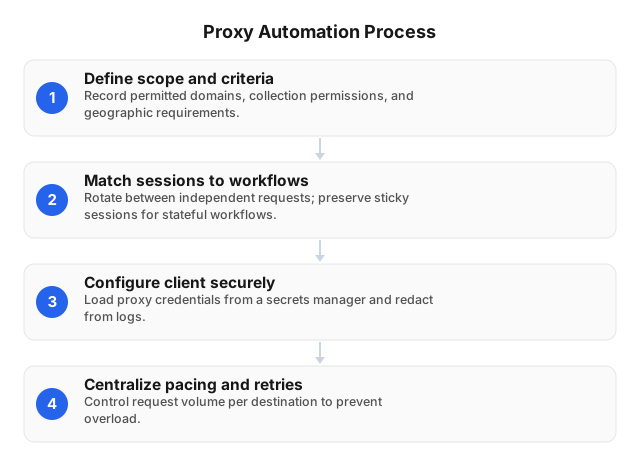
- Define scope and acceptance criteria. Record permitted domains, collection permissions, required fields, geographic needs, and retention rules. Limit security checks to approved assets.
- Match sessions to workflows. Rotate between independent public-page requests. Preserve sessions for authorized carts, pagination sequences, or authenticated tests. Check the provider’s session expiry behavior before relying on continuity.
- Configure the client securely. Load credentials from a secrets manager. Set the proxy explicitly in the HTTP client or browser context. Confirm that connection failures cannot silently send requests through an unintended route.
- Centralize pacing and retries. Enforce destination-wide limits across workers. Honor server retry guidance, apply backoff, and stop on access denials.
- Validate before expanding. Check required fields, regional content, latency, and bytes per usable record. Cache permitted repeat reads and suppress duplicate jobs.
EProxies supports HTTP(S) and SOCKS5, with 72M+ residential IPs across 195+ countries. Those capabilities define routing options, not expected results on a particular target. Test the locations and protocols your workflow actually uses.
Common Challenges and How to Overcome Them
Diagnose proxy automation failures by separating connection errors, target throttling, broken sessions, and invalid content. Each needs a different response. Replacing a proxy may help a failed connection, but it will not repair a parser or restore lost cookies. Record the failure category before retrying, and apply a shared retry budget.
Throttling and retry storms
Honor Retry-After, reduce per-domain concurrency, and apply exponential backoff with jitter. Share retry budgets across workers. Separate worker-level retries can otherwise amplify traffic during an outage.
Pause on access denials rather than rotating identities to continue.
Broken sessions and misleading results
Keep the proxy session, cookie jar, and browser context together during authorized multistep workflows. Check expected fields and locale before accepting a response.
A consent page can return a successful HTTP status yet contain none of the requested records. Track content validation separately from connection success.
Runaway costs and AI decisions
Track billed traffic per usable record, including retries and discarded responses. Cache permitted repeat reads and reject duplicate jobs before they reach the network.
Let AI tools recommend changes, but enforce domain allowlists and spending caps in code. Require human approval for changes to collection scope.
Implementation Scenarios: How to Validate Success
Evaluate proxy automation through valid task completions, session continuity, and traffic cost, not connection counts alone. The scenarios below are illustrative workflows, not verified customer case studies. Each identifies what must remain stable and what evidence would demonstrate success. Use these checks in a pilot before committing to production traffic.
Public product-data collection
For permitted price monitoring, queue requests by domain and region. Preserve each dependent pagination sequence; rotate between independent jobs.
Validate currency, product identifiers, and required fields before accepting results. Record transferred bytes per valid product record so retries cannot hide rising collection costs.
Regional checkout testing
For an authorized storefront, bind the proxy session, cookies, and browser context to the same test run. Select the required location and verify the location reflected in the response.
Compare delivery eligibility against expected test fixtures. Discard runs with unexpected location changes rather than treating them as storefront defects.
Security regression testing
For an owned application, test rate-limit behavior through approved proxy exits. Enforce aggregate traffic limits across workers rather than separate limits per IP.
Stop on unexpected access and retain redacted request logs for investigation.
Future Trends in Proxy Automation
The most useful direction for proxy automation is target-aware scheduling with policy limits that software cannot override. AI-assisted failure classification and concurrency recommendations may support that shift. Treat these as development directions, not guaranteed outcomes: require evidence that a controller can explain routing decisions, obey budgets, and stop when access conditions change.
A target-aware scheduler distinguishes connection failures from throttling, access denials, and parsing errors. It can back off after throttling, preserve an active session, or quarantine malformed results without treating every failure as a routing problem.
AI-assisted controllers can propose actions without owning permissions. Keep destination allowlists, credential access, and spending limits outside the model. Require approval before adding domains or changing collection scope.
For procurement, test failure behavior as carefully as normal operation. Trigger a simulated denial, expired session, and exhausted budget. Verify that the system stops or requests review instead of creating more traffic.
Related reading
Use these proxy operations guides to turn routing rules into repeatable checks. The anti-bot guide covers collection practices and target responses; the maintenance guide focuses on keeping proxy operations manageable. Pair those checks with your own destination permissions, retry budgets, and content validation rather than relying on provider connectivity alone.
- Best Practices for Web Scraping with Anti-Bot Protection
- Best Practices for Maintaining Proxy Servers in 2026
FAQ
Reliable proxy automation depends on matching session behavior to the task and enforcing permissions separately from routing. The answers below cover benefits, scraping uses, common failures, provider selection, and future development directions. Evaluate each choice against usable results, traffic costs, and stop conditions; a different exit IP does not grant additional access rights.
What are the benefits of proxy automation?
Proxy automation reduces manual connection changes, centralizes routing rules, and supports repeatable geographic tests and permitted data collection. Health checks can remove failing endpoints, while session rules preserve continuity during stateful workflows. Measure efficiency through cost per usable result, including retries, duplicates, and parsing failures.
How do proxies enhance data scraping?
Proxies support scraping by routing requests through selected locations and distributing permitted work across endpoints. Sticky sessions preserve IP continuity during dependent requests; rotation suits independent requests without shared session state. Keep cookies and exit locations aligned, and enforce target-wide limits regardless of how many proxies you use.
What are common proxy automation challenges?
Common challenges include broken sessions, authentication failures, excessive retries, inconsistent locations, and unusable responses. Separate connection errors from access denials and parsing failures so each triggers the right response. Honor retry guidance, pause on access denials, and redact credentials from logs.
How to choose the right proxy for automation?
Choose a proxy by testing location accuracy, session behavior, protocol support, and cost per valid result against your workload. EProxies supports HTTP(S) and SOCKS5, which are relevant compatibility checks rather than proof of target-specific performance. Verify session behavior and returned content in a pilot before increasing traffic.
What are future trends in proxy automation?
Future trends in proxy automation are likely to include target-aware scheduling, AI-assisted failure diagnosis, and stricter controls on automated decisions. Models can recommend changes to concurrency or retries, while code enforces destination allowlists, budgets, and credential isolation. Require human approval for scope changes, and treat access denials as signals to stop and review.
This article was written by the EProxies team and reviewed against our editorial quality standards before publishing.