
Ethical Considerations for Proxy Use in 2026: IT Checklist
TL;DR: Ethical proxy use in 2026 requires informed consent from residential endpoint owners, authorized destination access, privacy safeguards, and enforceable traffic limits. A successful request does not prove permission.
Approving a proxy service requires two separate checks: device owners must permit residential traffic relay, and destination owners must authorize the proposed activity. Neither permission establishes the other.
Use the checks below to evaluate provider evidence, map cross-border data flows, limit collection, and test shutdown rules before deployment.
Introduction to Proxy Use in 2026
A proxy routes network requests through an intermediary, changing the source IP address visible to the destination without granting additional access rights. Ethical use requires consent for residential traffic relay, authorized destination activity, and appropriate data handling. Approval should cover the entire workflow—including accounts, collected fields, and storage—not merely the network connection.
Before approving a proxy-backed workflow, document its purpose and the systems involved:
- Residential endpoint: Request evidence that device owners knowingly authorized traffic relay and can withdraw permission.
- Data path: Identify whether the intermediary sees connection metadata or decrypted content. Keep credentials and unnecessary personal data out of logs.
- Destination: Confirm that regional testing or public-data collection stays within approved access and target-site terms.
- Accountability: Assign an owner who can suspend the workflow when its purpose or data scope changes.
Understanding Ethical Proxy Use
Ethical proxy use means respecting the permissions of endpoint owners and destination services while limiting harm to people whose data is processed. A reachable page is not automatically an authorized collection source. Security teams should approve the purpose, access method, and collection scope before deploying scripts or AI agents through a proxy.
Evaluate each proposed use against three boundaries:
- Source consent: Require evidence that residential endpoint owners knowingly permit traffic relay and can withdraw.
- Destination authorization: Separate approved regional testing from access beyond granted permissions. Bypassing geographic restrictions may raise legal or contractual issues; escalate uncertain cases before deployment.
- Purpose accountability: Record the business owner, permitted targets, and prohibited actions. Apply the same restrictions to AI agents and manually operated tools.
Do not treat an HTTP success response as an authorization decision. The application must check the destination and requested data against its approved scope before sending traffic.
Privacy Concerns and Best Practices
Protect privacy in proxy workflows by minimizing collected data, verifying informed endpoint consent, and documenting what intermediaries can observe. Changing an IP address does not remove identifiers from cookies, account sessions, or request payloads. Review connection metadata, TLS handling, log contents, and retention before approving a route that carries sensitive information.
Ask providers to show how participants opt in, withdraw consent, and learn about bandwidth use. Unclear sourcing should block procurement. Pool size and performance cannot compensate for missing consent evidence.
Keep credentials, session tokens, and sensitive URL parameters out of proxy logs. Retain only metadata needed for operations or investigations, restrict log access, and validate destination TLS certificates.
Disclose monitoring scope to remote employees. Before sending collected data to AI tools, remove unnecessary personal identifiers and review the tools’ retention settings.
Legal Implications of Proxy Use
Legal review should assess access permissions, contracts, collected data, and relevant jurisdictions rather than only the provider’s location. A proxy connection does not authorize system access or data reuse. Document the actual activity—including authentication, collection purpose, and planned downstream processing—so counsel can evaluate the obligations that apply to that workflow.
Assess target-site terms separately from legal duties. A breach of terms and unlawful access are not interchangeable. Ask counsel to review authentication boundaries, collection purposes, and restrictions on later reuse.
Check whether proxy operators can see plaintext traffic, credentials, or logs. Require written commitments covering data handling and incident notification rather than relying on a general privacy statement.
For cross-border routing, map actual processing locations. An exit IP does not identify every jurisdiction involved. Record counsel’s approval for the specific workload, destination, and data categories.
For a fuller legal checklist, see Legal Boundaries of Proxy Server Usage in 2026.
Steps to Ensure Responsible Proxy Usage
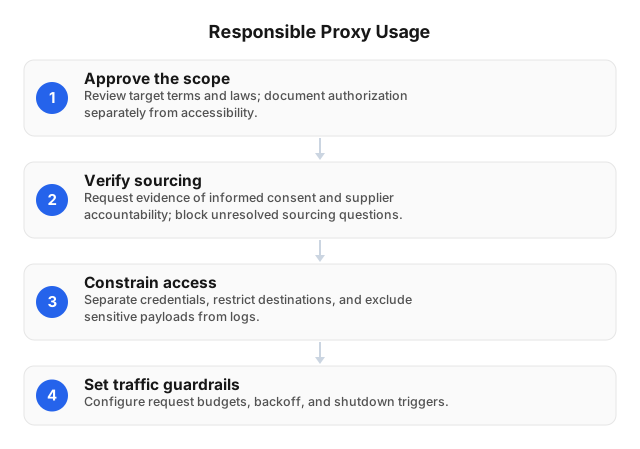
Responsible deployment requires documented authorization, verified residential-node consent, restricted credentials, and tested shutdown controls before traffic starts. Record each workload’s approved purpose, destinations, data fields, routing countries, and accountable owner. Those records should drive application settings so operators cannot silently expand collection when requests fail or business requirements change.
- Approve the scope. Review target terms and applicable laws. Document authorization separately from technical access. Send ambiguous collection requests to legal counsel.
- Verify sourcing. Request evidence of informed residential-node consent, withdrawal options, and supplier accountability. Leave procurement unapproved while sourcing questions remain unresolved.
- Constrain access. Use separate workload credentials, restrict destinations, and exclude sensitive payloads from logs. Map routing countries for privacy review.
- Set traffic limits. Configure request budgets, retry delays, and shutdown triggers. Do not rotate identities to defeat access denials.
- Audit execution. Monitor new destinations, retries, and complaints. Suspend workloads that exceed their approved scope.
Configuration walkthrough: test the controls before collection
Validate proxy routing and stop controls against an owned staging endpoint before connecting to a collection target. This walkthrough is a deployment check, not a reported customer test or measured result. Save the configuration and observed behavior with the approval record so reviewers can verify what the client actually enforced.
- Configure the connection. Select the supported HTTP(S) or SOCKS5 route, load credentials from a secret store, and keep destination certificate validation enabled. Do not disable TLS verification to resolve connection failures.
- Verify routing. Use an endpoint you control to inspect the source IP seen by the server. Compare it with the intended proxy route; a successful response alone does not show that the client used the proxy.
- Enforce scope in the client. Add approved hostnames to an allowlist. Validate redirect destinations before following them, rather than checking only the initial URL.
- Exercise failure handling. Have the staging endpoint return an access denial or rate-limit response. Confirm that the client pauses or stops according to the approved policy instead of changing IPs to continue.
- Inspect the logs. Check that request outcomes and shutdown reasons are recorded without authorization headers, session cookies, or sensitive query strings.
- Test revocation. Activate the shutdown control while retries are queued. Confirm that it cancels queued work as well as blocking new requests.
Treat continued retries after shutdown as a failed deployment check. Fix the queue or worker cancellation logic before approving production traffic.
For collection-specific controls, see Ethical Use of Proxies for Web Scraping.
Balancing Performance and Ethics
Measure performance by completed, authorized requests rather than throughput or HTTP success codes alone. Connection reliability does not establish endpoint consent, acceptable target load, or permission to retain returned data. An acceptance policy should reject out-of-scope responses and stop traffic when access conditions change, even if the proxy connection remains available.
Set concurrency limits for each target, cap retries, and define stop conditions before deployment. Honor rate-limit responses. Repeated denials should trigger review, not automatic IP rotation.
Cache reusable responses where permitted and remove duplicate collection. Both steps reduce requests without requiring additional exit IPs.
Track accepted, policy-compliant responses separately from transport success. A response containing unnecessary personal data should fail acceptance checks even if the request succeeded.
For AI-controlled collection, enforce limits outside the model. The request client must reject unapproved destinations and prevent autonomous retries from overriding traffic budgets.
Case Studies of Ethical Proxy Use
Responsible workflows combine explicit authorization, limited collection, and observable stop conditions. The scenarios below are illustrative operating patterns, not documented customer outcomes or measured tests. Use them to identify the evidence a deployment should retain: approved domains, permitted fields, configuration changes, and records showing why traffic paused or stopped.
Regional checkout testing
A retailer can test its own storefront through country-targeted proxies using synthetic accounts and approved destination domains. The test plan should exclude customer credentials and identify third-party services before execution. Security approval covers the retailer’s authorized systems; it does not automatically extend to every service embedded in the checkout flow.
Configure the client to stop before an unapproved payment processor receives requests. If completing the test requires that processor, obtain separate authorization and update the destination allowlist before resuming.
AI-assisted market research
An analyst can collect permitted public product listings while excluding reviewer profiles and other unnecessary personal data. The collection client should enforce approved domains, fields, and request budgets independently of the AI system. Access denials must pause the workflow rather than prompt the agent to rotate identities and continue blocked collection.
Require human approval before an AI-generated plan adds a domain or data field. Record the change in the collection configuration, not just in the model’s conversation history.
FAQ
Responsible use requires checks at both ends of the connection: consent from the device supplying the exit IP and authorization for the destination activity. Procurement evidence and runtime controls address different risks. These answers distinguish sourcing, access, privacy, and operational safeguards so teams can turn approval decisions into enforceable client settings.
What are the ethical concerns with proxy use?
The main ethical concerns are nonconsensual IP sourcing, unauthorized access, excessive collection, and harm to device owners or target services. Ask how participants consent, withdraw, and understand bandwidth use; an SDK agreement alone may not demonstrate informed consent. For AI-driven collection, require approval before expanding targets, collecting personal information, or exceeding traffic limits.
How can proxies be used responsibly?
Use proxies only for approved purposes, authorized targets, and documented collection limits, with informed consent from residential endpoint owners. Give each workload a named owner, separate credentials, and an enforceable request budget. Treat access denials and authentication challenges as stop-and-review signals, not reasons for aggressive IP rotation.
What legal issues should be considered with proxies?
Review applicable privacy laws, computer-access laws, contracts, and cross-border data-transfer duties for the specific proxy workflow. Public visibility does not by itself establish permission to collect, retain, or repurpose information. Assess target-site terms separately from legal obligations, and map provider processing and storage locations rather than relying on the exit IP’s country.
How do proxies impact privacy?
Proxies can hide the originating IP from a destination, but accounts, cookies, device characteristics, and request content can still identify users. Operators may also observe connection metadata or plaintext content, depending on configuration. Protect credentials, assess TLS handling, restrict logs, and disclose employee monitoring rather than treating routing as anonymity.
What are best practices for ethical proxy use?
Verify informed IP-source consent, authorize destinations, minimize collected data, protect credentials, and enforce traffic and retention limits. Test a shutdown mechanism, retain approval records, and audit changes to targets or collected fields. Reassess approval when the purpose changes or data feeds an AI system; permission for regional testing does not automatically cover model-training collection.
How can a security team verify that residential proxy IPs are ethically sourced?
Request documented informed consent, clear compensation terms where applicable, and a working withdrawal process. Confirm that participants understand third-party traffic will exit through their connections and that disclosures explain bandwidth use and device impact. Pool size, speed, and successful requests measure performance, not consent; unresolved sourcing evidence should block procurement.
This article was written by the EProxies team and reviewed against our editorial quality standards before publishing.