
Choosing Proxies for Digital Ads: 2026 ROI Guide
TL;DR: Residential proxies are the best default for localized ad verification, SERP monitoring, and market research. Use rotating sessions for geographic sampling and sticky ISP or residential sessions for multi-page tests. Proxies improve ad performance indirectly by exposing targeting, localization, redirect, and landing-page errors before they waste budget.
This guide gives advertising teams a practical framework for selecting IP type, location, session behavior, protocol, and pricing. It also explains how to test a proxy against real campaign destinations rather than relying on pool size alone.
How Proxies Support Digital Advertising
A proxy routes a request through another IP address. The destination then uses that IP’s location and network attributes when deciding which page, price, language, or ad experience to return.
Using a country-, city-, or ASN-targeted proxy, an advertiser can check:
- Whether an ad appears in its intended market.
- Whether the creative uses the correct language and currency.
- Whether tracking links reach the approved landing page.
- Whether regional promotions match the ad copy.
- Whether affiliate placements follow campaign rules.
- How public search results and competitor offers differ by location.
These checks produce evidence that helps teams find delivery errors, pause broken campaigns, correct regional offers, and refine bids or creative. They do not alter an ad platform’s auction or improve conversion rates automatically.
EProxies provides 72M+ residential IPs across 195+ countries, with country-, city-, and ASN-level targeting. HTTP(S) supports browser and API workflows, while SOCKS5 supports applications that need broader traffic compatibility.
Best Proxy Types for Advertising Tasks
Residential proxies are the best general-purpose option for digital advertising. Their IPs represent consumer internet connections, making them suitable for viewing localized public pages under realistic network conditions. However, no single proxy type fits every workflow:
| Proxy type | Best use | Session choice | Main trade-off |
|---|---|---|---|
| Residential | Ad verification, localized SERPs, offer monitoring, public-page research | Rotate for sampling; use sticky sessions for journeys | Bandwidth billing requires request controls |
| ISP/static residential | Account access, repeatable QA, campaign dashboards | Keep one IP for the full workflow | Limited rotation compared with a residential pool |
| Datacenter | Internal landing-page tests and location-neutral QA | Static or rotating | The network may not reflect a consumer connection |
| Mobile | Carrier-specific ads and mobile-network rendering | Sticky for a test journey | Higher cost is hard to justify without a carrier requirement |
Use mobile proxies only if the campaign changes by mobile carrier or network type. A mobile viewport test alone does not require a mobile IP; browser emulation may be enough.
EProxies offers rotating residential connections and sticky sessions lasting 24 hours or longer. Its ISP SOCKS5 plans start at $0.95 per IP, which suits workflows that need a consistent address.
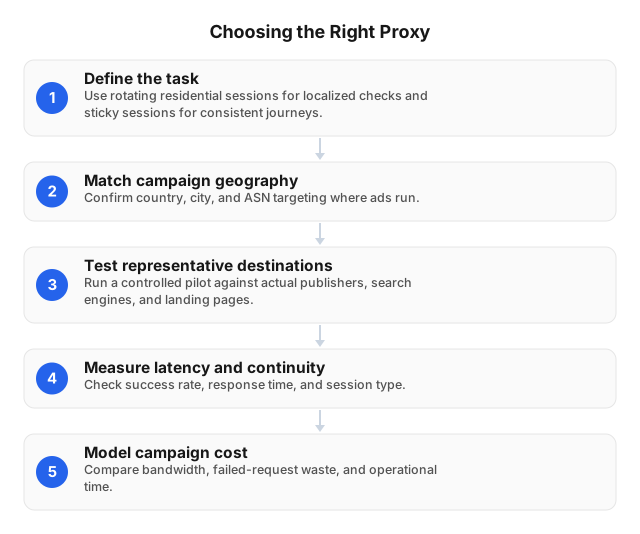
How to Choose a Proxy for Digital Advertising
Choosing the right type is only the first step. The proxy must also match the campaign decision, geographic scope, session requirements, destinations, and budget.
1. Define the decision the test will support
Start with a campaign question, not a desired IP count. Examples include:
- “Does the French campaign show euro pricing?”
- “Does this affiliate redirect users to an approved domain?”
- “Which promotion appears in three target cities?”
- “Does the checkout preserve the advertised discount?”
Record the expected result before testing. This prevents teams from collecting screenshots or search results that do not lead to a campaign action.
2. Match the session model to the workflow
Use rotation when each request is an independent observation, such as when sampling public search results across cities or checking whether an ad appears in several markets.
Use a sticky session for login flows, forms, carts, and conversion paths. Changing the IP between an ad click and checkout can reset localization, trigger a security check, or create an unrealistic journey.
3. Select geographic precision
Country targeting is sufficient for national campaigns. City targeting is more useful for local services, regional promotions, and campaigns with metro-level exclusions.
ASN targeting lets a team inspect results from a selected network context. It can help identify routing or delivery differences, but it should not be treated as proof that every customer on that network receives the same result.
4. Test the actual destinations
Run a pilot against the publishers, search engines, tracking links, and landing pages used by the campaign. A generic speed test cannot show whether a proxy returns the correct language, survives the full redirect chain, or maintains a session through checkout.
For each target, record:
- Successful requests as a percentage of attempts.
- Median and 95th-percentile response time.
- Correct country, city, language, and currency.
- Redirect and tracking-parameter integrity.
- CAPTCHA, block, and retry frequency.
- Data consumed per completed check.
- Cost per usable observation.
A useful cost calculation is:
Cost per completed check = total proxy and retry cost ÷ valid observations
This measure exposes cheap traffic that becomes expensive after failed requests and manual rework.
5. Check capacity and reliability
Pool size matters only if the required locations have enough usable addresses. Ask for a pilot in priority countries and cities rather than assuming a global total guarantees local depth.
EProxies’ service figures state 98.2% uptime, backed by a 99.9% uptime SLA. Review the SLA’s measurement method, exclusions, and credit terms before using the service for campaign-critical monitoring.
For a broader procurement checklist, see the Guide to Choosing the Best Proxy for Your Needs: 2026.
6. Model the correct pricing plan
Estimate monthly bandwidth from page weight, request frequency, location count, and retries. Browser-based checks consume more data than lightweight requests because they load images, scripts, fonts, and video.
EProxies offers:
- Pay-as-you-go residential traffic from $0.25/GB.
- Tiered residential pricing down to about $0.73/GB at 300GB.
- ISP SOCKS5 from $0.95 per IP.
- Unlimited plans from $79 per month.
Compare plans using the exact workload. A static ISP IP may cost less for a persistent dashboard session, while rotating residential traffic may be more efficient for thousands of independent regional checks.
How Proxies Can Improve Ad Performance
Once the setup matches the campaign, its value comes from diagnosis rather than direct ranking or auction effects. For example, a city-targeted check may reveal that an English ad sends German users to a US-dollar page. Fixing that mismatch can protect conversion quality and prevent spend on a broken experience.
Specific applications include:
- Placement verification: Confirm that paid placements appear on approved pages and in contracted locations.
- Localization QA: Check language, currency, prices, disclaimers, and inventory by market.
- Redirect auditing: Follow tracking links to find incorrect domains, missing parameters, or region-specific failures.
- Offer monitoring: Compare public promotions and search messaging in markets where bids or creative may need revision.
- Conversion-path testing: Keep one sticky IP from ad click through form submission or checkout.
- Affiliate compliance: Capture timestamps, URLs, screenshots, and location metadata for placements that need review.
A proxy observation is not proof of click fraud, unauthorized distribution, or a universal user experience. Confirm suspicious findings with platform logs, analytics, publisher records, and repeated checks from more than one IP.
Practical Advertising Workflows
The following workflows apply these selection principles to common advertising tasks.
Geo-targeted creative audit
Create a test matrix with one row per campaign and location. Include the expected creative, language, currency, offer, destination URL, and legal disclaimer.
Use a sticky residential session for each end-to-end journey. Capture the ad, redirect chain, landing page, and checkout state without changing the IP midway. Repeat the test from a second address before escalating a discrepancy.
Localized search monitoring
Use rotating residential sessions to sample public results from approved locations. Keep the query, language, device settings, and time window consistent so that location remains the main variable.
Search results can still differ because of personalization, timing, experiments, and prior session state. Treat a sample as a point-in-time observation rather than a complete ranking census.
Competitor offer tracking
Collect only public information permitted by the target site and applicable law. Store the observed price, promotion, timestamp, URL, and proxy location.
Set request limits and avoid collecting personal data. Rotation distributes independent observations, but it does not authorize access that a site or platform prohibits.
Common Proxy Selection Mistakes
Even a technically suitable proxy can produce misleading or unnecessarily expensive results if the workflow is poorly designed.
Buying on pool size alone
A large global pool may have weak coverage in the two cities that matter to a campaign. Test location accuracy and unique-IP availability in each priority market.
Rotating during multi-step tests
An IP change between a click, form, and checkout can break session continuity. Assign one sticky session to the complete journey.
Using residential traffic for every request
Reserve residential IPs for checks that need consumer-location context. Use direct connections or suitable internal infrastructure for location-neutral asset tests, link validation, and development QA.
Ignoring page weight
A page with autoplay video and several tracking scripts can consume far more bandwidth than an HTML request. Block nonessential media during routine checks if it does not affect the item under review.
Treating proxies as permission
A proxy changes network routing, not legal rights or platform authorization. Document the purpose of collection, apply request limits, minimize retained data, and follow advertising-platform terms, target-site rules, and privacy law.
Teams handling account access should also review Choosing Proxies for Online Anonymity: 2026 Guide. Anonymity controls reduce unnecessary exposure, but they do not replace access controls or data-governance policies.
FAQ
What are the best proxies for digital advertising?
Residential proxies are usually the best choice for localized ad verification, SERP monitoring, landing-page QA, and public offer research. Use rotating residential sessions for independent geographic samples and sticky residential or ISP sessions for logins and multi-page conversion tests. Datacenter proxies remain useful for low-cost internal QA that does not require consumer-network context.
How do proxies improve ad performance?
Proxies let teams inspect ads, redirects, prices, language, and landing pages from the locations their audiences use. These checks can uncover broken links, mismatched offers, incorrect currencies, and unauthorized placements before they consume more budget. Proxies improve the quality of campaign decisions; they do not directly raise an auction score or conversion rate.
What factors should I consider when choosing a proxy?
Prioritize geographic accuracy, success rate on real campaign destinations, session controls, response time, protocol support, authentication, uptime, and cost per completed check. Test the provider with the exact cities, publishers, search engines, and landing pages in your campaign.
Can proxies help with ad verification?
Yes. A location-targeted proxy can show which placement, creative, redirect, or landing page a request receives from a selected market. Preserve timestamps, screenshots, URLs, and location settings, then confirm suspicious results through repeated tests and platform data.
Are residential proxies better for advertising?
They are better when the test depends on consumer-location or network context. ISP proxies are better for stable sessions, while datacenter proxies may be sufficient for internal QA and location-neutral checks. A mixed setup usually controls cost better than routing every task through residential IPs.
Should digital advertising teams use rotating or sticky proxy sessions?
Use rotating sessions for independent checks across many locations or IPs. Use sticky sessions for account access, forms, carts, and conversion paths that must retain one network identity. Do not rotate midway through a journey unless IP-change behavior is the feature being tested.
How should marketers test a proxy provider before committing?
Run a limited pilot against real campaign targets in priority countries and cities. Track valid-response rate, median and 95th-percentile latency, localization accuracy, block frequency, bandwidth, and cost per completed check. Reject results that work on generic test pages but fail on the publishers and landing pages your team actually uses.
Related reading
This article was written by the EProxies team and reviewed against our editorial quality standards before publishing.