
How to Detect Proxy Servers and Bypass Blocks in 2026
TL;DR: Detect proxy servers by combining IP reputation, HTTP headers, and connection behavior—not by trusting one signal. Resolve mistaken blocks through approved allowlists or policy changes. Do not defeat access controls.
For network security analysts, the task is separating evidence of proxy use from evidence of abuse. This guide moves from detection methods to session-level investigation, tool evaluation, and validation of approved fixes without weakening unrelated security rules.
Understanding Proxy Servers and Their Detection
Proxy detection looks for signs that traffic reached a service through an intermediary. Those signs do not establish the user’s intent. Record proxy status separately from the access decision. This lets analysts investigate suspicious requests without assuming every proxy connection deserves a block.
Separate the evidence into two categories:
- IP evidence: Proxy databases and network ownership help classify an address. A listed address supports a proxy classification; an unlisted address does not prove a direct connection.
- Header evidence: Forwarding metadata can describe the path a request took. Its value depends on whether the intermediary supplying it is trusted.
A corporate gateway and an abusive client may both use proxies. Access policy therefore needs to account for authentication and request behavior, not just network classification.
Common Methods for Detecting Proxy Servers
With that distinction in place, start with IP reputation, network ownership, reverse DNS, and HTTP headers, then examine timing and request behavior. Each method answers a different question. Use agreement between signals to guide investigation, rather than treating any single result as conclusive proof.
- Check IP reputation and network ownership. Query current proxy, VPN, and Tor exit databases, and record lookup timestamps. Distinguish hosting networks from residential networks, but avoid treating either label as conclusive.
- Inspect reverse DNS. Look for hostnames that suggest hosting or gateway infrastructure. Missing or generic records do not establish proxy use.
- Examine HTTP headers. Inspect
ViaandForwardedwhere available. Client-supplied headers are untrusted; accept forwarded client addresses only from infrastructure your organization controls or explicitly trusts. Spoofed values can distort logs and later decisions. - Compare latency. Take repeated measurements against the same endpoint under similar network conditions. Congestion and routing differences can resemble the delay added by an intermediary.
- Correlate behavior. Machine-learning models and behavior analysis can add evidence. Test their classifications against known legitimate traffic before using them to enforce blocks.
Advanced Techniques for Proxy Detection
These checks become more useful when connected to individual sessions. Preserve uncertainty when signals disagree. An investigation record should capture both the suspected proxy indicators and the evidence that supports—or weakens—a finding of abuse.
Correlate signals and preserve uncertainty
Use database matches as leads, then check them against observable requests in your own systems. Compare reverse DNS with network ownership, inspect headers at the trusted entry point, and connect those findings to authentication records. This keeps the investigation from relying entirely on an external classification.
For routing investigations, ping and traceroute can provide supporting information, but neither proves proxy use. For timing problems, see Impact of Proxy Servers on Internet Speeds: 2026 Fixes.
Test detection against obfuscation
In an authorized test, compare standard and obfuscated connections against a gateway you control. Obfuscation can change the protocol features a detector sees, so measure the result rather than assuming coverage. Track missed detections separately from challenges issued to legitimate users. Flagging more traffic does not, by itself, demonstrate better detection.
Keep the destination, account, and request consistent during each comparison. Record which rule fired and whether the application received the request. Limit testing to systems and traffic covered by your authorization.
How to Bypass Proxy Blocks Effectively
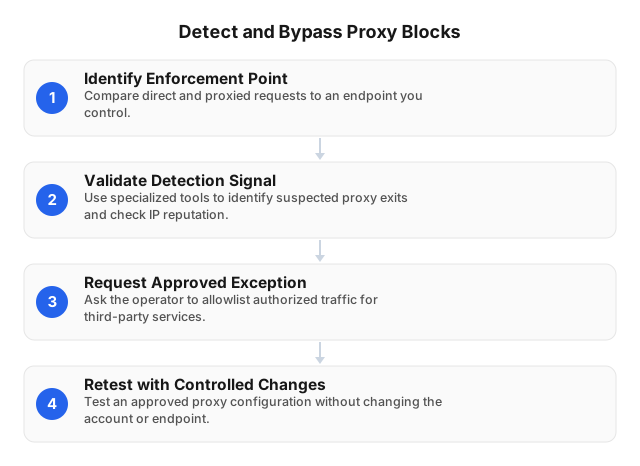
When an investigation concerns blocked access, identify the enforcing rule before changing the connection. Repeatedly changing IP addresses can obscure the cause without resolving it. Use an approved exception, supported API, or configuration fix. If a third-party operator explicitly denies access, request permission instead of routing around that decision.
- Find the enforcement point. Compare direct and proxied requests to an endpoint you control. Check gateway and application logs, distinguishing connection failures from explicit policy denials.
- Validate the signal. Check the reported proxy classification, expected location, and IP reputation to identify any policy or configuration mismatch.
- Request an approved exception. Ask the operator to allowlist authorized traffic or provide a supported API. Scope the exception to the required account, destination, or workflow.
- Retest with controlled changes. Keep the account, endpoint, and request unchanged while testing the approved configuration. Retain the narrowest exception that restores access.
For client configuration checks, use Setting Up Proxy Servers on Popular Operating Systems: 2026.
Comparison of Proxy Detection Tools
The investigation steps above also provide a basis for evaluating tools: compare the evidence they supply, how recently they update it, and how they handle disputed classifications. Avoid choosing on headline accuracy alone. An IP reputation database, HTTP header inspector, and route diagnostic serve different purposes.
| Tool category | Useful output | Main limitation | Evaluation check |
|---|---|---|---|
| IP reputation database/API | Known proxy, VPN, or Tor exit classification | Limited to the classification, not the access decision | Check update timestamps and correction procedures |
| Reverse DNS lookup | Hostnames suggesting hosting infrastructure | Limited to naming evidence | Compare with network ownership and IP classification |
| HTTP header inspector | Forwarding metadata and possible request inconsistencies | Missing headers do not prove a direct connection | Inspect at a trusted entry point |
| Latency and route diagnostics | Timing differences and route information | Cannot isolate the cause of a delay | Compare with an authorized baseline |
Test each tool against your own approved traffic. During procurement, include both proxied and known direct traffic. Record false positives, missed detections, lookup latency, and per-request cost separately. Ask how incorrect classifications are corrected.
Proxy Testing and Illustrative Scenarios
Tool-level results are only part of validation: test success against the destination, not just the proxy connection. Independent industry testing reported median success rates of 99.56% on stable CDN endpoints and 94.30% on real-world targets. An established connection does not guarantee authorized application access. The scenarios below illustrate investigation methods; they are not documented customer outcomes.
Detection: distinguish proxy use from abuse
Before enforcing a rule on suspicious sessions, define its purpose: identifying abusive sessions, for example, rather than simply identifying intermediaries. Test the proposed rule against labeled traffic that includes legitimate sessions, using request behavior and authentication logs to assess its decisions.
If authenticated, expected activity triggers the rule, review that false positive before expanding enforcement. Retain the evidence behind each decision so the review can distinguish a classification issue from an enforcement issue.
Block resolution: repair an authorized testing workflow
For an approved localization test, use gateway logs and the destination response to locate the block. If your gateway caused it, request a scoped exception from the policy owner, then retest the same workflow after approval so the result can be traced to that change.
Confirm that the intended destination is accessible and unrelated restrictions still apply. Retain the approval, affected rule, test request, and result in the change record.
Related reading
When the investigation points to client settings or connection performance rather than an intentional access denial, these guides support the next troubleshooting step. A working configuration does not itself grant permission to access a restricted service.
- Setting Up Proxy Servers on Popular Operating Systems: 2026 — operating-system configuration.
- Impact of Proxy Servers on Internet Speeds: 2026 Fixes — structured performance checks.
FAQ
These answers summarize the diagnostic choices and practical cautions for common proxy-detection and access questions.
How do websites detect proxy servers?
Websites can detect signs of proxy use through IP reputation, network ownership, reverse DNS, and HTTP headers.
What are advanced proxy detection techniques?
Advanced techniques combine IP intelligence, header checks, timing measurements, and session behavior. Residential network ownership does not prove direct household use.
How can I bypass proxy blocks?
For authorized access, resolve blocks through an approved allowlist, supported API, or correction to an inaccurate classification. First check for proxy authentication errors, geographic restrictions, rate limits, or explicit denials. Honor retry instructions and access decisions, and follow the service’s terms and applicable laws.
What tools are best for detecting proxies?
Choose a toolkit that combines IP reputation checks, reverse DNS lookups, HTTP logs, and network diagnostics. Use dig or nslookup for DNS checks. Diagnostic probes may be filtered or follow a different path from web requests, so interpret them cautiously.
This article was written by the EProxies team and reviewed against our editorial quality standards before publishing.