
Static vs Rotating Proxies: How to Choose in 2026
TL;DR: Static vs rotating proxies: choose static proxies when a workflow needs a consistent IP address, and rotating proxies when independent collection tasks benefit from distributed requests. Rotating services with sticky sessions can also preserve IP continuity within a multi-step workflow.
For IT managers and data analysts, the deciding factor is whether an IP change would disrupt the task—such as an authenticated session—or help distribute independent public-page requests. The comparison below maps those requirements to proxy choices, separates latency and retry costs from headline pricing, and keeps collection decisions grounded in target site terms and applicable laws.
Introduction to Proxies
A proxy is an intermediary server that forwards requests to a destination website using an outward-facing IP address instead of the client’s IP. Static proxies maintain a single IP address for all requests, giving a data collection workflow a consistent network identity across its interactions.
Choose IP behavior around the workflow’s need for continuity, not scraping volume alone. An authorized account session may need a persistent IP across login and subsequent requests; collecting unrelated public product pages does not necessarily require that continuity.
For procurement, separate IP persistence from IP source: “static” describes address behavior, while “residential” describes the network source. Also distinguish a fixed address from a time-limited sticky session before designing jobs around uninterrupted access. Neither arrangement grants permission to collect data; follow target-site terms and applicable laws.
Understanding Static Proxies
Static proxies route requests through the same exit IP address for the duration of an allocation or session. Choose a static proxy when IP continuity matters more than request distribution. Rotating proxies, by contrast, change IP addresses automatically per request or at a configured time interval.
- Check what “static” means: A fixed-IP allocation differs from a sticky session that temporarily retains an address from a rotating pool. EProxies supports sticky/static sessions of 24h+; confirm session duration and replacement behavior before designing a dependent workflow.
- Preserve application state: Keep cookies and authentication state aligned with the assigned IP during an authorized, multistep collection workflow.
- Control concentrated traffic: Every request shares the same address. Apply target-specific rate limits and backoff; a persistent IP does not remove blocking risk or permission requirements. Follow site terms and applicable laws.
Understanding Rotating Proxies
Rotating proxies automatically change the outgoing IP address for each request or at configured time intervals. For data collection workflows, choose rotation when requests can run independently; static proxies are ideal for account management and other tasks that require a consistent IP address.
Set rotation around the workflow
- Per-request rotation: Assign changing exit IPs to independent public-page fetches, such as product listings collected without a login.
- Interval-based rotation: Keep an IP until the configured interval expires. Check whether that boundary could interrupt a dependent sequence.
- Session continuity: Keep related requests together rather than changing IP midway through a login-dependent workflow.
Before deployment, identify which requests share authentication or session state. Separate independent fetches from those sequences, and follow target-site terms, rate limits, and applicable laws; IP rotation does not grant access permission.
Static vs Rotating Proxies: A Detailed Comparison
Static vs rotating proxies should be judged against the target: industry benchmarks (2025) report 94.30% median success on real-world sites versus 99.56% on stable CDN endpoints, not a static-versus-rotating split. Choose session continuity for stateful workflows and rotation for distributed public-data collection.
| Decision factor | Static proxies | Rotating proxies |
|---|---|---|
| IP behavior | Retain an IP across requests | Change IP per request or interval |
| Workflow fit | Logins and persistent sessions | Independent scraping requests needing greater IP-level anonymity—not untraceability |
| Detection trade-off | Requests accumulate under one IP | Distribute requests; other identifying signals remain |
| Latency and success | Measure on your actual targets | Measure with your intended rotation schedule |
| Cost efficiency | Evaluate IP fees against utilization | Evaluate traffic charges, including retries |
| Session handling | Preserve IP continuity | Keep multi-step transactions within sticky sessions |
Follow target-site terms and applicable laws; rotation does not authorize access.
Use Cases for Static Proxies
Static proxies suit authenticated data collection, account management, and checkout testing where requests must retain the same IP. Choose static proxies when session continuity matters more than IP diversity. The deciding factor is whether an address change would interrupt the workflow or compromise comparable observations.
For authorized account workflows, keep the proxy assignment aligned with the account’s cookies and browser session. An unchanged IP does not replace valid credentials or permission to collect data.
For retailer-owned checkout testing, hold the IP constant while moving from product selection to payment validation. Avoid changing the network origin mid-transaction.
For longitudinal localization checks, reuse the same exit IP to limit IP variation between observations. Verify persistence requirements: EProxies supports 24h+ sticky/static sessions, but confirm allocation terms before treating a sticky session as a permanently assigned address.
Use Cases for Rotating Proxies
Rotating proxies suit high-volume public web data collection, price monitoring, and search-result tracking when requests can run independently. Rotate between independent tasks, not within a session-dependent workflow. For IT managers and data analysts, the practical dividing line is whether each request needs the previous request’s identity.
For retail price monitoring, rotate between independent product-page fetches. Keep currency, delivery location, and cookies consistent so your dataset does not mistake localization differences for price changes.
For SERP tracking, keep location and query settings fixed while collecting results. Log the exit location alongside each response to distinguish geographic variation from ranking movement.
For scheduled catalog collection, distribute independent fetches across workers, but enforce target-level rate limits across all IPs. Follow site terms and applicable laws; stop on access denials rather than treating rotation as permission to continue.
Choosing the Right Proxy for Your Needs
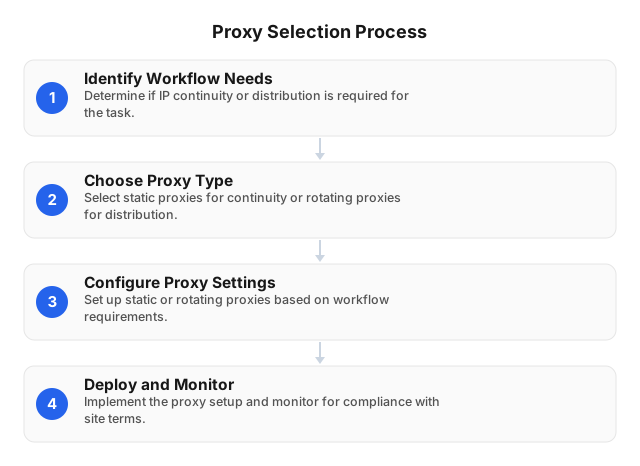
Proxy selection should follow workflow requirements, not headline success rates: industry benchmarks (2025) report 94.30% median success on real-world targets, not a static-versus-rotating verdict. Keep IPs stable for stateful workflows; rotate between independent collection jobs. Validate either choice against your actual targets.
- Map session boundaries. Keep authorized login and checkout workflows on stable IPs. Rotate between independent product-page or search-result collection jobs, not midway through a session.
- Pilot comparable workloads. Hold URLs, concurrency, geography, and timeouts constant. Measure usable records, response latency, retries, and session failures—not HTTP status alone.
- Calculate delivered-data cost. Divide total proxy spend, including retry traffic, by usable records. Compare bandwidth billing with per-IP pricing.
- Verify operational fit. EProxies supports 24h+ sticky/static sessions; confirm renewal behavior before longer jobs. Set target-specific rate limits and follow site terms and applicable laws.
Related reading
- Rotating Proxies: Impact on SEO Strategy in 2026
- Comparing Rotating Proxies: What to Look for in 2026
FAQ
Proxy selection for data collection should follow the unit of work: preserve an IP within a stateful workflow, and consider rotation between independent collection tasks. Evaluate cost per usable record, including retries and incomplete results, rather than choosing solely by advertised bandwidth prices or pool size.
What is the main difference between static and rotating proxies?
A static proxy preserves the same exit IP, while a rotating proxy changes exit IPs per request or on a configured interval. The practical distinction is whether a sequence of requests needs a consistent network identity: changing IPs between login and an authenticated page request can disrupt a session. Rotation policy and IP source are separate choices—“rotating” does not automatically mean residential.
When should I use a static proxy?
Use a static proxy when an authorized workflow depends on IP continuity, such as account administration, authenticated reporting, or a multistep checkout test. Keep the IP, cookies, and session credentials consistent throughout the workflow, and verify what happens if the proxy connection fails. For recurring jobs, confirm whether the provider assigns a persistent IP or merely preserves an address for a limited sticky-session period.
What are the benefits of rotating proxies?
Rotating proxies distribute independent collection requests across multiple exit IPs, reducing dependence on a single address and supporting geographically distributed sampling. For public price monitoring, preserve an IP while collecting related pages, then rotate between independent tasks if the provider supports that configuration. Rotation does not replace request pacing: follow target-site terms and applicable laws, and avoid using IP changes to circumvent access controls.
How do I choose between static and rotating proxies?
Choose static sessions when requests share login state or depend on continuity; choose rotation when collection tasks are independent and require distributed exit IPs. Test both configurations against the same permitted targets, holding request rate and geography constant, and compare usable records, retries, latency, and billed traffic. Industry benchmarks (2025) reported median residential success rates of 99.56% on stable infrastructure versus 94.30% on real-world targets—a reason to validate your workload, not evidence that either rotation strategy is inherently superior.
Are rotating proxies more secure than static ones?
Rotating proxies are not inherently more secure: changing an exit IP does not encrypt traffic, protect stored credentials, or prevent a destination from recognizing an authenticated account. Assess transport encryption, proxy authentication, credential handling, and provider data practices separately from rotation. A stable IP can also be preferable for authorized systems that use IP allowlists; frequent address changes may conflict with that control.
Is a sticky session the same as a static proxy?
A sticky session retains an exit IP for a defined period within a rotating service, whereas a persistent static-IP offering is intended to keep the assigned address beyond an individual session. EProxies lists rotating and sticky/static sessions of 24h+, which can support workflows requiring extended IP continuity. Before relying on that duration for an authenticated collection job, confirm expiration and reconnection behavior; session duration alone does not establish permanent IP ownership.
This article was written by the EProxies team and reviewed against our editorial quality standards before publishing.