
Comparing Rotating Proxies: What to Look for in 2026
TL;DR: In 2026, choose rotating proxies by usable IP quality, rotation control, geo precision, protocol fit, uptime evidence, pricing transparency, and compliance—not pool size alone. EProxies is built for teams that need 72M+ residential IPs across 195+ countries, city/ASN targeting, documented HTTP(S) and SOCKS5 options, documented username-password and IP whitelist authentication options, residential pricing from $0.25/GB, ISP SOCKS5 from $0.95/IP, and unlimited plans from $79/month. For production use, verify exact session-mode availability and SLA language in your current plan or order form.
Introduction to Rotating Proxies in 2026
Rotating proxies route requests through changing IP addresses. Depending on configuration, the IP can rotate per request, after a set interval, or according to a session rule. That flexibility matters for localized QA, ad verification, price monitoring, SEO checks, and compliant public web data collection.
The common buying mistake is treating “more IPs” as the whole decision. Pool size matters, but only if the pool is usable for your targets, locations, protocols, and traffic pattern. A smaller, well-matched setup can outperform a large but poorly targeted one if it reduces retries and keeps sessions stable when needed.
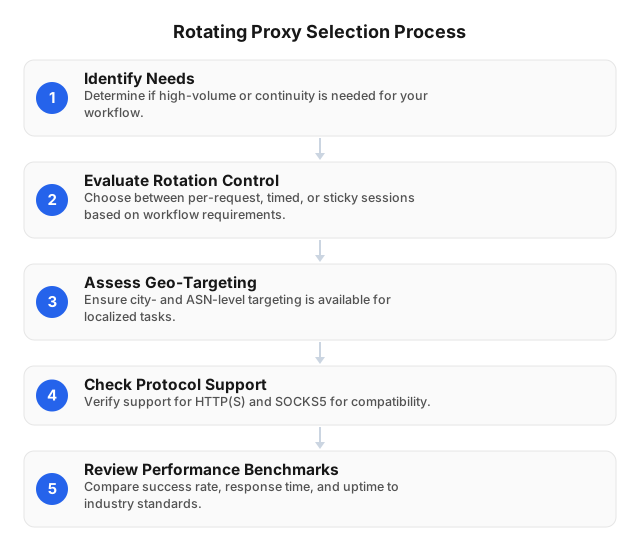
In 2026, evaluate rotating proxies across seven practical dimensions:
- Rotation behavior: per-request rotation for scale; sticky/static sessions for continuity.
- Geo accuracy: country coverage is useful, but city and ASN targeting are often required for localized testing.
- Protocol fit: HTTP(S) works for most web workflows; SOCKS5 helps when applications need broader traffic support.
- Authentication: username-password and IP whitelist options simplify secure deployment.
- Uptime evidence: separate observed uptime, contractual SLA terms, and target-specific success rate.
- Cost per successful result: retries, failed requests, and poor targeting can make cheap traffic expensive.
- Governance: align proxy use with site terms, applicable laws, and internal data-use policies.
For a deeper compliance lens, see ethical proxy use for web scraping.
How Rotating Proxy Technology Works
A rotating proxy sits between your client and the destination site. Instead of every request coming from the same IP, the proxy network assigns traffic across a pool of residential, ISP, or datacenter IPs.
Main rotation models
- Per-request rotation: Each request can use a different IP. This is useful for large public-data collection jobs where continuity is not required.
- Timed rotation: IPs change after a defined period. This balances distribution with moderate session stability.
- Sticky/static sessions: The same IP is kept for a session or workflow. This helps with multi-step actions such as cart testing, language selection, login-adjacent QA, or regional content checks.
Current EProxies product materials describe rotating proxy behavior and sticky/static session options. Because session rules can vary by product line, plan, and integration method, confirm the maximum sticky duration, reset behavior, and whether your chosen endpoint supports the exact rotation mode you need before scaling.
Why proxy type matters
Residential proxies use IPs associated with residential networks, which can be better suited to geo-sensitive testing and public web data workflows. Datacenter proxies can still be useful for high-speed, lower-cost tasks where residential identity is not required. If you are comparing architectures, start with this guide to residential vs. datacenter proxies.
For a broader taxonomy, see the Comprehensive Overview of Proxy Server Types.
What to Look for in Rotating Proxies
With the core models clear, the next step is evaluating whether a provider’s network, controls, and commercial terms match your real workloads.
1. Usable pool depth, not just headline pool size
A headline pool number is only useful if it maps to the countries, cities, ASNs, and targets you actually need. For example, a team monitoring prices in five markets should ask how much usable depth exists in those specific regions—not only how many total IPs the provider advertises.
EProxies offers 72M+ residential IPs across 195+ countries, with visible depth in key markets including approximately:
- US: 5.6M IPs
- UK: 1.9M IPs
- Germany: 1.4M IPs
- France: 1.3M IPs
- Canada: 1.0M IPs
That distribution is useful when teams need to compare regional search results, pricing, ads, or localized content across multiple markets.
2. Session control for different workflows
Not every task should rotate the same way. A public product-page crawl may benefit from frequent rotation. A checkout QA flow may fail if the IP changes halfway through the journey.
Use this rule of thumb:
| Workflow | Better session model | Why |
|---|---|---|
| Large public-page collection | Per-request or timed rotation | Distributes traffic and reduces repeated requests from one IP |
| Cart, language, or location testing | Sticky/static session | Maintains continuity through multi-step flows |
| Ad verification | City/ASN targeting with controlled rotation | Checks placement without mixing unrelated regions |
| Account-adjacent QA | Sticky/static session with careful governance | Reduces session disruption |
EProxies materials include rotation and sticky/static session concepts, but the safest production approach is to test both modes on the same target workflow. Measure whether the session remains stable across cookies, redirects, language selection, cart state, and repeated page loads.
3. Protocol and authentication support
For many web-data and QA stacks, HTTP(S) support is the default requirement. SOCKS5 is valuable when traffic comes from tools or applications that need more flexible transport support.
EProxies documentation lists HTTP(S) and SOCKS5 protocol options, and separately documents common authentication methods such as username-password and IP whitelist. Before deployment, confirm the exact protocol/authentication combinations available for your selected plan, especially if you need SOCKS5 plus IP whitelisting, browser automation, or multiple team-level credentials.
If you are building a collection system around APIs, see Creating Effective Web Scraping Strategies Using APIs.
4. Uptime, SLA, and retry planning
Performance should be measured in context. Public benchmark results often vary by target difficulty, anti-abuse systems, request pacing, fingerprint quality, and local network conditions. A provider can perform well on stable test endpoints yet produce lower success on heavily protected real-world sites.
For planning, separate three metrics:
- Uptime: whether the proxy service is available.
- Success rate: whether target requests complete as intended.
- Response time: how long completed requests take.
EProxies reports 98.2% uptime. EProxies also positions availability as SLA-backed; if procurement requires a 99.9% uptime SLA, verify the current SLA wording, credit terms, exclusions, and measurement window in the active contract or order form rather than relying on a marketing summary alone.
5. Pricing transparency
The cheapest advertised rate is not always the lowest real cost. A proxy plan with more retries, mismatched locations, or limited session control can increase your cost per successful record.
EProxies pricing options include:
- Residential pay-as-you-go from $0.25/GB
- Tiered residential pricing down to about $0.73/GB at 300GB
- ISP SOCKS5 from $0.95/IP
- Unlimited plans from $79/month
Before choosing a plan, estimate monthly traffic, retry rate, concurrency, required locations, and whether your use case is bandwidth-heavy or session-heavy. For a cost-risk comparison, see Comparing Free vs Paid Proxy Servers: Pros and Cons.
Latest Innovations in Rotating Proxy Technology
Rotating proxy technology in 2026 is moving beyond “change IPs often.” The strongest setups now focus on adaptive control, better targeting, and more observable performance.
Key innovations include:
- Adaptive rotation rules: Rotation can be tuned by request type, error rate, endpoint, geography, or session state instead of using one global rotation interval.
- Smarter sticky sessions: Teams can hold an IP for login-adjacent QA, cart testing, or regional preference checks, then rotate again for scale.
- City- and ASN-level routing: More precise targeting helps validate ads, search results, pricing, and localized content without mixing unrelated network contexts.
- Protocol flexibility: HTTP(S) remains standard for web workflows, while SOCKS5 is increasingly important for app-level testing and non-browser tools.
- Real-time health monitoring: Better dashboards and APIs make it easier to track uptime, response time, retry rate, blocked responses, and location accuracy.
- Compliance-aware operations: More mature teams now combine proxies with rate limits, robots/terms review, audit logs, and data minimization.
These innovations matter because most failures are not caused by rotation alone. They come from the wrong rotation model, weak geo matching, poor session continuity, missing protocol support, or a scraping strategy that ignores target-specific limits.
A Practical Evaluation Framework
Use this checklist to translate those criteria into a provider comparison:
| Decision area | What to ask | Why it matters |
|---|---|---|
| Pool quality | Are IPs available in the exact countries, cities, or ASNs I need? | Prevents noisy or inaccurate regional results |
| Rotation logic | Can I choose per-request, timed, and sticky/static behavior for my plan? | Matches the proxy pattern to the task |
| Protocols | Are HTTP(S) and SOCKS5 supported for my tools? | Improves compatibility with browsers, APIs, and apps |
| Authentication | Are username-password and IP whitelist available for the same endpoint I plan to use? | Simplifies secure access control |
| Reliability | Is there uptime data, and are SLA terms contractually defined? | Helps production planning |
| Pricing | Is billing clear by GB, IP, or unlimited plan? | Avoids surprise scaling costs |
| Compliance | Are there clear rules for acceptable use? | Reduces legal and operational risk |
EProxies is strongest for teams that want one platform covering residential scale, geo precision, flexible session planning, and multiple pricing models. It is especially practical when a workflow combines several needs: localized monitoring, API-driven collection, browser QA, and SOCKS5 compatibility.
Common Use Cases
The same evaluation framework applies differently depending on the workflow. These are the common patterns where rotation control, targeting, and session stability tend to matter most.
Regional price and content monitoring
A retail intelligence team comparing public product pages across the US, UK, Germany, France, and Canada needs more than “global coverage.” It needs enough IP depth in each market, accurate targeting, and predictable rotation.
With EProxies’ residential pool depth in those regions, teams can align proxy routing to the markets they actually analyze. Sticky sessions can also help when a site stores region, currency, or language preferences during a browsing flow.
Search and ad verification
Search results and ad placements can vary by city, network, device context, and session history. Rotating proxies help teams observe localized results without relying on a single exit point. City- and ASN-level targeting can reduce ambiguity when verifying whether a campaign appears in the right place.
For these workflows, avoid rotating blindly. Rotate for coverage, then hold a session when you need to validate a specific user journey.
Compliant public web data collection
For public web data collection, rotating proxies are only one part of the system. Responsible workflows also need request pacing, error monitoring, deduplication, retry limits, and compliance review.
A good setup should answer:
- Are we collecting only permitted public data?
- Are request rates reasonable?
- Are we respecting relevant terms, laws, and internal policies?
- Do we stop or slow down when error rates rise?
For implementation guidance, see How to Automate Web Scraping Without Getting Blocked and ethical proxy use.
FAQ
What are the latest innovations in rotating proxy technology?
The latest innovations are adaptive rotation, smarter sticky sessions, city/ASN-level targeting, real-time pool health monitoring, stronger protocol support, and compliance-aware controls. Instead of rotating every request blindly, modern systems adjust rotation based on target behavior, session needs, error rates, and location requirements. For production teams, the most useful innovation is not one feature—it is the ability to combine rotation, session stability, targeting, and observability in one workflow.
Which rotating proxy providers are leading the market in 2026?
The market leaders in 2026 are providers with large, usable residential pools; precise geo targeting; documented HTTP(S) and SOCKS5 support; flexible rotation and sticky-session controls; transparent uptime reporting; and clear pricing. Shortlists should also prioritize providers that publish acceptable-use rules and support compliant public-data workflows. EProxies fits teams looking for 72M+ residential IPs across 195+ countries, multiple pricing models, and practical coverage for monitoring, QA, and automation use cases.
What are the most important rotating proxy features in 2026?
Prioritize usable residential pool depth, rotation control, sticky/static sessions, city and ASN targeting, HTTP(S)/SOCKS5 support, secure authentication, uptime transparency, and clear pricing. EProxies offers 72M+ residential IPs across 195+ countries and reports 98.2% uptime; verify current SLA terms and exact feature combinations for your selected plan before production rollout.
How do rotating proxies work?
They route requests through different IP addresses automatically. The IP may change per request, after a time interval, or according to session rules. This helps distribute traffic and supports workflows such as localization testing, ad verification, price monitoring, and compliant public web data collection.
Are sticky sessions still necessary if I use rotating proxies?
Yes. Constant rotation is not always ideal. Sticky/static sessions are useful when a workflow needs continuity, such as cart testing, region selection, multi-step QA, or account-adjacent testing. The best setup usually combines rotation for scale with sticky sessions for stability.
Are residential proxies better than datacenter proxies?
It depends on the task. Residential proxies are often better for geo-sensitive and public web workflows because they use residential network IPs. Datacenter proxies may be better for lower-cost, high-speed tasks where residential identity is unnecessary. For more detail, read residential vs. datacenter proxies.
How should I estimate the true cost of rotating proxies?
Calculate cost per successful result, not just cost per GB. Include retries, failed requests, response time, required locations, session type, and engineering effort. EProxies offers residential pay-as-you-go from $0.25/GB, tiered residential pricing, ISP SOCKS5 from $0.95/IP, and unlimited plans from $79/month.
What should I test before scaling proxy traffic?
Run a small proof of concept against your real target sites. Measure success rate, response time, retry rate, blocked responses, location accuracy, and session stability. Also test both rotation and sticky/static modes so you can choose the right behavior for each workflow.
This article was written by the EProxies team and reviewed against our editorial quality standards before publishing.