
Rotating Proxies: Impact on SEO Strategy in 2026
TL;DR: Rotating proxies improve keyword analysis by collecting localized SERPs at scale without tying every request to one IP. Use per-request rotation for independent keyword checks, sticky sessions for pagination or consent flows, and static proxies for workflows that require a persistent identity. Rotation also hides the collector’s direct IP and reduces IP-based correlation, but cookies, logins, browser fingerprints, and query patterns can still identify a session.
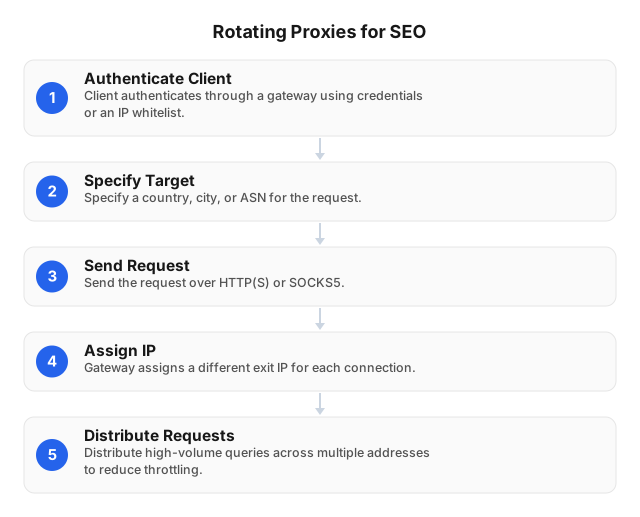
How Rotation Changes SEO Data Collection
A rotating proxy gateway selects exit IPs from a pool. It can assign a new IP to every request or retain one exit through a session identifier.
This mechanism affects SEO research in four practical ways:
- Localized sampling: Country- or city-targeted exits show how rankings, local packs, shopping units, and competitors vary by market.
- Higher collection capacity: Requests are distributed across multiple exits instead of concentrating traffic on one IP.
- Cleaner independent observations: A fresh IP, cookie jar, and browser context reduce carryover between unrelated keyword checks.
- Stateful browsing when required: Sticky sessions keep the same IP for consent choices, pagination, authentication, or multi-step captures.
Rotation improves the measurement process, not the page being measured. It does not create backlinks, strengthen content, fix crawling problems, or directly raise rankings.
EProxies provides more than 72 million residential IPs across 195+ countries, with HTTP(S) and SOCKS5 support.1 Pool size is not proof of usable coverage in a specific city, carrier, or ASN; benchmark the exact locations required by the project.
Per-Request, Sticky, and Static IPs
Per-request rotation for independent checks
Use a new exit for observations that do not depend on previous requests:
- checking 2,000 unrelated keywords;
- sampling one query across 20 cities;
- comparing desktop and mobile SERP features;
- auditing public metadata across thousands of URLs;
- testing whether regional pages appear in their intended markets.
Reset cookies and other client identifiers with the IP. Reusing a cookie jar after changing the IP creates a mixed identity and can preserve personalization from an earlier request.
Sticky sessions for multi-step jobs
A sticky session retains one exit for a defined period or task. Use it for:
- moving from page one to page two of a SERP;
- accepting a consent prompt before collecting results;
- selecting a language or delivery location;
- signing in to an authorized SEO platform;
- loading related assets for a complete page capture.
Test usable persistence rather than relying solely on the advertised session duration. Record whether the exit survives idle periods, how often it changes mid-job, and whether a failed IP is replaced automatically.
Static proxies for persistent identities
A static proxy assigns one IP repeatedly. It is appropriate for allowlisted systems, long-lived authenticated accounts, stable regional monitoring, and workflows where an unexpected address change triggers security checks.
The trade-off is concentration. A static address accumulates the full request history and becomes a single point of failure, while rotation spreads independent work across a pool. The Comparing Rotating Proxies: What to Look for in 2026 explains how to evaluate rotation controls, pool coverage, and session behavior.
A Repeatable Keyword-Analysis Workflow
Search results can change with location, language, device, cookies, account state, endpoint, and time. A defensible test changes one variable while holding the rest constant.
Suppose a footwear retailer compares “running shoes” in London, Manchester, and Glasgow. Use the same:
- search endpoint and query spelling;
- browser language;
- desktop or mobile profile;
- consent state;
- clean cookie policy;
- local sampling window;
- parser version;
- repetition count.
Change only the city-targeted exit. If Glasgow repeatedly displays more local stores while London favors national retailers, the retailer has evidence for testing store pages or city-specific inventory. If the device, cookies, language, and location all change, no one can identify which variable caused the difference.
Define each measurement profile before collection:
| Input | Controlled example |
|---|---|
| Target | Berlin, Germany |
| Language | German |
| Device | Mobile |
| Session model | New IP and cookie jar per query |
| Sampling window | 08:00–10:00 local time |
| Repetitions | Three per keyword |
| Accepted output | Correct locale and expected result structure |
| Validation | Automated checks plus a manual sample |
Repeated samples expose unstable rankings and transient SERP experiments. For example, positions 3, 3, 9 should not be reported as a stable rank of three; flag the keyword for another sampling window and inspect whether a local pack, shopping unit, or alternate page changed the result layout.
Rotation also strengthens keyword clustering. If “emergency plumber” consistently triggers local packs across five cities but “how to fix a leaking tap” returns instructional pages nationwide, the first term belongs in a local transactional cluster and the second in an informational cluster. Geographic SERP evidence is more reliable than grouping both terms from wording alone.
Validate the Result Body, Not the Status Code
An HTTP 200 OK response can contain a consent page, challenge, empty template, wrong language, or incomplete SERP. Count a request as successful only after validating its content and location.
Track these metrics by destination and target location:
- Valid-result rate: responses containing the expected result elements;
- Localization accuracy: observed country, city, ASN, language, and currency versus the requested profile;
- Challenge rate: CAPTCHA, block, consent-only, or verification responses;
- Session completion: stateful jobs finished without an IP change;
- IP reuse: duplicate exits within the measurement window;
- Latency: median and 95th-percentile response times;
- Retry burden: total requests divided by accepted records;
- SERP variance: rank and feature changes across repetitions.
Use cost per valid, correctly localized record as the commercial metric:
(proxy + compute + storage + retry cost) ÷ accepted records
An illustrative $10 run that produces 8,000 accepted records costs $0.00125 per usable result. If another configuration costs $8 but only 5,000 of its responses pass geography and content validation, its usable cost is $0.0016—28% higher despite the lower invoice.
Pilot the Configuration Before Scaling
A controlled pilot should contain enough variation to expose location, session, and blocking problems without committing a full production budget.
- Select 100–500 representative queries. Include national terms, local-intent phrases, long-tail keywords, branded searches, and queries that produce maps or shopping modules.
- Create fixed profiles. Record location, language, device, endpoint, cookies, headers, parser version, and time window.
- Test both rotation modes. Use per-request rotation for independent checks and sticky sessions for multi-step flows.
- Start with low concurrency. Increase from 5 to 10, 25, and 50 workers only while valid-result rate remains stable.
- Reject invalid bodies. Detect challenges, empty templates, missing result containers, and wrong-language pages before parsing rankings.
- Verify exit geography. Independently inspect a sample instead of trusting the requested location label.
- Review at least 30 accepted and 30 rejected records manually. This catches parser errors that aggregate metrics hide.
- Calculate usable yield. Include retries, invalid records, bandwidth, compute, and storage.
Repeat the benchmark after a parser change, material volume increase, new target market, or destination redesign. A setup that performs well at 10 concurrent requests may produce more challenges or incorrect locales at 100.
Reliability: Gateway Uptime vs. SERP Success
EProxies planning materials report 98.2% uptime, while separate service material references a 99.9% uptime SLA.2 These figures measure different concepts.
Treat 98.2% as an observed planning metric. For the 99.9% SLA, verify:
- which gateways and network components are covered;
- the measurement period;
- scheduled-maintenance exclusions;
- destination-side and customer-side exclusions;
- the claim procedure;
- available service credits or remedies.
A reachable gateway can still return an invalid SERP. Production monitoring therefore needs two separate alerts: one for gateway connectivity and another for valid-result rate by destination and location.
Choosing a Proxy Type and Billing Model
| Proxy type | Best fit for SEO work | Primary limitation |
|---|---|---|
| Residential | Local SERPs and international keyword research | Variable latency and bandwidth-based cost |
| ISP | Persistent sessions and repeated checks from one region | Narrower location depth than rotating residential pools |
| Datacenter | Internal QA and crawling sites that permit automation | More exposed to IP-category filtering |
| Mobile | Tests that specifically require carrier-network context | Higher cost and variable throughput |
EProxies lists pay-as-you-go residential service from $0.25/GB, tiered residential pricing down to about $0.73/GB at 300GB, ISP SOCKS5 access from $0.95 per IP, and unlimited plans from $79 per month. These figures apply to separate offers rather than one linear pricing curve; verify current minimums, included locations, concurrency, and overage terms.
Traffic billing fits intermittent research. Per-IP ISP plans fit persistent identities. Unlimited plans require a throughput test because “unlimited” traffic may still operate under concurrency, fair-use, or target restrictions. See the Proxy Type Selection by Task: 2026 SEO & Scraping Guide for task-specific selection criteria.
Privacy and Security Boundaries
A proxy replaces the collector’s direct source IP with the exit IP seen by the destination. Rotation further limits how much activity can be associated with one exit and separates collection traffic from an employee’s home address or a company’s office network.
It does not provide complete anonymity. Sites can correlate activity through account logins, cookies, browser fingerprints, TLS characteristics, URL identifiers, and repeated query sequences. A rotating IP paired with a persistent analytics cookie remains linkable.
Apply these controls:
- use HTTPS to protect traffic between the client and destination;
- keep proxy credentials in a secrets manager;
- restrict gateway access by role or source address;
- use separate cookie jars for independent jobs;
- remove account IDs, tokens, and sensitive query parameters from logs;
- define retention periods for raw pages and IP metadata;
- inspect the provider’s logging, data-processing, and IP-sourcing policies.
A proxy routes selected application traffic, whereas a VPN commonly routes a broader device or network tunnel. Proxy Servers vs VPNs for Digital Privacy in 2026 covers that distinction in detail.
Collection must follow applicable law, contracts, privacy obligations, and target-site terms. RFC 9309 standardizes the robots exclusion protocol, but a robots rule is neither legal permission nor a substitute for authorization.
Related Reading
- Comparing Rotating Proxies: What to Look for in 2026
- Proxy Servers vs VPNs for Digital Privacy in 2026
- Proxy Type Selection by Task: 2026 SEO & Scraping Guide
FAQ
How do rotating proxies improve keyword analysis?
Rotating proxies let researchers collect the same keyword from multiple countries or cities without routing every query through one IP. This reveals regional ranking differences, local packs, SERP features, and competitor pages that a single-location check can miss. Per-request rotation also distributes independent checks, while repeated localized samples help distinguish stable intent patterns from temporary SERP variation.
What are the privacy benefits of using rotating proxies?
They prevent the destination from seeing the collector’s direct IP and reduce the amount of activity associated with any single exit address. Rotation can also separate research traffic from corporate or home-network infrastructure. It does not defeat cookies, logins, browser fingerprints, or behavioral correlation, so teams still need session isolation and careful logging controls.
How do rotating proxies compare to static proxies?
Rotating proxies change exits per request or session, making them better for large sets of independent keyword checks and geographically distributed sampling. Static proxies retain one identity, which is preferable for allowlisting, authenticated accounts, and long-lived workflows but creates a single point of failure and a concentrated request history. Sticky rotation offers a middle ground by holding one IP only for the duration of a stateful job.
Do rotating proxies improve rankings?
No. They improve the geographic coverage and resilience of SEO data collection. Rankings change only when teams act on that evidence—for example, by correcting local-intent mismatches, strengthening regional pages, or fixing technical problems.
Should rank tracking rotate the IP for every request?
Rotate both the IP and cookie jar for independent keyword checks. Keep a sticky IP for pagination, consent settings, authentication, or any sequence that depends on session state.
Are residential proxies always best for SEO?
No. Residential exits fit localized public-web research, ISP proxies fit persistent regional sessions, and datacenter proxies can be faster for internal systems or sites that permit automated access. Mobile proxies are justified when carrier-network context is an explicit test variable.
How should teams compare proxy providers?
Benchmark the required cities and destinations rather than relying on global pool size. Compare valid-result rate, localization accuracy, challenge rate, sticky-session completion, p95 latency, IP reuse, and cost per accepted record. Run the same query set, concurrency levels, and validation rules for every candidate.
What does a 99.9% uptime SLA guarantee?
Only the components, exclusions, measurement window, and remedies defined in the current contract. It does not guarantee inventory in a particular city or that a search destination will return a valid, correctly localized SERP.
Footnotes
- EProxies product and protocol documentation supplied for this article (Sources S1 and S5): 72M+ residential IPs, 195+ countries, and HTTP(S)/SOCKS5 support. ↩
- EProxies uptime and SLA material supplied for this article (Source S3): 98.2% reported uptime and a separately stated 99.9% uptime SLA, subject to current service terms. ↩
This article was written by the EProxies team and reviewed against our editorial quality standards before publishing.