
Rotating Proxies in E-commerce: A 2026 Case Study Guide
TL;DR: Use rotating proxies for independent price and stock checks, and preserve sessions for connected shopping steps. Measure usable, location-matched records—not just completed requests. Validate product identity, currency, seller, and delivery destination before sending observations into analytics or repricing systems.
An IP change during a shopping journey can reset a cart or change an offer’s location context. The walkthrough below is a proposed configuration and validation procedure, not a report of customer results or EProxies performance benchmarks.
Understanding Rotating Proxies in E-commerce
Rotating proxies assign different outgoing IP addresses between requests or at configured intervals, making them suitable for independent product observations. Connected shopping journeys may instead require a stable exit address and persistent cookies. Choose the rotation boundary around the task: changing addresses halfway through delivery selection can make otherwise valid prices incomparable.
Match rotation to the observation
Treat a standalone product lookup as an independent job. Keep the requested market fixed while allowing the exit address to change between jobs.
Treat product selection, cart creation, and delivery confirmation as a connected journey. Preserve the supported proxy session and cookie jar until that journey finishes; if either loses continuity, restart rather than joining records from different contexts.
Store the product identifier, variant, timestamp, requested geography, observed delivery region, currency, and session identifier with each observation. A requested country is configuration evidence, not proof that the storefront served that country’s offer.
Key Benefits of Rotating Proxies for E-commerce
Distributing independent requests across exit addresses reduces a collection job’s dependence on a single IP, while geographic targeting supports market-specific price and stock observations. These mechanisms can improve collection coverage, but they do not guarantee access or accuracy. The useful output is a validated offer with consistent product, seller, currency, and delivery context—not merely a downloaded page.
For regional monitoring, separate collection jobs by intended market. A storefront may use cookies, account settings, or a delivery postcode alongside IP location, so inspect the page’s actual delivery setting before accepting its price.
For repeated catalog checks, retain failure categories alongside successful records. Otherwise, a missing observation can look like a product withdrawal when the real cause was a timeout, consent screen, or parser failure.
Request distribution does not authorize more traffic. Follow site terms, applicable laws, and published rate limits; reduce traffic when a storefront signals throttling.
Comparing Rotating Proxies: Residential vs. Datacenter vs. Mobile
Residential, datacenter, and mobile proxies differ in network origin, not in guaranteed data quality. Select the network context your research requires, then compare options against the same products, markets, and collection windows. Evaluate accepted records, latency, and transfer consumption together; a cheaper download is not cheaper research if its contents fail validation.
| Proxy type | Appropriate evaluation scenario | What to validate |
|---|---|---|
| Residential | Regional price and stock research using residential-network exits | Displayed currency, delivery destination, and complete offer fields |
| Datacenter | Permitted public-catalog collection using hosting-network exits | Target accessibility and product-field completeness |
| Mobile | Research that specifically requires cellular-network context | Cellular exit context; device behavior must be tested separately |
EProxies offers 72M+ residential IPs across 195+ countries and supports HTTP(S) and SOCKS5. These specifications describe network scope and connection options, not a target-specific collection success rate.
Do not conflate proxy origin with rotation policy: a residential connection can still need a sticky session. See Static vs Rotating Proxies: How to Choose in 2026 for the session-continuity trade-offs.
Exclude access-denial pages, consent screens, and incomplete offers from accepted-record counts—even when the HTTP request completes successfully.
Implementation Patterns for E-commerce
E-commerce collection should use separate workflows for independent catalog observations and connected cart checks. Rotate between standalone visits; retain supported sessions and cookies through delivery selection and checkout validation. Both workflows need explicit acceptance rules so that a change in seller, variant, or shipping context cannot silently become a reported price movement.
Price monitoring across markets
Assign each job a country and delivery context before collection. Capture the product identifier, variant, seller, currency, availability, and observation time, then compare those fields with the job’s expected values.
Keep product price, tax treatment, shipping charge, and delivered total in separate fields when available. A product-only price and a delivery-inclusive total are not comparable observations.
Quarantine location mismatches before they reach repricing systems. Do not “correct” the currency label while leaving the underlying offer untouched.
Cart-price validation
Use an authorized cart test and preserve its cookie jar, delivery destination, and supported proxy session throughout the journey. Check the provider’s documented sticky-session expiry behavior before scheduling the task.
Record advertised price and checkout total separately. If shipping changes after destination selection, retain that change as offer context rather than attributing it to a product-price update.
If the cart resets or the destination changes unexpectedly, restart the observation. Stitching the initial product page to a different checkout session produces a misleading total.
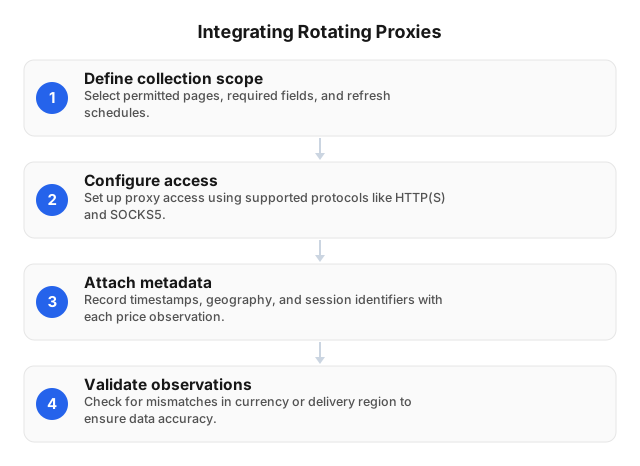
Step-by-Step Guide to Integrating Rotating Proxies
Configure rotating proxies inside the collection worker, then verify authentication, geography, session behavior, and extraction before enabling scheduled jobs. EProxies supports HTTP(S) and SOCKS5; use the protocol your client supports. Keep credentials outside source code and logs, and test the same deployed runtime that will perform collection rather than relying solely on local success.
- Define the record contract. Specify permitted pages, required product fields, delivery context, and rejection reasons before writing retry logic.
- Configure access. Load the supplied endpoint and credentials from protected configuration using the provider’s documented authentication syntax.
- Verify the route. Use an IP-check endpoint you are authorized to query to inspect the outgoing address. Treat this as a connectivity check, not proof of storefront localization.
- Fix geography. Apply documented targeting controls, then confirm the storefront’s displayed currency and delivery destination.
- Set session boundaries. Rotate independent jobs; retain the documented sticky-session identifier and cookie jar for connected steps.
- Bound retries and logging. Set a retry limit, timeout, and backoff policy. Record response status, latency, transferred bytes, session identifier, and validation outcome without exposing credentials.
Run a pre-launch validation check
Use a permitted product page and an authorized cart journey as separate test cases. This setup tests routing, extraction, and session continuity independently; it does not assume that successful routing proves the whole workflow works.
For the product-page test, enable rotation while keeping the requested market fixed. Save the returned content and compare the extracted product identifier, variant, seller, currency, destination, and price against that content.
For the cart test, begin with a fresh cookie jar, select the delivery destination, and retain the same supported proxy session through connected steps. Inspect saved content after each transition for cart resets or location changes.
| Observation | What to inspect before retrying |
|---|---|
| Price appears in saved content but not in the record | Selectors, rendering requirements, and parsing logic |
| Exit address does not change as expected | Documented rotation rules, session settings, and connection reuse |
| Currency or delivery destination changes | Redirects, cookies, account settings, and page-level location controls |
| Cart resets | Cookie persistence and documented proxy-session expiry |
| Local collection works but deployment fails | Deployed credentials, authentication restrictions, network access, and runtime differences |
| Access is denied or throttled | Site instructions, response headers, schedule, and concurrency |
Repeat the checks from the deployed worker before increasing volume. Restrict access to saved responses and avoid retaining account or checkout information the test does not require.
Common Challenges and Solutions in Proxy Integration
Diagnose proxy integration failures by separating transport errors, session failures, localization mismatches, and extraction defects. Each category requires a different response: rotating again cannot repair a broken selector, and retrying cannot restore an expired cart. Require the intended product, currency, delivery location, and availability field before ingestion, and retain a rejection reason for every discarded observation.
| Symptom | Likely inspection area | Corrective action |
|---|---|---|
| Cart loses its delivery setting | Cookies, redirects, session expiry | Restore continuity and restart the journey |
| Unexpected currency | Targeting and storefront location settings | Reapply context and quarantine the observation |
| Missing price | Saved response versus parser output | Separate retrieval failure from extraction failure |
| Repeated throttling | Schedule, concurrency, response headers | Honor Retry-After when provided and reduce traffic |
| Transfer consumption rises | Retries, duplicate jobs, rejected downloads | Diagnose waste before purchasing more capacity |
Residential routing can introduce variable latency, so measure timeouts separately from content failures. A fast access-denial page and a slow valid product page should not share a success category.
Track transferred bytes per accepted record as well as total bandwidth. Repeatedly downloading unusable content increases spending without improving market coverage.
Procurement and Data-Quality Priorities
Buy proxy capacity against validated collection needs rather than advertised pool size alone. Test your actual storefronts, variants, and delivery contexts, including failed downloads and retries. Compare collection spend with accepted records from the same evaluation period, and keep service availability separate from target-site accessibility: an available proxy connection can still return unusable content.
Calculate cost per accepted record by dividing collection spend by accepted-record count. If no records pass validation, report a failed evaluation rather than presenting a misleading unit cost.
EProxies reports 98.2% uptime, backed by a 99.9% uptime SLA. Reported uptime and the contractual SLA are distinct measures; neither establishes the proportion of storefront responses that will contain valid prices.
Before automated repricing, quarantine changed product identifiers, unexpected currencies, and missing availability. Require a comparable follow-up observation before acting on a suspected price change.
Related Reading
Choose supporting proxy guidance according to the decision you need to make: session continuity, search monitoring, or provider evaluation. The articles below address those separate workflows. For e-commerce collection, carry the same acceptance contract into any evaluation: product variant, seller, currency, and delivery destination must remain comparable before prices enter analysis.
- Static vs Rotating Proxies: How to Choose in 2026 — compare independent-request rotation with persistent sessions.
- Rotating Proxies: Impact on SEO Strategy in 2026 — distinguish search-location monitoring from storefront offer validation.
- Comparing Rotating Proxies: What to Look for in 2026 — structure provider comparisons around workload requirements.
FAQ
Use rotating proxies for independent observations and supported sticky sessions for connected shopping journeys. The distinction determines whether an IP change distributes collection work or disrupts the task being measured. For either workflow, accept records only after checking product identity, currency, delivery destination, and collection time; connection success alone does not establish a comparable offer.
What are rotating proxies used for in e-commerce?
Rotating proxies support public price monitoring, stock checks, and localization research by changing exit addresses between independent observations. Keep variants, sellers, and delivery context consistent when comparing offers. Rotation does not authorize restricted access or remove published rate limits.
How do rotating proxies improve data collection?
Rotating proxies improve data collection by distributing independent requests across exit IPs, reducing dependence on a single address and supporting geographically targeted observations. This can reduce interruptions associated with a particular exit, but it does not guarantee access. Validate each returned product, currency, and delivery context because rotation cannot repair parsing errors or incorrect localization.
What are the differences between proxy types?
Residential, datacenter, and mobile proxies identify network origin, while rotating and sticky settings determine how exit addresses persist or change. Choose the origin your research requires, then test localization, content completeness, latency, and cost on permitted target pages. A mobile exit alone does not reproduce a mobile device’s browser behavior.
How can I integrate rotating proxies into my e-commerce platform?
Integrate rotating proxies into the collection worker that feeds your analytics system, rather than applying them indiscriminately to customer traffic. Configure the supplied endpoint, credentials, geography, and supported session settings using the provider’s documentation. Validate the deployed worker’s routing and extracted content before scheduling collection, and pause after repeated access denials.
What challenges might I face using rotating proxies?
You may encounter broken sessions, incorrect localization, variable latency, access denials, and higher transfer costs from retries. Preserve supported sessions and cookies for connected shopping steps, and quarantine responses with unexpected currencies or destinations. Inspect saved content and classify failures before deciding whether to fix extraction, restore session continuity, or reduce traffic.
This article was written by the EProxies team and reviewed against our editorial quality standards before publishing.