
Proxy vs VPN in 2026: Encryption and Privacy Compared
TL;DR: A proxy forwards traffic from configured applications; a VPN encrypts traffic routed through its tunnel. For corporate access, verify routes, DNS, employee authentication, and resource permissions. For proxy use, verify application coverage and encryption. HTTP and SOCKS5 do not inherently encrypt the client-to-proxy connection, and neither service makes users anonymous.
Hiding an IP address does not verify employee identity or grant access to corporate resources. Check three boundaries separately: the device-to-service connection, the service-to-destination connection, and the applications or routes each service covers.
Introduction to Proxy Servers and VPNs
Use a proxy to route selected application requests and a VPN to protect traffic assigned to an encrypted tunnel. Both can change the source IP websites see, but neither a changed IP nor encryption grants access to an internal application. Start with three requirements: the destination, which traffic needs protection, and who may access each resource.
| Evaluation point | Proxy server | VPN |
|---|---|---|
| Traffic selection | Application proxy settings or an enforced forwarding policy | Routing table and tunnel policy |
| IP visible to destinations | Proxy’s outbound IP | VPN gateway’s outbound IP |
| Connection protection | Depends on proxy transport and application encryption | Encrypts traffic inside the device-to-gateway tunnel |
| First deployment check | Does the intended application use the proxy? | Do required routes and DNS requests enter the tunnel? |
An employee reaching an internal file server needs an authenticated, authorized access path. A QA client checking a public storefront needs controlled outbound routing. Document these as separate requirements, even if both run on one laptop.
How Proxy Servers Work
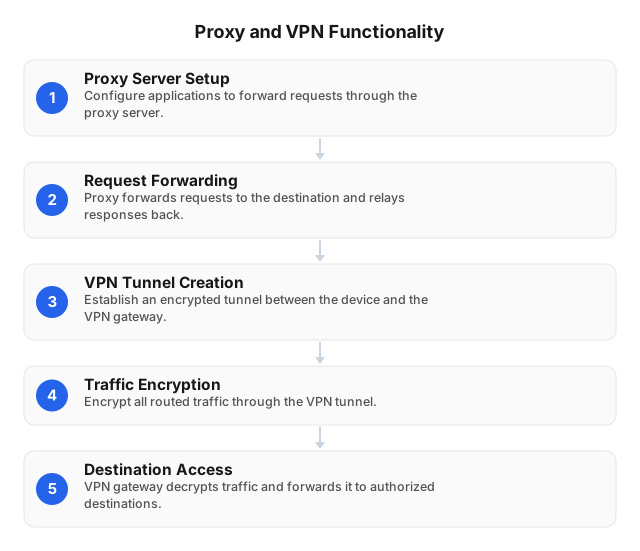
A proxy receives connections from configured applications, forwards traffic to a destination, and relays responses. The website typically sees the proxy’s outbound IP. Coverage depends on application support and settings: configuring a browser’s proxy host and port may leave an email client, command-line tool, or background updater connecting directly.
Before deployment, test three points:
- Application coverage: Compare the browser’s exit IP with the email client’s connection path.
- Proxy transport: Check whether the client connects using HTTP, HTTPS, or SOCKS5.
- Destination encryption: Confirm that HTTPS certificate validation remains enabled.
An HTTP proxy can carry encrypted HTTPS content using CONNECT. However, proxy authentication may still travel over an unencrypted client-to-proxy connection.
SOCKS5 authentication does not encrypt traffic either. Use application encryption or a separately protected connection.
How VPNs Work
A VPN encrypts selected traffic between a device and a gateway, then forwards it toward its destination. Full-tunnel and split-tunnel policies determine coverage. Gateway permissions determine which resources employees can reach. Check both controls during deployment: an encrypted corporate connection should not automatically grant access to finance databases or administrative interfaces.
Inspect these settings during rollout:
- Full tunnel: Confirm that required IPv4 and IPv6 internet routes enter the tunnel.
- Split tunnel: Record included corporate subnets and excluded destinations.
- DNS: Verify that internal names use the intended resolver.
- Access policy: Require employee authentication and restrict access to approved applications or subnets.
Tunnel encryption ends at the gateway. Retain HTTPS for onward web connections. Test what happens to protected traffic when the tunnel disconnects.
Security Features of Proxy Servers vs VPNs
For private corporate access, prioritize encrypted connections, employee authentication, and resource permissions over a changed public IP. For proxy traffic, check client-to-proxy encryption and destination HTTPS separately. Neither service type guarantees a particular logging policy. Request written retention periods, administrator-access rules, and deletion procedures; encryption alone does not prove that a service keeps no logs.
| Security feature | Proxy servers | VPNs | Acceptance check |
|---|---|---|---|
| Encryption boundary | HTTP and SOCKS5 lack built-in transport encryption; HTTPS proxies use TLS | Encrypt traffic selected for the tunnel | Test applications, routes, and exclusions |
| Identity exposure | Destinations typically see the proxy IP | Destinations typically see the gateway IP | Check the exit IP, but test encryption separately |
| Operator visibility | May reveal connection records and unencrypted content | Gateway can observe connection records and unencrypted onward traffic | Review timestamps, destination records, and content inspection |
| Performance | Depends on exit location, forwarding, TLS, and destination | Depends on gateway location, routing, and encryption processing | Measure latency, throughput, and failed requests with encryption enabled |
Benchmark the same workload, destination, and number of simultaneous connections for both options. Disabling TLS to improve proxy speed changes the security conditions and invalidates the comparison.
Use Cases: When to Use a Proxy vs a VPN
Choose a managed VPN for employees who need an encrypted path to private corporate resources. Choose a proxy for selected outbound applications, authorized regional checks, or controlled browsing. Give each deployment separate client settings and access rules. A residential exit IP helps test public regional content; it does not authorize access to an internal file server.
For a finance employee, require authentication and confirm that the device meets your access requirements. Permit only necessary finance applications. Test internal DNS resolution. Verify whether public internet traffic enters the tunnel or uses a split-tunnel exclusion.
For storefront QA, configure the proxy in the test client. EProxies offers 72M+ residential IPs across 195+ countries, HTTP(S) and SOCKS5, city- and ASN-level targeting, and sticky sessions of 24h+.
Keep the exit IP stable for a checkout test. Rotate between independent regional checks. Use the static vs rotating proxy guide to match session behavior to the test.
Budget VPN deployments by users and gateway capacity. Budget metered proxies by GB and session requirements.
EProxies reports 98.2% uptime, backed by a 99.9% uptime SLA. Observed availability and a contractual commitment are different measures. Check SLA terms against your test window. Follow target-site terms and applicable laws.
Encryption Methods: Proxy vs VPN
An HTTPS proxy encrypts the client-to-proxy connection, while a VPN encrypts traffic selected for its device-to-gateway tunnel. Destination HTTPS provides a separate layer in both designs. Before sending credentials, check the transport protocol and certificate validation. Also check whether a traffic-inspection system decrypts the destination connection at an intermediary.
| Method | Encryption boundary | Deployment check |
|---|---|---|
| HTTP proxy | No built-in client-to-proxy encryption; CONNECT can carry destination HTTPS | Do not send proxy credentials over plaintext transport |
| HTTPS proxy | TLS protects client-to-proxy traffic; destination HTTPS adds a separate layer | Validate the proxy certificate and document TLS inspection |
| SOCKS5 proxy | No built-in traffic encryption | Require application encryption; authentication alone is insufficient |
| VPN | Encrypts traffic routed into the device-to-gateway tunnel | Verify tunnel routes and retain onward HTTPS |
Include certificate failures in acceptance testing. A client that silently accepts an invalid certificate can undermine encryption, even when its settings say “HTTPS.”
Data Privacy Concerns: Proxy vs VPN
Both services shift trust to an operator that may see connection records and any unencrypted content it handles. End-to-end HTTPS limits content visibility unless an inspection system decrypts it. During procurement, distinguish content inspection from connection logging: destination addresses, timestamps, and source IPs may remain visible even when application content is encrypted.
Request written answers for these seven fields:
- Connection timestamps
- Source IP addresses
- Destination records
- Retention periods
- Deletion procedures
- Subprocessors
- Disclosure obligations
If a corporate proxy decrypts HTTPS for inspection, restrict access to inspection logs. Document employee-notice requirements.
For VPNs, retain access records needed for incident investigation without automatically collecting browsing histories. For either service, check diagnostic logs before production use. Look for passwords, authorization headers, and request bodies.
Related reading
Use the security comparison to evaluate encryption boundaries and access controls, and the scraping comparison to choose application-specific routing. Check each recommendation against required destinations, client settings, session persistence, and logging terms. A tool suitable for public-data collection may still lack the identity checks and permissions needed for employee access.
- Proxies vs VPNs: Which Is Better for Security in 2026?
- Proxy vs VPN: Which Is Better for Web Scraping?
FAQ
Evaluate security by testing encryption, traffic coverage, access permissions, and logging independently—not by relying on the product label. Proxies forward selected application traffic; VPN routing policies select traffic for an encrypted tunnel. An exit-IP check proves that a destination sees another IP, but it does not prove that credentials are encrypted or corporate resources are restricted.
What is the main difference between a proxy and a VPN?
A proxy forwards configured application connections, while a VPN encrypts traffic routed through its tunnel. Browser proxy settings may leave email and background services connecting directly. VPN coverage depends on full-tunnel or split-tunnel policy. Verify application paths, IPv4 and IPv6 routes, and DNS handling before assuming device-wide protection.
How does a proxy server enhance security?
A proxy enhances security by enforcing destination restrictions, authenticating clients, or inspecting traffic when those controls are configured. A residential routing service primarily changes outbound IP routing; it does not automatically provide corporate access controls. Verify allowlists, authentication, and client-to-proxy encryption separately. Changing the IP a website sees does not itself encrypt traffic or secure internal applications.
Why might a VPN be more secure than a proxy?
A VPN encrypts device-to-gateway traffic, while basic HTTP and SOCKS5 forwarding provide no equivalent transport protection. That advantage applies only to traffic inside the tunnel. Check split-tunnel exclusions, DNS routing, and gateway permissions. An encrypted connection should not give every employee access to every internal subnet.
When should I use a proxy instead of a VPN?
Use a proxy for application-specific outbound routing or authorized regional testing, rather than private-network access. EProxies supports HTTP(S), SOCKS5, and city- and ASN-level targeting for those tasks. Configure the test client and preserve its exit IP when session continuity matters. Keep residential routing separate from employee authentication and corporate access policies.
What are the privacy implications of using a proxy?
Using a proxy shifts trust to its operator, which may see connection metadata and unencrypted content; it does not make activity anonymous. End-to-end HTTPS protects content unless TLS inspection decrypts it, but destination addresses and connection timing may remain visible. Websites can still identify users through logins, cookies, and browser fingerprints. Review retention periods, subprocessors, administrator access, and diagnostic logs before sending sensitive traffic.
This article was written by the EProxies team and reviewed against our editorial quality standards before publishing.