
Web Scraping for Market Research in 2026: Analyst Guide
TL;DR: Web scraping for market research works best as a governed measurement pipeline: define the business decision, collect only the public fields needed, prefer APIs where they fit, validate every parser, use residential proxies for scale or localization, and track quality by source. In 2026, the strongest programs monitor prices, promotions, stock status, assortment, reviews, search placement, and competitor messaging on a recurring schedule—not as one-off crawls.
What Web Scraping Adds to Market Research
Web scraping turns observable public pages into structured, time-stamped data. A manual analyst might check 50 competitor product pages once a week; a scraper can collect price, stock status, coupon text, delivery promise, seller name, review count, and page position every morning at 09:00 in each target market.
Use scraping when the research question depends on evidence that changes online:
- competitor price moves by SKU, country, or seller;
- regional stockouts and delivery gaps;
- marketplace ranking changes for priority keywords;
- new claims on landing pages, product pages, or category banners;
- review themes after a product launch, packaging change, or service issue.
Scraping does not explain motivation. It shows what changed, where it changed, and when it changed. Surveys, interviews, panels, and customer research still explain why buyers reacted.
Highest-Value Market Research Use Cases
The strongest use cases turn those observable changes into repeatable signals for pricing, merchandising, product, and marketplace teams.
Price, Promotion, and Shipping Monitoring
A reliable price monitor captures more than the headline price. Store product URL, product ID, seller, list price, sale price, coupon text, shipping fee, tax treatment, delivery promise, currency, stock label, country, and timestamp.
Normalize before reporting. A competitor can appear 12% cheaper because one page excludes shipping while another bundles delivery into the displayed price. For dashboards, create a comparable landed-price field: item price + mandatory fees + standard shipping, converted into one reporting currency.
A practical alert rule is stricter than “price changed.” Trigger only when a named competitor undercuts by more than 5–8% for two consecutive runs. That filters out broken parses, temporary coupons, marketplace seller mismatches, and single-run localization errors.
Assortment and Availability Intelligence
Assortment scraping tracks SKU count, brand count, pack size, bundle type, category path, seller count, stock label, delivery option, and page position. This helps category teams identify missing variants and weak coverage by market.
Example: a beverage brand may look fully distributed at the national level, but localized scraping can show that 12-pack variants are unavailable for next-day delivery in Berlin and Manchester while competing multipacks remain available. That finding points to a replenishment or listing issue, not a broad brand-performance problem.
Localized collection requires location control. Country, city, language, currency, cookies, and session state can all change visible results. EProxies’ published network specifications list 72M+ residential IPs across 195+ countries, which supports market-by-market checks instead of treating one default page as the only market view.
Review and Sentiment Research
Review scraping is useful when the output is a product signal, not a personal profile. Capture rating, review date, product ID, country, verified-purchase flag where visible, review text, and topic label. Avoid names, profile URLs, avatars, and account identifiers unless legal review explicitly approves the field and retention period.
Topic classification should come before sentiment scoring. “Negative sentiment increased” is too vague to act on. “Battery complaints rose from 7% to 14% of English-language reviews after the March hardware refresh” gives product, QA, and support teams a specific signal to test against returns and tickets.
Search Rank and Share-of-Shelf Tracking
Search and category scraping measures rank, sponsored labels, snippet wording, badges, review count, seller count, stock status, and page position. It supports marketplace SEO, campaign monitoring, regional demand sensing, and share-of-shelf reporting.
For broader examples, see Top Web Scraping Use Cases in 2026.
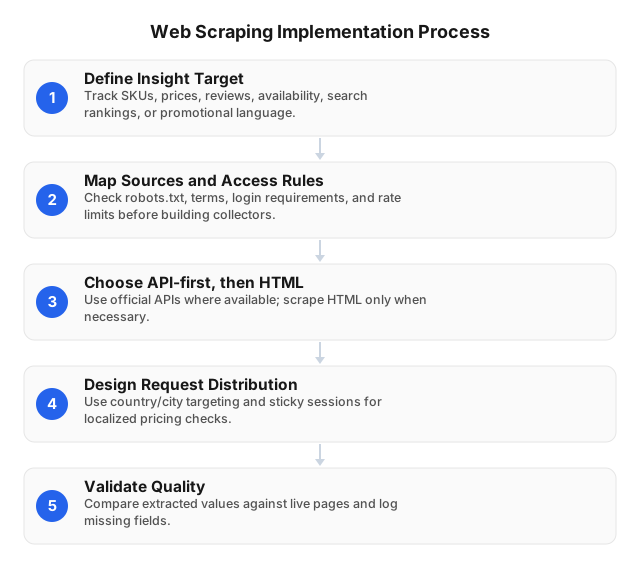
How to Implement Web Scraping for Market Research
Once the use case is clear, implementation should start with the decision the data will support, then work backward to sources, fields, collection methods, proxies, validation, and storage.
1. Start With a Decision Rule
Write the business rule before building the crawler:
- adjust pricing if three named competitors undercut by more than 6% for two consecutive days;
- investigate supply if monitored stockouts exceed 20% in a region for 48 hours;
- escalate product feedback if a review topic grows by more than 3 percentage points month over month;
- alert marketplace managers if a priority SKU falls below position 10 for two target queries.
This prevents uncontrolled crawling. If the decision does not require reviewer names, unrelated links, or account identifiers, exclude them from the schema.
2. Build a Source Register
Create a source table with URL pattern, required fields, collection frequency, access method, login status, terms review notes, robots.txt notes, personal-data risk, owner, and retention period.
Classify each source:
- Official APIs: use first when they provide the required fields and rate limits are workable.
- Public HTML pages: use when visible context matters, such as badges, page rank, local delivery text, or promotional banners.
- Restricted sources: avoid unless legal review confirms access rights, purpose, and data-handling controls.
For API-first design, see Creating Effective Web Scraping Strategies Using APIs.
3. Choose the Lightest Accurate Collection Method
Match the method to the page:
- HTTP requests: efficient for static pages and predictable HTML.
- Browser automation: needed for JavaScript-rendered grids, infinite scroll, location modals, or client-side price rendering.
- Hybrid collection: API for stable product facts, browser or HTML scraping for visible rank, promo copy, and local presentation.
Browser automation gives higher page fidelity but costs more CPU, memory, bandwidth, and orchestration time. Use it where static collection misses fields; do not make it the default for every URL.
4. Configure Proxies by Measurement Need
Proxy setup should reflect the research problem:
- use rotating residential sessions for broad public collection across many URLs;
- use sticky sessions when cookies, cart state, language, or location must persist;
- use country or city targeting for localized pricing, SERP, and availability checks;
- use HTTP(S) for most scraping stacks;
- use SOCKS5 when the toolchain needs protocol flexibility.
EProxies’ published product specifications list HTTP(S), SOCKS5, rotating sessions, sticky/static sessions, and location targeting across its residential network. Current published pricing includes pay-as-you-go residential from $0.25/GB, tiered residential pricing down to about $0.73/GB at 300GB, ISP SOCKS5 from $0.95/IP, and unlimited plans from $79/month.
For rotation architecture, read Understanding Proxy Rotation: Tech & Best Vendors.
5. Validate Before Scaling
A 200 status code does not prove the scrape worked. The response may be a challenge page, empty template, regional fallback, partial render, or page with missing prices.
Track quality by domain, country, and collection method:
- HTTP success rate;
- median and p95 response time;
- CAPTCHA or challenge-page rate;
- missing-field rate;
- duplicate product rate;
- price mismatch rate against manual checks;
- parser repair time after layout changes;
- percentage of records below confidence threshold.
EProxies reports 98.2% uptime, backed by a 99.9% uptime SLA. Treat uptime as infrastructure context, then run a pilot against your actual URLs, countries, cadence, and parser logic before expanding volume.
6. Store Raw and Clean Data Separately
Keep raw HTML or API responses for audit, parser repair, and dispute resolution. Store cleaned records in a separate table with source URL, timestamp, country, session type, extraction version, field-level confidence, and normalization rules.
This makes failures diagnosable. If shipping text starts appearing in a price column, the raw snapshot shows whether the source changed, the parser broke, or the normalization rule was too broad.
Latest Web Scraping Trends for 2026
With the measurement pipeline in place, the main 2026 shift is not simply collecting more pages. It is collecting cleaner evidence from more dynamic pages, with clearer validation and governance.
AI-Assisted Extraction With Deterministic Validation
AI extraction is useful for messy labels, review topics, template changes, and pages where fields appear under inconsistent names such as “capacity,” “volume,” “net weight,” and “size.” It reduces parser maintenance, especially across multilingual sites.
Do not let AI write directly into reporting tables without checks. Validate price format, currency, date, SKU ID, rating range, availability label, and country. Route low-confidence records to review or quarantine them from dashboards.
Browser-Based Collection for Interactive Pages
More market data sits behind client-side rendering, location prompts, infinite scroll, and dynamic product grids. Browser automation captures what a real user sees, including rank order, badges, delivery promises, and modal-driven location changes.
The trade-off is cost. Browser jobs consume more bandwidth and compute than direct HTTP requests, so reserve them for pages where visible presentation matters.
Continuous Monitoring Instead of Quarterly Crawls
Market research teams increasingly run scraping as an alerting system. Useful triggers include competitor price movement above 10%, product disappearance from a category, review-topic spikes, page-one rank loss, and sudden changes to delivery promises.
Continuous monitoring needs operational metrics, not just scraped rows. Track missed schedules, broken parsers, alert precision, validation error rate, and time to repair.
Compliance-by-Design
Legal review now belongs in project design. Maintain a source register with business purpose, fields collected, access status, personal-data exposure, retention period, and owner. Separate market research use from AI-training use because the risk profile and expectations can differ.
For EU planning, read Legal Guidelines for Web Scraping in the EU 2026.
Legal and Ethical Guardrails
Those operational controls need legal and ethical boundaries. Public availability does not remove privacy, contract, or security obligations. A public product price is lower risk than a profile page containing names, photos, employment history, or contact details.
Use these controls:
- collect only fields required by the decision rule;
- avoid login-gated, paywalled, private, or sensitive data;
- review terms of service and robots.txt;
- avoid bypassing access controls;
- set rate limits, retries, and backoff rules;
- identify and filter personal data before BI storage;
- document purpose, owner, retention, and deletion;
- stop collection when a source blocks or objects pending review.
For operating principles, read Ethical Use of Proxies for Web Scraping.
Example Market Research Programs
The following examples show how the same principles translate into practical programs with defined fields, thresholds, and quality checks.
Daily Competitor Price Monitor
A consumer goods team tracks 500 public product URLs across five countries. The scraper collects sale price, promo text, stock status, seller, shipping fee, delivery promise, and timestamp. Alerts fire only when a named competitor is more than 8% cheaper for two consecutive days.
The team manually checks 2% of records weekly. That sample catches parser drift, seller mismatches, and shipping normalization errors before they affect pricing decisions.
Regional Assortment Audit
A marketplace analyst compares category pages in the U.S., U.K., Germany, France, and Canada. The dataset includes SKU count, brand count, pack size, delivery option, seller count, stock label, and page position.
The output is a coverage matrix: missing sizes, weak bundles, low placement, out-of-stock regions, and delivery gaps by country. That matrix is more useful than a raw export of scraped URLs.
Review Theme Tracker
A product team collects public reviews for three product lines. The pipeline removes personal fields, classifies text into topics, and tracks topic share by month.
If “fit issue” rises from 6% to 13% after a redesign, the team compares the pattern against returns, support tickets, and follow-up survey responses before changing the product page or packaging.
FAQ
How to implement web scraping for market research?
Start with a decision rule, such as a pricing alert, stockout threshold, review-theme trigger, or rank-loss alert. Build a source register, test official APIs first, scrape only necessary public fields, validate records against manual checks, and store raw and cleaned data separately. Use rotating or sticky residential proxies when localization, scale, or session continuity is required.
What are the ethical concerns in web scraping?
The main concerns are privacy, site burden, access-control circumvention, terms violations, and secondary use of collected data. Reduce risk by collecting only necessary fields, avoiding login-gated or sensitive data, filtering personal data, applying rate limits, documenting retention, and stopping collection when a source objects or blocks access. Market research scraping should measure public market signals, not build personal dossiers.
What is web scraping for market research?
Web scraping for market research is the automated collection of public web data for analysis. Common fields include prices, ratings, reviews, product titles, stock status, search rank, promotional copy, seller count, and category placement. Useful outputs include timestamps, source URLs, country labels, and quality checks.
How does web scraping improve market research?
It gives analysts fresh observable evidence instead of relying only on periodic reports. Teams can monitor daily price changes, detect stockouts, track review themes, compare regional offers, and spot competitor messaging changes. It works best alongside surveys, panels, interviews, and licensed datasets.
What are the latest trends in web scraping?
The latest trends in web scraping are AI-assisted extraction, browser-based collection for interactive pages, API-first pipelines where APIs provide reliable fields, continuous monitoring with alerts, stricter compliance review, and location-aware testing. Teams are also adding deterministic validation around AI outputs so prices, currencies, dates, ratings, and availability labels do not enter dashboards unchecked. The practical shift is from “crawl more pages” to “collect cleaner evidence with known error rates.”
What proxy setup works best for market research scraping?
Use rotating residential proxies for broad public collection, sticky sessions for workflows that need continuity, and country or city targeting for localized results. Choose HTTP(S) for most scraping stacks and SOCKS5 when the toolchain needs protocol flexibility. Test against your actual target domains before scaling because success varies by site, country, and cadence.
Is web scraping legal for market research?
It can be legal when a project collects permitted public data, respects applicable laws and site terms, avoids harmful traffic patterns, and handles personal data correctly. Risk rises with login-gated data, sensitive personal data, access-control circumvention, or aggressive request loads. Get legal review before collecting restricted, personal, or regulated data.
How should teams measure scraping quality?
Track success rate, response time, CAPTCHA rate, challenge-page rate, missing-field rate, duplicate rate, parser repair time, and manual validation error rate by source. Run pilots by domain and country because generic infrastructure uptime does not predict page-level extraction quality. Keep raw snapshots so parser failures can be diagnosed instead of guessed.
This article was written by the EProxies team and reviewed against our editorial quality standards before publishing.