
How to Evaluate Proxy Providers: 2026 Scorecard
TL;DR: Proxy providers differ in usable-response rate, latency, geographic accuracy, IP availability, session control, support, and billing—not merely pool size. For e-commerce scraping, proxies let authorized collectors retrieve localized prices, stock, sellers, and delivery options at scale; select a provider by testing cost per validated record on the exact retailers and markets you need. EProxies offers 72M+ residential IPs across 195+ countries, HTTP(S) and SOCKS5, 98.2% uptime backed by a 99.9% uptime SLA, residential traffic from $0.25/GB, ISP SOCKS5 from $0.95/IP, and unlimited plans from $79/month.
Match the Proxy Type to the Request
Residential proxies route traffic through consumer-network IPs, which helps reproduce country- or city-specific storefronts. Static ISP proxies retain one address for longer workflows. Datacenter proxies usually deliver lower latency and cost, but some retailers identify their hosting-network addresses more readily.
Use:
- Rotating residential proxies for independent product, category, or search requests.
- Sticky residential sessions for pagination, postcode selection, carts, or other short sequences that must preserve location.
- Static ISP proxies for authorized account or browser workflows requiring a consistent IP.
- Datacenter proxies for accepted targets where speed matters more than residential network identity.
Pool size indicates potential coverage, not available capacity in every location. A 70-million-IP network can still have limited inventory in a specific city, carrier, or autonomous system number (ASN). Test each required market rather than extrapolating from a global total.
See Proxy Type Selection by Task: 2026 SEO & Scraping Guide for a workload-based selection matrix.
Measure What Reaches the Dataset
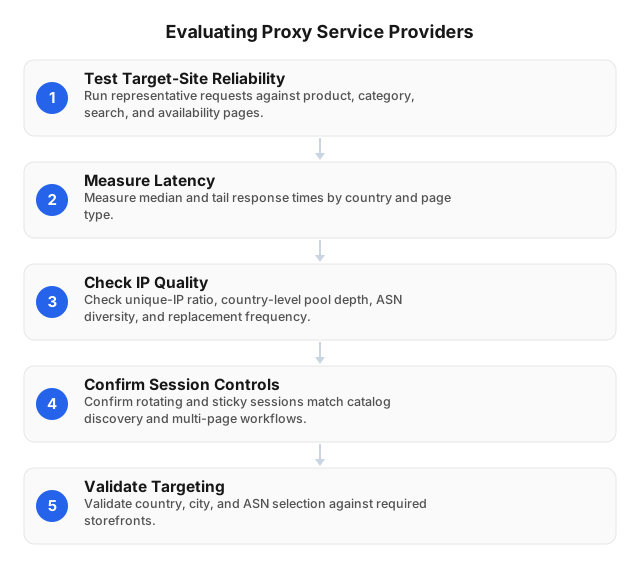
Provider performance differs along seven practical dimensions: data validity, latency, localization, IP diversity, session behavior, reliability, and operational support. Benchmark all candidates with the same URLs, locations, headers, cookies, concurrency, timeout, and retry policy.
1. Usable-record rate
HTTP success is not data success. A response with status 200 may contain a CAPTCHA, consent wall, wrong currency, unavailable-product template, or missing price.
Usable-record rate = validated records ÷ attempted requests
For a retail product, validation might require the expected SKU, price, currency, seller, stock status, delivery region, and timestamp. If 10,000 attempts return 9,850 HTTP 200 responses but only 9,400 complete records, the meaningful success rate is 94%.
2. Median and p95 latency
Measure the complete operation, including connection setup, proxy routing, target response, and retries. Median latency represents normal traffic; p95 exposes slow requests that keep workers occupied and delay the queue.
For example, nine one-second responses and one 21-second response average three seconds. That average hides a tail-latency problem that can reduce throughput under fixed concurrency.
3. Localization accuracy
Check the returned storefront, not just an IP-location database. Cookies, language headers, account settings, domains, and saved postcodes can override the apparent exit location.
Log the requested country or city, observed exit location, storefront domain, currency, language, and delivery region. Country-level targeting should not be presented as city-level accuracy unless the test confirms it.
4. IP and ASN availability
Record unique exits, repeated addresses, ASN distribution, and failures by market.
Unique-IP yield = unique exits observed ÷ rotating requests
A low yield can indicate scarce local inventory, session reuse, or the provider’s rotation policy. Ask whether advertised pool figures represent currently routable addresses, daily observations, or historical inventory.
5. Rotation and sticky-session behavior
Test rotating and sticky configurations separately. Rotation should change addresses according to the configured policy; a sticky sequence should retain its IP and country for the required duration.
Also test exit failure. A provider may return an error, assign a same-country replacement, or unexpectedly move the session to another market. Comparing Rotating Proxies: What to Look for in 2026 covers these controls in detail.
6. Reliability and support
Uptime does not reveal target-specific acceptance or localization quality. Review the SLA’s measurement window, covered products, exclusions, service-credit formula, and claim deadline.
Test credentials, IP allowlisting, endpoint syntax, usage reporting, error messages, and credential rotation. Submit one ticket with a timestamp, endpoint, location, request ID, and sanitized error; useful support should identify a reproducible cause rather than recommend blind retries.
7. Sourcing and contractual fit
Request written documentation covering participant consent, enrollment disclosures, withdrawal, access controls, and abuse investigations. Terms such as “peer-to-peer” or “ethically sourced” do not replace a documented process.
Review the retailer’s terms, applicable contracts, privacy obligations, and access restrictions. Robots.txt expresses crawler preferences; it does not itself grant authorization.
Run a Controlled Provider Trial
A defensible comparison needs enough volume to reveal repeated exits, intermittent failures, and load-related changes:
- Build a representative set. Include product, category, search, stock, and delivery pages from every required market.
- Define validation rules first. Specify mandatory fields, correct currencies, allowed redirects, and localization requirements before viewing results.
- Freeze client settings. Use identical timeouts, headers, cookies, retries, session durations, and concurrency.
- Log every attempt. Capture status, final URL, latency, bytes, exit IP, ASN, location, CAPTCHA detection, and missing fields.
- Test independent and stateful traffic separately. Rotation can perform well while sticky sessions fail, or vice versa.
- Ramp to production load. A ten-request connection check says nothing about performance at 50 workers.
- Repeat during peak and off-peak windows. Local inventory and retailer response times can change by hour.
- Classify failures. Separate connection errors, 403/429 responses, localization errors, invalid content, and parser defects.
Respect Retry-After where a 429 response provides it, lower concurrency after repeated server errors, and avoid retry storms. A parser defect requires code changes; an incorrect country requires targeting or session changes. Combining both into one “failed” bucket prevents diagnosis.
Compare Cost per Usable Record
Per-GB price measures transferred data, not delivered output. Retries, CAPTCHA pages, and incorrect storefronts consume bandwidth without producing records.
Proxy cost per usable record = proxy charges ÷ validated records
| Route | Rate | Traffic | Validated records | Proxy cost per record |
|---|---|---|---|---|
| A | $1.00/GB | 100GB | 90,000 | $0.00111 |
| B | $0.80/GB | 130GB | 90,000 | $0.00116 |
Route B advertises a 20% lower traffic rate but costs more per record because retries consume 30GB of additional traffic. Add compute time, minimum commitments, traffic expiration, overages, and engineering support to the production estimate.
EProxies publishes:
- pay-as-you-go residential access from $0.25/GB;
- residential tier pricing of approximately $0.73/GB at 300GB;
- ISP SOCKS5 proxies from $0.95/IP;
- unlimited plans from $79/month.
These are different offers and billing models, not one linear discount schedule. Confirm the current checkout price, included traffic, expiration, concurrency, and overage terms before committing.
E-Commerce Case: From Page Success to Product Data
A publicly reported small-scale test used residential proxies to collect titles, prices, ratings, and reviews for 24 products and export the results to CSV. The case demonstrates the workflow, but 24 products are too few to establish sustained success rate, geographic precision, tail latency, or performance under concurrency.
A production evaluation should instead test a matrix such as 500 SKUs across three countries, producing 1,500 expected records per run. Validate the SKU, displayed price, currency, seller, stock status, delivery availability, and capture time; use rotating sessions for independent products and sticky sessions only for postcode or pagination sequences.
For example, a team might set these acceptance thresholds before testing:
- at least 97% usable records;
- at least 99% correct-country storefronts;
- p95 latency below eight seconds;
- no unexplained country change during a 30-minute sticky session;
- proxy cost below $0.002 per usable record.
Those thresholds are project examples, not industry averages. Page weight, freshness requirements, city-level targeting, and the cost of missing a price should determine the actual limits.
EProxies reports 72M+ residential IPs across 195+ countries and 98.2% uptime, backed by a 99.9% uptime SLA. Compare those published figures with workload results: if measured over the same 30-day period, 98.2% availability corresponds to roughly 13 hours of unavailability, while 99.9% corresponds to about 44 minutes, so definitions and covered services matter.
Network architecture also affects performance. Datacenter routes tend to prioritize speed, residential routes provide consumer-network locations with greater route variability, and static ISP routes preserve identity while concentrating requests on fewer addresses. See Comparing Proxy Types: Speed vs. Privacy.
Collect only fields needed for the analysis and set retention periods for raw HTML, request logs, exit-IP data, and extracted records. For adjacent privacy and routing distinctions, read Proxy Servers vs VPNs for Digital Privacy in 2026. Search-monitoring teams can also review Rotating Proxies: Impact on SEO Strategy in 2026.
FAQ
How do proxy providers differ in performance?
Proxy providers differ in usable-response rate, median and p95 latency, location accuracy, available IPs per market, rotation behavior, sticky-session stability, and recovery from failed exits. Test those metrics against identical retailer URLs and settings, then compare cost per validated record rather than advertised pool size or HTTP success alone.
How can proxies benefit e-commerce data scraping?
Proxies help authorized e-commerce collectors distribute requests and retrieve localized prices, currencies, sellers, stock status, and delivery options from different markets. Rotation supports independent catalog pages, while sticky sessions preserve location during pagination or postcode workflows; neither replaces permission, rate control, or data validation.
What is the cost range for proxy services?
EProxies publishes residential access from $0.25/GB, approximately $0.73/GB at the 300GB tier, ISP SOCKS5 from $0.95/IP, and unlimited plans from $79/month. Because these products use different billing units, compare their current terms and resulting cost per usable record.
Why is ethical sourcing important in proxies?
Residential traffic passes through third-party devices and connections, so participants need informed enrollment and a practical withdrawal method. Documented consent, access controls, and abuse handling reduce privacy, security, legal, and supply-chain risks without removing the customer’s compliance obligations.
How long should a proxy trial run?
Run the complete request matrix during at least one peak and one off-peak window, at intended production concurrency. Continue long enough to test rotation, sticky-session duration, local inventory, rate-limit behavior, and support response rather than merely confirming connectivity.
When should sticky proxies replace rotating proxies?
Use sticky sessions when several authorized requests must preserve one IP and location, such as pagination or delivery-postcode selection. Use rotation for independent catalog requests because unnecessary persistence concentrates traffic and reduces IP diversity.
What result should determine the winning provider?
Choose the provider that meets predefined data-quality, localization, latency, session, sourcing, and contractual requirements at the lowest sustainable cost per usable record. Reject a lower per-GB price if retries, wrong-country pages, or missing fields make the delivered dataset more expensive.
This article was written by the EProxies team and reviewed against our editorial quality standards before publishing.