
Comparing Proxies for Competitive Intelligence: 2026
TL;DR: Match proxy type, location, and session behavior to the research task—not the largest advertised IP pool. Rotating sessions suit independent public-page checks. Sticky sessions help maintain context during multistep research. Validate each record’s location, currency, and completeness before treating it as competitive evidence.
For analysts tracking competitor prices, stock, and local search visibility, location changes can create false signals. A different currency or delivery address may explain an apparent price change. Set those controls before collection.
Introduction to Proxies in Competitive Business Intelligence
Proxies route research requests through selected network locations, helping analysts view market-specific versions of public websites. A retailer may change prices, inventory, or shipping eligibility based on the visitor’s IP location. An IP address alone does not reproduce a local customer’s experience. Language, cookies, login state, and delivery address can also affect the page.
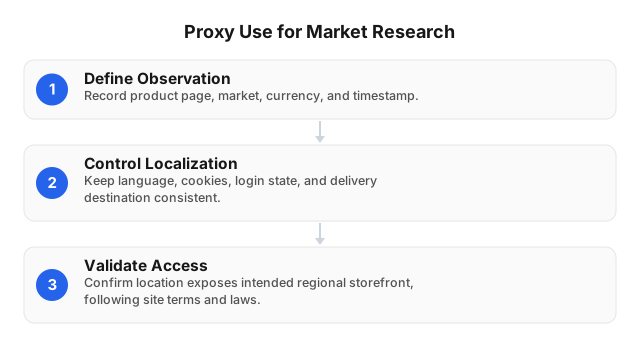
Treat geography as a controlled variable:
- Define the observation: Record the public product page, destination market, currency, and collection timestamp.
- Control localization: Keep language, cookies, login state, and delivery destination consistent.
- Validate access: Confirm that the selected location opens the intended public regional storefront.
- Respect boundaries: Follow site terms and applicable laws. Do not circumvent authentication, paywalls, or access controls.
With those controls established, choose the network context that supports the research.
Types of Proxies Used in Business Intelligence
Residential, data center, ISP, and mobile proxies provide different network contexts for public-data research. Choose the network origin that fits the question. A household-network address may suit regional retail checks, while a data center address may suffice for permitted collection that needs no household context. Neither choice guarantees access or accurate records.
| Proxy type | Research fit | What to verify |
|---|---|---|
| Residential | Public-page research using household-network IPs | Location accuracy, sourcing, and session behavior |
| Data center | Permitted, repeatable collection without household-network context | Target compatibility and geographic consistency |
| ISP | Research requiring ISP-associated addresses with hosted infrastructure | Sourcing and session persistence |
| Mobile | Research using carrier-network IPs | Carrier location and the separate browser or device setup |
Residential addresses are less explicitly associated with hosting infrastructure, but websites can still detect automation through request patterns and browser signals.
Similarly, a mobile IP does not reproduce a mobile device. Configure and validate the browser separately.
For a broader comparison, see Proxy Types Compared: Speed vs. Privacy.
Comparison of Proxy Features for Business Intelligence
Once you have selected a network type, compare usable, location-matched observations rather than advertised IP counts. Test each feature against your collection workflow, keeping timestamps, geography, and session context consistent so differences between records reflect the market rather than the collection setup.
| Feature | Competitive intelligence use | Trade-off or validation check |
|---|---|---|
| Rotating sessions | Distribute independent product checks | Fix geography so rotation does not distort comparisons. |
| Sticky sessions | Maintain an IP during a shopping journey | Manage cookies separately; an unchanged IP does not guarantee unchanged pricing. |
| City targeting, where available | Compare local offers and availability | Verify delivery location and currency, not just IP location. |
| Response time | Support timely monitoring | Measure complete collection time, including retries and parsing. |
Calculate cost per usable observation by dividing total collection spend by validated records. Include retries, rendering, and validation in the spend rather than comparing cost per request alone.
Use Comparing Rotating Proxies: What to Look for in 2026 to assess rotation controls before a pilot.
Benefits of Using Proxies for Competitive Intelligence
With the right collection setup, analysts can separate regional offers from broader pricing changes. The benefit is comparable evidence, not simply more pages. Consistent comparisons reduce the risk of interpreting a regional difference as a change in a competitor’s pricing strategy.
For regional comparisons, align these fields:
- Product identifier and variant
- Currency and delivery destination
- Collection window
- Login state and promotion eligibility
Record shipping charges separately. Otherwise, a delivery surcharge can look like a product price increase.
Session choice then follows the comparison: a listing-to-product-page check may require continuity, whereas separate product checks can be independent. In either case, the resulting dataset must distinguish what the competitor showed from what the collection process failed to retrieve.
Challenges and Limitations of Proxy Use
A successful request is not necessarily usable evidence. A response may contain a challenge page, missing prices, or a default storefront instead of the intended market. Network availability therefore cannot establish dataset completeness. Validate product identity, currency, page content, and location before accepting a record into the comparison dataset.
Session behavior introduces further risks. Rotation can change geography or disrupt context, while stale cookies can retain an earlier store or delivery destination even when a sticky session preserves the IP.
Record exit location, currency, session policy, and collection time with each observation. Track missing coverage separately from genuine stockouts so collection failures do not become apparent competitor changes.
Operational constraints also matter: blocked requests, variable response times, inaccurate geolocation, and traffic costs can limit a workflow. Retries and browser rendering may increase spend without adding valid records.
Finally, public access does not establish permission to collect or reuse data. Review any personal-data exposure alongside the site terms and applicable laws, and exclude access-controlled prices from public-data collection.
Implementation Scenarios for Competitive Research
The following scenarios translate those controls into collection designs, not documented customer outcomes. Each design needs testing on the actual target sites. Its acceptance criteria should reflect the research question, including which market, store, product variant, and collection window make a record usable.
Regional pricing research
Use geographically targeted sessions for public price comparisons. Record tax treatment alongside currency, delivery location, and collection time, and keep product identifiers and variants aligned across markets. Exclude any response showing the wrong regional storefront, even when the request succeeds.
Stock-availability monitoring
Rotate sessions between independent product checks, but preserve context when availability depends on a selected store. Record the store and product variant with each result. Classify blocked or incomplete pages as collection failures rather than confirmed unavailability; otherwise, they can become false stockouts in the competitor report.
Localized promotion tracking
Keep geography and session state consistent when comparing public promotional pages. Record eligibility conditions, such as delivery area or login requirements, without bypassing access controls. Check that extracted offers match the rendered page. A headline discount should not enter the dataset without its applicable product, dates, and conditions.
How to Choose the Right Proxy for Your Needs
Use these scenarios to define a representative test. Choose through a permitted pilot on your actual research targets. A provider’s network size or availability figure does not establish price-data accuracy, so include product pages and browsing sequences rather than relying on a simple connectivity check.
- Define the observation. Specify product identifiers, geography, currency, stock status, and collection time. Compare identical baskets before interpreting regional price differences.
- Match session behavior. Test independent checks and any permitted browsing sequences that require the same IP. For multistep research, verify that the session lasts through the sequence and that cookies retain the intended market context.
- Pilot representative targets. Measure complete, correctly localized records, collection time, retries, transferred traffic, and cost per usable observation.
- Check operational fit. Verify geographic availability, authentication, protocol support, SLA remedies, and target-site permissions.
EProxies offers 72M+ residential IPs across 195+ countries, with HTTP(S) and SOCKS5 support. Its stated uptime is 98.2%, backed by a 99.9% uptime SLA. Treat observed uptime and the contractual SLA as separate measures.
Evaluate those specifications against the pilot results to determine whether the available locations and session controls meet your research requirements.
Related reading
For a closer technical comparison before testing a provider, use these guides. The first examines proxy types through speed and privacy trade-offs; the second focuses on rotation controls and evaluation criteria.
FAQ
These answers distinguish the role of the proxy network from the controls needed to produce comparable competitive evidence.
What are the benefits of using proxies in business intelligence?
Proxies help analysts collect public market data through selected network locations. This supports regional comparisons of prices, availability, and search visibility.
How do proxies enhance competitive intelligence?
Proxies help analysts observe public offers from the markets they study. Their session controls support both independent checks and browsing sequences, depending on the research task.
What challenges do businesses face when using proxies?
Businesses can face blocked requests, variable response times, inaccurate geolocation, traffic costs, and legal or contractual limits. The key distinction is between a collection failure and a genuine market observation, such as a confirmed stockout.
How do you select the best proxy for competitive analysis?
Select a proxy by testing valid, comparable observations on your actual research targets. Use representative pages and multistep workflows to assess geographic accuracy, session continuity, collection time, and total cost per usable record.
This article was written by the EProxies team and reviewed against our editorial quality standards before publishing.