
Adaptive Proxy Selection for Global Enterprises in 2026
TL;DR: Build adaptive proxy selection as a policy-enforced routing service, not a latency-only load balancer. First reject routes that violate geography, protocol, credential, session, or budget rules; then score eligible routes using destination-specific completion rate, p95 latency, capacity, session fit, and cost per successful task. Look for geographic and protocol coverage, rotating and sticky sessions, granular targeting, real-time telemetry, configurable failover, concurrency controls, scoped credentials, usage reporting, SLA terms, and predictable pricing.
What Is Adaptive Proxy Selection?
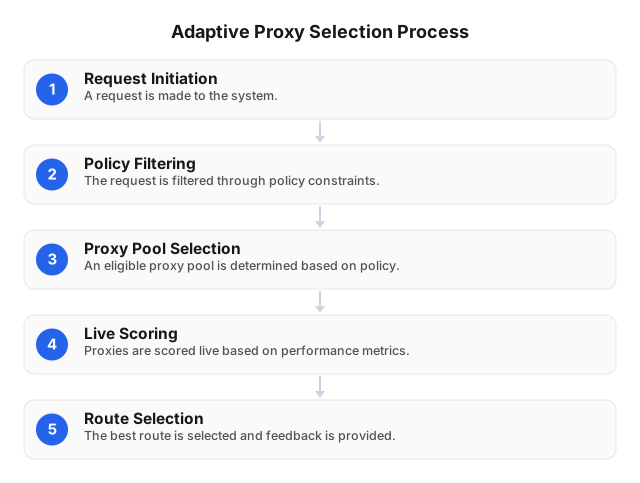
Adaptive proxy selection chooses a route from current policy, workload, health, and cost data instead of assigning every request to a fixed pool. It is an implementation pattern rather than a protocol standard:
Request → eligibility filter → route score → selection → outcome measurement → updated score
A route is more than an IP address. It can include:
- Proxy product and pool
- Exit country, city, or ASN
- HTTP(S) or SOCKS5
- Rotating, sticky, or static session behavior
- Credential scope and account
- Concurrency and traffic quota
- Destination-specific health history
Hard constraints must run before scoring. A route with 200 ms lower latency remains ineligible if it exits through an unapproved jurisdiction, lacks the required protocol, cannot preserve a checkout session, or would exceed the workload’s budget.
Measure health by destination or target class rather than relying on a provider-wide average. Two applications using the same pool can produce different results because of DNS resolution, regional peering, page size, authentication, destination throttling, and session requirements.
At minimum, record:
- Completed tasks divided by initiated tasks
- p50 and p95 response time
- DNS, TCP, TLS, proxy-authentication, timeout, and destination errors
- HTTP status, including 403, 407, 429, and 5xx responses
- Successful tasks per minute at the required concurrency
- Country, city, and ASN match
- Session age and unexpected exit changes
- Bytes, retries, and cost per completed task
A “task” should reflect business work. For a checkout test, success means completing the entire sequence—not receiving HTTP 200 on the first page.
Where Adaptive Selection Produces Measurable Value
Workload-specific routing
Separate policies prevent one workload’s priorities from distorting another’s:
| Workload | Hard requirements | Primary score inputs | Failure behavior |
|---|---|---|---|
| Localization test | Required country or city | Geographic accuracy, session stability | Stop if no approved local exit exists |
| Authorized public-web collection | Approved destinations and retry ceiling | Completion rate, cost per record, throughput | Move stateless work to the next eligible route |
| Regional uptime monitoring | In-country exit and protocol support | p95 latency, availability | Use an explicitly approved fallback region |
| Multi-step portal | Sticky or static route | Session continuity, completion rate | Restart or stop; do not silently change identity |
| Interactive application | Low response-time ceiling | p95 latency, connection failures | Fail over after a bounded error window |
For product-level trade-offs, use the Proxy Type Selection by Task: 2026 SEO & Scraping Guide.
Controlled failover
Failover should respond to a sustained, classified failure—not one timeout. An illustrative policy for stateless monitoring could be:
- Evaluate a rolling window of 100 attempts.
- Quarantine the route if completion falls below 95%.
- Keep it in cooldown for 10 minutes.
- Send 5% canary traffic after cooldown.
- Reinstate it only after two consecutive healthy windows.
- Stop or use a predetermined route if telemetry is unavailable.
Thresholds must match the workflow. A daily catalog job may tolerate delayed completion; a payment or authentication test may have a tighter error budget and require an immediate stop when session identity changes.
Enforceable routing boundaries
The selector should restrict routes by application, environment, account, destination, jurisdiction, protocol, and monthly budget. Separate credentials can prevent a development collector from consuming a production pool or accessing a jurisdiction approved only for another team.
NIST SP 800-207 states that trust should not be granted solely because of network location.1 Applied here, a proxy exit’s location does not replace authentication, authorization, workload identity, or data-handling controls. Proxy routing also does not establish permission to collect data; legal authority, privacy obligations, retention rules, and applicable site terms require separate review.
What to Look for in an Adaptive Proxy Service
Evaluate the routing controls and the underlying proxy supply together. A sophisticated selector cannot compensate for missing coverage, unstable sessions, or opaque billing.
1. Geographic and network-level targeting
Confirm availability in the countries and cities the application actually needs. If ASN or carrier targeting matters, request a current list and test the usable inventory under expected concurrency; a global IP count does not reveal capacity in one city or network.
Define fallback boundaries during procurement. For example, a German storefront test might permit DE only, while a general EU availability monitor might permit DE → NL → FR.
2. Protocol and application compatibility
Verify HTTP, HTTPS tunneling, and SOCKS5 against the actual client libraries and DNS behavior. SOCKS5 can support applications that do not use HTTP, while HTTP(S) proxies often integrate more directly with web clients and observability tooling.
Test authentication, connection reuse, timeout handling, IPv4 or IPv6 requirements, and whether DNS resolution occurs locally or through the proxy. A protocol checkbox alone does not prove compatibility with the production stack.
3. Rotation and session controls
The service should support independent rotating requests and persistent sessions with documented duration limits. Confirm whether a sticky session preserves the same exit for a stated period, until inactivity, or only on a best-effort basis.
For a 12-minute checkout, configure a session longer than 12 minutes and test interruption behavior. The application must know whether to resume, restart from step one, or stop after an exit changes.
4. Telemetry and error attribution
Useful telemetry separates:
- Local DNS failures
- Proxy DNS failures
- TCP and TLS setup errors
- Proxy authentication failures
- Quota or concurrency rejection
- Destination HTTP responses
- Client-side parsing and workflow errors
Without phase-level data, a destination’s HTTP 429 response can be mistaken for proxy failure. That causes unnecessary route churn while the destination’s rate limit remains unresolved.
5. Configurable scoring and failover
Require destination-specific health windows, minimum sample sizes, cooldowns, canary percentages, and separate removal and reinstatement thresholds. The system should expose why a route was selected or rejected rather than returning only a generic health score.
Deterministic fallback is essential. If the scorer or telemetry pipeline fails, the service should retain an approved route for low-risk stateless work or fail closed for jurisdiction-sensitive and stateful tasks.
6. Capacity and concurrency controls
Ask for limits by account, product, country, and credential. Test completed tasks per minute at normal and peak load; do not infer usable capacity from the advertised number of IPs.
A load test should increase concurrency in steps—for example, 10, 25, 50, and 100 simultaneous tasks—and record completion rate, p95 latency, authentication errors, and throttling at each step.
7. Security and administrative controls
Look for scoped credentials, IP allowlisting where applicable, credential rotation, role-based administration, audit logs, and separate production and development accounts. Logs should identify the policy version and selected route without storing credentials, response bodies, or personal data by default.
8. Transparent usage and SLA terms
Usage reporting should show transferred bytes, retries, active sessions, and spend by credential or workload. Review how traffic is rounded, whether failed requests are billable, how overages work, and whether automatic spending limits are available.
For an SLA, inspect the covered products, measurement interval, exclusions, claim process, and service credits. A contractual availability percentage does not guarantee that a specific destination will accept or complete a request.
How to Implement Adaptive Proxy Selection
1. Inventory workloads
Record the destination, approved exits, protocol, concurrency, expected session length, data sensitivity, monthly traffic, and whether the task can survive an exit change.
A useful entry is:
German storefront test | DE only | HTTPS | sticky ≥20 min | 20 sessions | restart on exit change
Avoid one global policy for unrelated applications. A one-request monitor and a six-step checkout have different definitions of success.
2. Establish destination-specific baselines
Test the existing route and, where policy permits, a direct connection. Capture at least 100 representative attempts per candidate route when volume allows, including normal and peak periods.
Record:
- Task completion rate
- p50 and p95 DNS, connection, TLS, and total response time
- Error category and HTTP status
- Retries and transferred bytes
- Cost per completed task
- Throughput at expected concurrency
- Exit-location and session consistency
Keep connection time separate from server response time. Otherwise, a slow destination can make a healthy proxy route appear defective.
Use a repeatable performance comparison and provider evaluation scorecard to control test duration, destinations, payloads, concurrency, and retry behavior.
3. Apply hard eligibility rules
Reject noncompliant routes before comparing performance:
exit country not allowed       → reject
required protocol unavailable  → reject
session duration too short     → reject
credential scope invalid       → reject
concurrency or quota exhausted → reject
monthly budget exceeded        → reject
policy status unknown          → fail closed
If a regulated workload permits exits in only Germany and France, the selector must not choose Belgium because its current latency is lower.
4. Score eligible routes
Use an auditable score before considering a predictive model:
Score = 0.40S + 0.25L + 0.15C + 0.10F + 0.10K
Where:
S= completion-rate scoreL= normalized p95 latency scoreC= available-capacity scoreF= session-fit scoreK= normalized cost-per-success score
Normalize inputs to 0–100; invert latency and cost so lower values score higher. Calculate scores separately by destination, region, protocol, and session type.
Weights must reflect the task. A stateless monitor might assign 50% to completion and 5% to session fit. A localized checkout might assign 30% to geographic accuracy, 30% to session stability, and only 10% to latency.
5. Control stale and sparse data
A route with three successful attempts should not automatically outrank one with 9,800 successes from 10,000 attempts. Set a minimum sample count and retain a conservative prior until the route has enough evidence.
Timestamp every metric. If health data is older than the workload’s tolerance—five minutes for an interactive service, for example—reduce its confidence or invoke the predetermined fallback.
6. Prevent route flapping
Use hysteresis: remove a route at one threshold and reinstate it at a stricter threshold. For example, quarantine below 95% completion but require at least 98% across two probe windows before restoring normal traffic.
Do not apply rapid failover to pinned workflows. A stateful task should follow its restart-or-stop policy rather than inheriting the stateless route pool’s latest winner.
7. Canary and audit
Start with one region or 5% of eligible stateless traffic. Inject DNS failures, rejected credentials, quota exhaustion, lost sessions, delayed telemetry, and scoring-service outages.
For every decision, log:
- Request or task identifier
- Policy version
- Candidate routes and rejection reasons
- Selected pool, region, protocol, and session type
- Health snapshot used for selection
- Timing and error category
- Retry and failover result
Do not log credentials or response bodies. Restrict task identifiers if they could expose customer or account information.
Session, Capacity, and Cost Controls
Rotating sessions fit independent requests. Sticky or static routes fit carts, authenticated portals, and multi-step regional checks. Set the requested session duration beyond the workflow’s p95 completion time; a 15-minute workflow might use a 20-minute session rather than an exact 15-minute cutoff.
Usable capacity is narrower than total network size. A provider may have extensive global inventory but limited simultaneous capacity for one country, city, ASN, protocol, and destination combination. Measure successful tasks per minute under expected load.
Retries can multiply both traffic and target pressure. If a 1 GB task is downloaded once and then retried five times in full, billing can reach 6 GB. Use error-specific retry rules:
| Failure | Typical action |
|---|---|
| One TCP reset | Retry once with backoff |
| Proxy authentication rejected | Refresh credentials or stop |
| HTTP 429 | Respect the delay; reduce request rate |
| Invalid request or HTTP 400 | Fix the request; do not rotate repeatedly |
| Sticky-session exit changed | Restart or stop according to workflow policy |
| No compliant route available | Fail closed |
Track cost per completed task, not only price per GB. A $0.50/GB route that requires three attempts costs more per result than a $0.80/GB route that succeeds on the first attempt.
EProxies Network and Plan Fit
EProxies publishes a residential network of 72M+ IPs across 195+ countries.2 Its published service information lists HTTP(S) and SOCKS5 support3 and rotating plus sticky/static options.4
EProxies also reports 98.2% uptime and a 99.9% uptime SLA.5 These figures can use different scopes, products, or measurement periods, so procurement teams should verify the SLA definition, exclusions, monitoring method, service-credit calculation, and covered plan.
| Option | Published starting point | Likely evaluation case |
|---|---|---|
| Pay-as-you-go residential | From $0.25/GB6 | Variable traffic, pilots, or intermittent regional tests |
| Tiered residential | About $0.73/GB at 300 GB6 | Predictable higher-volume workloads |
| ISP SOCKS5 | From $0.95/IP6 | Longer sessions requiring stable exits |
| Unlimited | From $79/month6 | Sustained traffic where monthly pricing beats metered usage |
These are published offering details, not destination-level performance guarantees. Verify included traffic, overages, concurrency, location depth, session limits, and current pricing before purchase; plan families may use different billing models and inclusions.
A production trial should cover the required countries and destinations for at least one normal and one peak operating window. Compare completion rate, p95 latency, session retention, concurrency, and cost per successful task—not only headline price or network size. See Comparing Proxy Types: Speed vs. Privacy for the underlying speed, stability, and identity trade-offs.
Enterprise Challenges and Controls
| Challenge | Operational symptom | Control |
|---|---|---|
| Failure misclassification | Healthy routes are quarantined after destination 429 or 5xx responses | Log DNS, TCP, TLS, authentication, proxy, destination, and application phases separately |
| Session disruption | Cart, login, currency, or regional content changes mid-workflow | Pin the route; verify exit consistency; restart or stop after identity loss |
| Sparse telemetry | A new route with three successes outranks a proven route | Require minimum samples and apply confidence weighting |
| Delayed telemetry | Selection uses health data from a previous incident window | Timestamp metrics and reject data older than the workload threshold |
| Route flapping | Traffic oscillates between similarly scored routes | Use rolling windows, cooldowns, canaries, and separate removal/reinstatement thresholds |
| Retry inflation | Traffic and cost rise faster than completed tasks | Cap retries by error type and monitor bytes per successful task |
| Compliance drift | A fallback begins exiting through an unapproved region | Version policies and require approval for geography or credential changes |
| Control-plane failure | The selector cannot retrieve scores or policy | Use a last-known-approved route only where permitted; otherwise fail closed |
| Hidden capacity limits | Completion falls sharply at peak concurrency | Load-test each required region and monitor throttling separately from target errors |
The selector, telemetry pipeline, credential store, and provider API are separate dependencies. Give each one its own health check; a healthy proxy pool cannot compensate for an unavailable policy store.
FAQ
What is adaptive proxy selection?
Adaptive proxy selection chooses among policy-approved routes using workload requirements and current health data. A route can be evaluated by exit location, protocol, session type, completion rate, p95 latency, capacity, and cost per successful task.
How to implement adaptive proxy selection?
Inventory workloads, baseline each destination, and reject routes that violate hard policy constraints. Score the eligible routes, then add minimum sample sizes, cooldowns, canary probes, error-specific retries, audit logs, and a fail-closed rule where no compliant fallback exists.
What are the challenges of using adaptive proxies?
The principal challenges are failure misclassification, sparse or stale telemetry, route flapping, broken sticky sessions, retry-driven costs, hidden regional capacity limits, and compliance drift. Phase-level error logging, confidence thresholds, hysteresis, session pinning, versioned policies, and deterministic fallbacks address these failure modes.
What features should I look for in an adaptive proxy?
Look for country, city, and ASN targeting; HTTP(S) and SOCKS5 compatibility; rotating and sticky sessions; destination-level telemetry; configurable scoring, cooldowns, and canaries; concurrency controls; scoped credentials; usage reporting; and explicit SLA terms. Test session retention, p95 latency, task completion, error attribution, and cost per successful task in the exact regions and destinations you plan to use. Require a deterministic fallback or fail-closed mode for stale telemetry and unavailable policy services.
Which metrics should enterprises track?
Track task completion rate, p50 and p95 response time, error phase, throughput, retries, transferred bytes, session changes, and cost per completed task. Segment the results by destination, exit region, ASN, protocol, pool, credential, and session type so one healthy workload does not conceal another’s failures.
Does a 99.9% uptime SLA guarantee request success?
No. An SLA measures availability under its contractual definition, while request completion also depends on DNS, authentication, routing, destination availability, throttling, and application behavior. Review the SLA’s scope and exclusions, then test production destinations independently.
Can AI improve proxy selection?
A model can forecast congestion, estimate route health, or help classify failures. Deterministic rules should still control jurisdictions, protocols, credentials, session requirements, and budgets, with logged model inputs and a rules-based fallback when the model or telemetry service is unavailable.
Footnotes
- NIST Special Publication 800-207, Zero Trust Architecture, section 2: access decisions should not rely solely on network location. ↩
- EProxies published residential-network specification: 72M+ residential IPs across 195+ countries. ↩
- EProxies published protocol specification listing HTTP(S) and SOCKS5 support. ↩
- EProxies published session and routing specification listing rotating and sticky/static options. ↩
- EProxies published uptime information: 98.2% reported uptime and a 99.9% uptime SLA. ↩
- EProxies published pricing information for pay-as-you-go residential, tiered residential, ISP SOCKS5, and unlimited plans. ↩ ↩2 ↩3 ↩4
This article was written by the EProxies team and reviewed against our editorial quality standards before publishing.